Software
Houzz Logo Print
biondanonima

This HAS to be a code violation-solution?

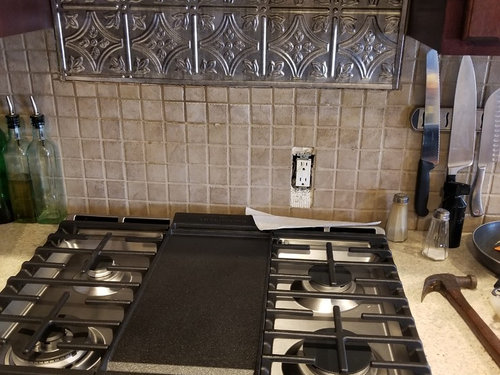
We just replaced an old freestanding range with a slide in, and upon exposing the backsplash that was previously hidden by the range control panel, found this:


No idea what the previous owners were thinking when they renovated the kitchen, but this is obviously not good. What's the best remedy? Can I just put a metal plate right over it, or do I need to remove the outlet box before covering the hole? Thanks in advance for your help!

Comments (27)

  • 8 years ago
    last modified: 8 years ago

    Easiest solution? Remove the device and cap the wires (or make a joint there if the device feeds through to another) and put a blank plate on it.

    However, since that will be butt ugly right behind your cooktop and in your backsplash, removing the box altogether is an option, but may or may not be an involved procedure. You can't just bury the box or remove it and shove the wires back in the wall.

    If the device is the dead end of a circuit, then you'll need to find where it comes from and kill it at that location (likely another outlet on the counter, perhaps a homerun back to the panel), then the box can be removed and wires abandoned in the wall.

    If the device feeds through, and downstream devices are still needed, then you'll need to find the source AND downstream device and complete the circuit between those two if you'd like to remove the box. This may or may not be a big PITA, depending on how accessable the locations are (attic/basement access?) and/or your willingness to cut sheetrock and patch.

    biondanonima (Zone 7a Hudson Valley) thanked yankee4210
  • 8 years ago

    I'm not really worried about the butt ugliness of a plate in the backsplash - this kitchen is destined for a full remodel eventually, so unattractive is okay if it's easy/cheap. Do I need to remove the outlet, or can I put the plate right over it?

  • 8 years ago

    Like Ron said, you can leave the outlet if you'd like, just get an outlet plate for it. Or, like I said above, remove it, cap the wires or splice them through depending on how many sets are in the box, and blank plate it off. Your choice.

    biondanonima (Zone 7a Hudson Valley) thanked yankee4210
  • 8 years ago

    Yes, whoever did the tile in the kitchen did a really poor job - they also neglected to grout a whole section, etc. I'm guessing it was a DIY by the former owner - they did a major reno of the house and did a lot of work themselves. The lack of grout made it easy for me to steal a tile from a hidden area to fix the spot behind the range, though, so I guess there's an upside to laziness!

    As for further electrical issues, we have had an electrician out a couple of times in the year we've owned the place and he has corrected minor things as he finds them. I'm considering going to induction when we decide to fully renovate, which will require some electrical upgrades, so I will definitely have everything checked out then. I'll pick up a solid plate the next time I'm at the hardware store and get that thing hidden. Thanks very much for your help!

  • 8 years ago
    last modified: 8 years ago

    So where is the electric outlet that you need to run the sparks and digitals in your gas range? They didn’t have their freestanding range plugged into that outlet?

  • 8 years ago

    I'd put a cover plate on it and use it. Why not? A receptacle right by the range is useful. For example, you can plug in the mixer when you make something that has to be beaten over a double boiler (seafoam frosting!).

  • 8 years ago
    last modified: 8 years ago

    An outlet there is more for a gas range with the electric spark, not for an electric range. Since you are not using it, you can either cap it off and finish the tile job (if able to abandon it if it doesnt feed anything else) or just put a cover plate there. Too close to the range and water (boiling, etc) to be left as is anyhow.

    biondanonima (Zone 7a Hudson Valley) thanked Vith
  • 8 years ago

    "Too close to the range ..."

    I wouldn't have installed one there, for sure. I'd rather see it off to one side, to avoid the risk of power cords contacting hot stuff.

    But ranges used to have utility receptacles right on their control panels! (Maybe some still do, I haven't paid attention.) And unless the code has changed recently, it only says that recepts aren't required behind a range, not that they're prohibited.

    Since it's there already, I say they might as well use it -- carefully.

  • 8 years ago

    There is another outlet closer to the floor behind the range for the electrical controls, etc. I have NO idea why they left this one in place other than that they were too lazy or cheap to properly disconnect it and patch the wall. It's a different type of outlet than the others in the backsplash (they are all GCFI, this one isn't), so I can only assume it was there prior to renovation and they just left it because they knew their range would cover it up.

    My primary concern about this outlet (other than the lack of GCFI, etc.) is that the new slide-in range vents out the back, so it will be venting quite close to that outlet. I'll feel more comfortable when it's covered with something heat proof.

  • 8 years ago

    Manually trip the other kitchen GFCIs and determine if one of them also shuts off that receptacle. If it does, then it is GFCI protected and you can just install a metal receptacle plate (which should resist any heat coming off the stove top).

    If it does not shut off when another GFCI is tripped, then its not protected. It would be best to find the breaker its connected to, and with electricity turned off, remove the receptacle itself and put wire nuts on the wires. Then install a blank metal face plate.

    Bruce

    biondanonima (Zone 7a Hudson Valley) thanked Bruce in Northern Virginia
  • 8 years ago

    Alternatively, if it isn't GFCI protected now, you could just put a GFCI receptacle there.


  • 8 years ago

    If the outlet closer to the floor is behind the range, and it trips, how difficult would it be to reset it?

  • 8 years ago

    I don't know how difficult it would be to reset the one that is closer to the floor - I assume we could just slide the range out, so not a big deal. I never thought about it, actually - is that likely to happen?

  • 8 years ago

    If you put a GFCI down near the floor, it probably will be difficult to get to. It's also not required. Only the receptacles serving the countertop areas need to be so protected.


    biondanonima (Zone 7a Hudson Valley) thanked Ron Natalie
  • 8 years ago

    Couple of ideas for convenience and looks: if you end up covering it up with a plate, you can paint the plate to match the wall, I would think. Unless that's not allowed under code - someone please say if that's the case.

    If you keep it accessible, greasy gunk is a problem. Consider some kind of outlet cover that closes, or a second cover plate of some kind that will keep it covered and can be removed when you want to use the outlet. I would say hold it on with a magnet but the metal plates are SS I think and magnets will not stick.

  • 8 years ago

    Plates can be painted, outlets cannot.

  • 8 years ago

    I did not see any comment regarding code. Where I live the stste code compliance does not allow wires with nuts to be covered with a blank plate. Wires at an outlet site must have the sctual outlet/switch.

  • 8 years ago

    so they don't allow junction boxes.... dumb.

  • 8 years ago
    last modified: 8 years ago

    That's a very strange code. Never heard of that. What jurisdiction? The CEC has no such provision.

  • 8 years ago

    How else would you enclose wires that have to be connected? That's weird.

  • 8 years ago

    Yeah, that's a new one on me too. Seems like it would prohibit junction boxes. Where is this?

  • 8 years ago

    No that is not what I said or least mean to say..I said wires and nuts cannot be covered with a blank plate- any other cover, ie piece of wood, drywall. It must either be in a covered box properly or switch/outlet. Florida

  • 8 years ago

    That's not what you said. And I don't believe for a minute you meant it since you said it had to be with "with a switch or outlet" which isn't allowed without a box either. Nice backpeddling.

  • 8 years ago

    I thought that junction boxes couldn't be covered over with permanent materials like drywall or wood. They must be accessible. If that's from the attic or basement that's OK but you can't hide one behind a wall where there is no way to get to it. Am I right about that?

  • 8 years ago

    If it is abandoned (aka disconnected from whatever feeds it and no power) it can be covered up.

  • 8 years ago

    Look carefully at what Ed said: "I said wires and nuts cannot be covered with a blank plate- any other cover, ie piece of wood, drywall. It must either be in a covered box properly or switch/outlet." Ed, what do you mean by a blank plate - any other cover..." A properly covered box IS one with a blank plate.