Software
Houzz Logo Print
westes

Avoiding Root Rot When Transplanting to Gritty Mix

When I buy new succulents, they typically come from the nursery in a soil mix that is peat moss and pumice. I have lately started an experiment where I get two of the same plant. I put one of these into a new peat moss mix (30% peat, 40% Turface, and 30% lava rock) and the other into gritty mix (4 parts Turface, 3 parts bark, and 2 part stone). I bare root the plants before putting them into the new soil.

What almost always happens is that the plant that goes into the new peat mix thrives, almost instantly. I can water it right away and I have no problems with root rot (so far).

The plants that go into gritty mix show signs of stress right away. If I do not water them they start to lose shape and look like they might be in a mild transplant shock (nothing a succulent cannot handle but there are signs there that something is not healthy). If I water them - and particularly if I water them when I plant them - they often get root rot. Then I have to sever roots and it is a long and difficult recovery process.

My question is what can I do to improve my chances when bare-rooting a succulent and planting it into gritty mix?

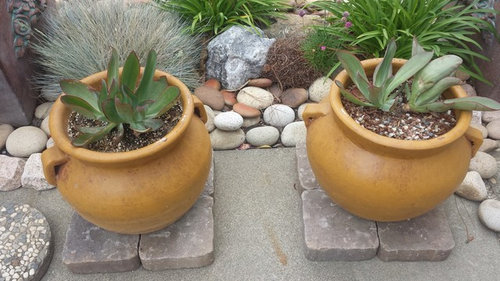
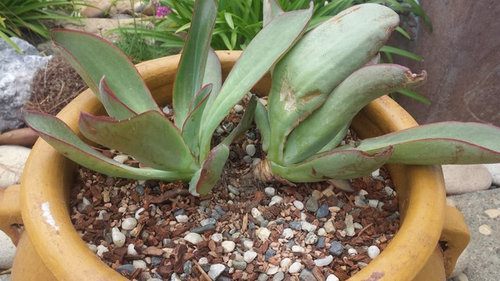
The plant on the left in the following photo is in a peat moss mix and the plant on the right is in the gritty mix. The right side of the gritty mix plant has become limp and I can already tell the base is loose and wiggling and is coming down with rot.

Comments (17)

  • 8 years ago

    Water them immediately, water them often. Very often. As in, daily, for most transplanted succulents, excepting only the most sensitive ones (i.e. dormant mesembs).

    This is because they've just been surviving in water-retaining medium. It will take time for them to get used to being practicing succulents again. In the meantime, they will need to be eased out of the shock.

    Also note that gritty mixes with granite and other inorganic components will get hot quickly and add stress to plants that have been accustomed to the cooling effects of peat. They have to be eased back into the heat as well.

    westes Zone 9b California SF Bay thanked User
  • 8 years ago
    last modified: 8 years ago

    I dont water them immediately - in fact i dont water for 2 weeks after transplant - i clean the old mushy soil beforehand. As for the heat, i dont place them in full sun in the meantime either.

    westes Zone 9b California SF Bay thanked Stefan
  • 8 years ago

    Looks like you’ve found a mix that works.

    westes Zone 9b California SF Bay thanked Kara 9b SF Bay Area CA
  • 8 years ago

    @Pagan I agree with your logic. The key idea I am still missing is when is it okay to get them planted and start the watering. Should I plant them in totally dry soil and let the roots heal there for a full week, while the plant goes into shock? Then start watering every day? Or should I leave them bare rooted for a week with no soil and no water, and only after the roots are healed should I plant them in gritty mix and then start watering every day?

    I'm sequencing things incorrectly, and I can only guess that the root rot might be coming from watering roots that have not healed properly.

  • 8 years ago

    @Stefan, okay, so your process is to bare root, plant them in gritty dry, and leave them out of the sun for two weeks, then start to water with the plants still in shade? How quickly will you acclimate them to the sun after you start watering?

  • 8 years ago

    @kara so far I am quite impressed by the peat moss mixes I have developed where peat is 30% or less of the total volume. But I am stubborn enough to want to keep trying with gritty mix and understand its advantages and limitations. Once we get to Winter and heavy rains, gritty may have some real advantages.

  • 8 years ago

    I typically bare-root them and allow them to dry overnight. That's enough time for cuts to heal over.

    If I am bare-rooting more sturdy plants, I have a lot more leeway before the roots dry out from exposure--plants like adeniums, haworthias, gasterias will be fine out of the pot for about a week and even longer (guess how I know that). But they are left out that long only because I can't be arsed to stick to a potting schedule.

    Plants with thin, wispy roots are a bit more sensitive. I usually pot them up and water them right away.

    I'm curious, too, why you're moving your plants to gritty mix, considering where you are. I have to do it because my winters are a pain--I have a lot of winter growers that need water but can't stay wet too long. My summer growers are mostly in soil-based medium now so I won't have to go insane watering them more times than I'm willing.

    On the other hand, if Al Tapla is correct--and I have no reason to think that he isn't--my plants that are in soil-based medium are only tolerating their condition and will thrive better in gritty mix. But that also means watering nearly every day in summer (sure, that's definitely going to happen).

    So, yeah. Over and out.

    westes Zone 9b California SF Bay thanked User
  • 8 years ago
    last modified: 8 years ago

    I myself being an avid user of the gritty mix for years do not have much luck either with any of my succulents unless it's a cactus and even those I have killed in it. Not because the mix stinks, but because I do, when it comes to watering properly..

    I can not keep up with watering mine before the top few inches dry out and that can be every day in a hot window, hot sun, or under lights. So the very shallow roots near the surface die back and then once a water again, the once healthy roots that use to take up water before I desiccated them in just a day will stop functioning and just rot.

    If you are one that can water properly, and that means every day on most occasions until the roots have grown into the mix which can be timely, you must water more frequently making sure not to wait too long between intervals.

    With the mix I now use, containing some peat, I can put mine on any hot surface, on my hot sunny roof, usually meaning full sun, and under hot lights in a warm room, even on a hot window sill in winter, without coming home by the end of the day to see them toasted. It's nice to see that the top layer of my mixes retained enough moisture for a day or two to give me time to water again Then too, no fear of rot even on cool days or no matter how much it rains, because I use a heck of a lot more of per lite and pumice than I do peat.

    westes Zone 9b California SF Bay thanked myermike_1micha
  • 8 years ago

    It’s funny all of the different methods here, really goes to show that what works for one person won’t necessarily work for another person. I keep all of my plants in 100% pumice and I haven’t really had any problems besides conophytums (which I’m not sure if it’s me or the pumice. Probably me). I just bare root the plant, splash a drop of cinnamon if I accidentally break a large root, and then plant it into dry, sifted pumice. I usually wait at least a few days, between 3-4 or sometimes a week. All of these things I learned from reading on here. Not saying my way is right but it works for me, I guess you will just have to experiment until you find the perfect process!

    westes Zone 9b California SF Bay thanked AS _NJ ZONE 6B
  • 8 years ago

    I like when I trade with someone and their personal mix is still left on the roots. The mix is always different, never the same;). It’s like a fingerprint. Even if the mix has the same ingredients as someone else’s it’s still different because one person may sieve, while another keeps the particles inconsistent.

    westes Zone 9b California SF Bay thanked Kara 9b SF Bay Area CA
  • 8 years ago

    @Pagan I find that tougher succulents - once they really acclimate to the gritty mix - really take off. I definitely do not want to water more than twice a week. But as I get more experience I do see that there are specific species - like aeoniums - that might do better in a more moisture-retentive soil. Getting the plant to really acclimate to the gritty mix can take quite a while, and during that warm-up period, I guess you should be watering more often. I am so fearful of root rot that I try to not do that. But I haven't quite got it figured out yet.

    I am very much still in the learning stage. The soil that is best in summer may not be the best in winter. I need to get full season experiences growing the same plants in very different soils to really gauge which soil is best for each species.

  • 8 years ago

    @myermike a lot of what you write resonates with me and mirrors my experiences. I think keeping the peat to 30% or less of the mix and using inorganic materials for the remaining 70% is important. It creates a lot of the virtues of the gritty mix but with a much more moisture-retentive soil. I have not lived with this kind of peat mix during a wet winter yet, so I reserve the right to change my mind. So far so good.

  • 8 years ago

    @AS_NJ I do wonder if having a completely inorganic soil makes rot-sensitive plants like Euphorbia tolerate wider conditions. I wonder if the organic bark component in gritty mix is a better environment for fungal pathogens that opportunistically cause root rot. I am thinking of going to a totally inorganic mix for my cactus and euphorbia.

  • 8 years ago

    @Kara I am still at the stage where I keep everything uniform and just pray that the plant is going to live. Someday I hope to be successful enough at this that I can be sentimental about other gardeners' soil mixes left on my plants. :)

  • 8 years ago

    I totally agree, westes. The only plants I have in soil-based medium are mesembs and adeniums. Mesemb roots are too fine to survive gritty mix and even for them, soil only accounts for 25 percent at most. The rest is pumice.

    For adeniums, soil is about 50 percent of the mix--I can't stand how often I had to water these monsters in summer when they were in the 5:1:1 version of the gritty mix, especially when they start blooming.

    In any case, I've further simplified my gritty mix down to just pumice and crushed granite. Mostly, everything else is in just pumice. My two tropicals are in akadama but I'm growing them in semi-hydro and it works really well.

    Don't worry, you'll get the hang of it. Once the transition is over, succulents are really happier being, you know, succulent lol

    westes Zone 9b California SF Bay thanked User
  • 8 years ago

    About a month or 3 weeks acclimation, easier during rainy weather.

    westes Zone 9b California SF Bay thanked Stefan