Software
Houzz Logo Print
miranda_33

Receptacle in un-heated Garage

7 years ago
last modified: 7 years ago

There is a receptacle on the back masonry wall of my unheated garage. It was installed when the home was built 25 years ago. We moved in about 12 years ago. The receptacle is dead, I am not sure why. It looks like it has been painted around several times, and even the receptacle itself got painted, and maybe paint got in? Anyway, I had some work done in my home and the guys used my garage as a workshop, but the only receptacle they could use was the one in the ceiling for the door opener, so I really am ready to address replacing the dead wall receptacle in the garage.

It is unheated garage, and the temps are typically about 10-15 degrees warmer than whatever it is outside. Where I live, winter nighttime temps of -5F are fairly common. Do I need a special type of receptacle to handle that? Or do I just get an ordinary one? Does it matter that it is installed on a masonry wall? It doesn't look like a GFCI; there is garden hose outlet on the same wall but it is about 6' away and 3-4' down. Please forgive my ignorance on this, anything I need to know about which receptacle to get would be helpful - type, brand, etc. TIA!

Comments (14)

  • 7 years ago

    Has the receptacle been dead the whole time you've owned the house?


    There's a good chance that replacing the receptacle will do nothing. It's possible that there isn't any power at that receptacle at all.

    The first step, before buying anything to replace it, would be to open up the outlet and test if there's any power. You'll have to be careful since you obviously don't know what circuit this outlet might be on, so you can't kill power to it before opening it up. (I guess you could flip the main switch and turn off power to your whole house and then turn it back on when you're ready to test.).


    If there's no power, then you have to try to figure out where the wires are travelling in your wall to follow them upstream to the previous location and see if there's a problem there. And so on and so on. Maybe an upstream GFCI outlet tripped and cut off power to that outlet.

    Or maybe when the garage door opener was installed, the installer 'stole' the power from the cable going to this outlet (ie. cut the wire and rerouted it) and abandoned this wiring and outlet.


    But to answer your direct questions:

    Cold doesn't matter with receptacles.

    This outlet should be GFCI protected. By either a GFCI breaker, an upstream GFCI receptacle or a GFCI receptacle at this location.


    Miranda33 thanked greg_2015
  • 7 years ago
    last modified: 7 years ago

    Thanks Greg for that information. The outlet was working when we moved in. I am not sure when it died. It’s not used much. I noticed about 5 years ago that it was dead, but can’t identify the cause.

    I’m glad to know that the cold won’t affect it. There’s also a lot of leaves and dust that blow into the garage if that matters.

    Looking at Home Depot, they seem to carry only Leviton GFCIs. That’s fine, right?

    How do I know which of the types you mentioned, GFCI breaker, upstream, or GFCI receptacle, to get?

  • 7 years ago

    Greg has written wisdom up there.

    I'd add: don't worry about what to use here until you find out why the receptacle you have now isn't working.

    Do you really want your car mechanic blindly changing parts, having you bring it back again and again until he finally stumbles on the one that's not working right? I sure don't. Well, changing the receptacle without knowing whether that's the actual problem is the same thing.

    That said, if you're lucky, it's something gone awry right there in the box.

    But if you're not so lucky, then it's time for some troubleshooting. And the kind of troubleshooting needed here requires a moderate level of patience and skill.

    You can view this not-so-lucky scenario in two ways. Either (1) it's a chance to learn a lot about basic electrical principles really fast, or (2) it's time to call in a pro.

    Miranda33 thanked DavidR
  • 7 years ago
    last modified: 7 years ago

    As mentioned already, you need to figure out why its dead. Sometimes the receptacles break internally and have an open condition, but that's usually due to frequent use or having something hit it.

    Also check for another GFCI somewhere else on an outside receptacle or one in the basement. At one time it was fairly common to install one GFCI and then connect several external receptacles to that circuit to protect it. It makes troubleshooting very confusing. My past house, that was built in about 1978, had one GFCI for all the bathrooms, and one GFCI for all the exterior receptacles, and it took a while to figure out it was wired that way. AFAIK it complied with the electrical code when built.

    The leviton GFCI's are fine, and I suggest you look for one that says slim or compact. The slim size is easier to fit into an old junction box, which is probably what you have.

    Bruce

    Miranda33 thanked Bruce in Northern Virginia
  • 7 years ago

    You've checked your breakers/fuses to make sure that's not the problem?


    As above, check other GFCI's. We had a non-GFCI garage receptacle that was downstream from a guest bath GFCI. A pain every time it'd trip. I eventually figured out the circuit, bypassed the first GFCI and installed GFCI's in the 3 downstream.


    How comfortable are you with electricity? You've a good meter and know how to use it? Next would be doing your own trouble-shooting or calling an electrician.

    Miranda33 thanked opaone
  • 7 years ago

    I've seen all three cases I mentioned. I was selling a property and the home inspector (in a flash of brilliance) found an open ground in the garage. Sure enough the connection in the feeding box was open (looks like it dated from the house's original construction). I've just had a GFCI go bad (not surprising as the irrigation system that was plugged into it seems to have taken a lighting strike as it's controller was blown to tiny bits). My last townhouse had water infiltration into one of the boxes causing a ground fault.

    You can't fix things (at least not economically) without diagnosing the problem first. All three of these things manifested themselves in the same way.

    Miranda33 thanked Ron Natalie
  • 7 years ago

    How do I know which of the types you mentioned, GFCI breaker, upstream, or GFCI receptacle, to get?


    GFCI downstream is a wiring config. To save money an electrician would install a single GFCI receptacle and then put other receptacles that are required to be GFCI protected 'downstream' of it on the same circuit. This was very common in houses and remodels from about (early 1970's ?) when GFCI was first required to maybe early 2000's.


    So, check any GFCI's outlets you have, test trip them, and reset them. That may fix your problem.

    Miranda33 thanked opaone
  • 7 years ago
    last modified: 7 years ago

    This has all been such great advice, thanks to everyone! My electrical expertise extends as far as replacing switches and receptacles for more modern-looking ones, i.e. just improving appearance. I do not have the expertise required to analyze as described here, so I will hire an electrician for this repair (darn it!).


    All the other GFCIs in the entire house are working. The breakers and fuses are fine. It does not look like there is any water infiltration at all, though paint infiltration is a good possibility.

  • 7 years ago

    Miranda, I would start by pulling the receptacle out of the box and checking it for loose wire connections and possible burned spots. There may be a very simple and easy to fix reason why it isn't working (especially since you said it was functional when you moved in). At a minimum, I would replace the receptacle before I called in a pro.

    Miranda33 thanked ci_lantro
  • 7 years ago

    Are you sure that you don't have a tripped GFCI somewhere else that may be upstream of the problem receptacle? I once spent the better part of a day trying to diagnose a dead receptacle, and, just before giving up and running a new cable to that location, I found a tripped GFCI that was nearby -- but in a not very obvious location -- that had caused the problem.

    Miranda33 thanked kudzu9
  • 7 years ago

    Back in the day when GFCI receptacles were very expensive, it made sense to use one to protect many downstream receptacles, but doesn't now make sense to use GFCU receptacles everywhere? I recently bought a box of 10 for something like $30!

  • 7 years ago

    To reiterate a lot of what was already said. Get a multitester (cheap ones can be found and it's a real handy item if you don't already have one), then pull out the existing receptacle and see if the wires to it are powered. If they are then find which circuit they're on and kill the power to the outlet prior to swapping it out. If there is no power, then do some investigation or call an electrician to diagnose the problem.


    I'm not always Mr. Safety but I don't swap hot receptacles. I'd pull one out of the wall and put some multitester leads on a hot plug but I wouldn't remove and replace one to see if it's hot without confirming the power status before trying to get the leads free. My 0.02

    Miranda33 thanked sdello
  • 7 years ago

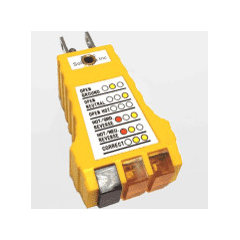
    I would also get one of these:

    Miranda33 thanked mtvhike