Software
Houzz Logo Print
simmtalker

Need Help Confirming Duct Insulation

8 years ago
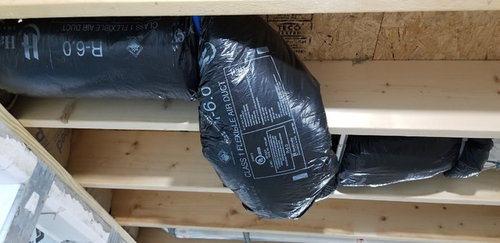
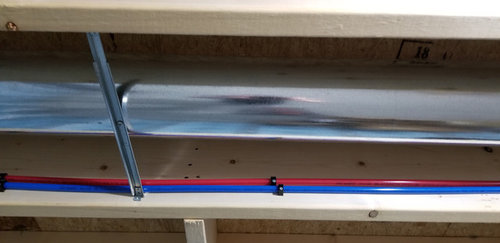
I just noticed that the rigid duct work appears to have no insulation on it. The contract states "Insulated (R-6) Snap-lock/flex duct to floor supply registers."


The few pieces of flexible duct are clearly marked with "R-6," but there's nothing at all on the rigid duct work. Shouldn't I be able to see some type of insulation on the rigid duct work, or at least it should be marked if it is some type of insulated product??


Attached are two photos -- one of flexible duct showing "R-6" and one of rigid duct.


Thank you!!!!


Comments (22)

  • 8 years ago

    The duct work is in an unconditioned basement, and while any energy loss would be inside the building, it would be a wasted in the basement.


    As for the flex duct, they do have it awkwardly twisted in places.

  • 8 years ago

    Do you mean an unfinished basement? Not unconditioned. It's still within the envelope of the house. It doesn't drop below freezing in the winter, right?

    Otherwise, you'd need insulation throughout the whole floor.

  • 8 years ago
    last modified: 8 years ago

    What a sec, since when is "below freezing" the standard for unconditioned space?

    Space is either conditioned - at a set temp of say 70 - or it is not. There is no partial in code language. A basement that is not fully insulated and does not have registers and returns is unconditioned by any interpretation of the code. Code in most of the 50 states requires R-8 on all duct work. (I could be wrong on the details but certainly NC requires R-8 and we are not strict.)

    Where is this construction?

  • 8 years ago

    Okay, I stand corrected. I guess in my part of the world, unconditioned basements aren't really a thing. I've never heard of that kind of space.

    Maybe it's more common in temperate climates?

  • 8 years ago

    If it unconditioned space then should there be insulation between it and the conditioned space? There doesn't appear to be any in the photo.

  • 8 years ago
    last modified: 8 years ago

    And there is no insulation on the water pipes. Good point Mike. And if that is true, then insulation really isn't needed.

  • 8 years ago

    A typical basement that is mostly underground is going to have a temperature range of 65-75 degrees. In my house the basement is the coolest part of the house so having insulation on the duct work would actually be counter productive.

    ... contract states "Insulated (R-6) Snap-lock/flex duct to floor supply registers."

    It looks like contract only specifies the flex duct to be insulated. I don't understand why two types of duct work are being used in a basement. I think you are better off having all hard duct work. Much better air flow that the flexible type.

  • 8 years ago

    There are no vents/registers to heat or cool the basement, and it is not meant to be heated or cooled. The basement has insulation on the walls but no insulation between basement and first floor of house (I thought it was going to be insulated by the builder, but that's a future project, at this point). If it is a below ground basement without some major issue, basements don't freeze in this area (PA).

  • 8 years ago

    mike_home -- From an internet search, I only found the rigid duct to be called "snap-lock." Are you saying the flex duct is called "snap-lock"??

  • 8 years ago

    From your description it sounds like a hybrid that may be covered by code addendums in your area. It seems unlikely. The inspector would know.

    Here in Dallas, this would not pass inspection because you either have to insulate the ducts and the ceiling (if the basement or crawl space are not conditioned) or you would have to insulate the basement or crawlspace walls and floor and condition the whole space. Then you don’t need insulated ducts (I chose the latter option for my house).

  • 8 years ago

    Is the contractor done?

    Have you mentioned this lack of insulation to the contractor?

  • 8 years ago
    last modified: 8 years ago

    ... you either have to insulate the ducts and the ceiling (if the basement or crawl space are not conditioned) or you would have to insulate the basement or crawlspace walls and floor and condition the whole space.

    I thought that's how it worked here, too.

    Is the contractor done?

    Have you mentioned this lack of insulation to the contractor?

    Yes, they are done working, BUT I WANT TO CONTACT THEM ABOUT THIS ASAP, since I just noticed the lack of insulation. I wanted to be sure I was understanding the "snap-lock" was the rigid duct stated in the contract, before I contact the HVAC company. I was also hoping someone would confirm that if the rigid duct were insulated, that it would be visible or printed somewhere on the product, as other insulated items are.

  • 8 years ago
    last modified: 8 years ago

    If the rigid duct was insulated, it would be outside of the metal. So it definitely isn't insulated.

    I agree that the "snap-lock" is the rigid duct. Otherwise, your contract is stating that only flex duct would be used and that's obviously not the case. So either they violated the contract by using rigid duct or they violated the contract by not insulating the rigid duct. The latter seems the most likely.

    I would also bring up the pinched flex duct when you make your complaint (unless it isn't as bad as it looks in that picture). Personally, I'd prefer that flex duct to be replaced with rigid even if it cost a little extra. How much flex duct did they use? Would it be a considerable cost to have it replaced?

  • 8 years ago
    last modified: 8 years ago

    Maybe the rigid duct is a cold air return.

  • 8 years ago

    If the installer created and then walked away from that flex crimp thinking he was done and had done a good job, you have to wonder what other half-a ___ed things were done.


    I'd first ask the supervisor or a boss to come look at it and then depending on what you hear, maybe pay for a different contractor to spend an hour and give you a second opinion.

  • 8 years ago

    Simmtalker, you are correct. The snap lock is the rigid insulation, I was concentrating on the work "flex".

    The duct is made in sheets and is snapped into place to make a cylinder. But I don't think a rigid snap lock rigid duct is available with insulation. The insulation would have to wrapped around the duct and sealed.

  • 8 years ago

    Thanks for climate and better description.

    Best practice is insulated ductwork to R-8. If the basement is adequately insulated, it isn't a big deal either way. You will lose heat but it isn't a shocking amount. Do you have subslab insulation and do you know what your wall insulation is (in the basement)?

    The lost heat from the ducts will go towards heating the basement which will increase the loss to the ground. The ground is probably 55 in the winter so not a huge difference in temp but it is a big area.

  • PRO
    8 years ago

    The photo appears to show a pre-cast/pre-insulated foundation system and insulated rim joist. If this is indeed the case, then the ducts are inside a conditioned space. The 2015 IECC doesn't require insulation of ducts in conditioned spaces.

    The ductwork and piping should be subject to inspection by local code officials at the rough-in stage. If either fails to comply with code requirements they should fail inspection.

  • 8 years ago

    For the uninsulated, you would need to know what it is for. It might be a return. It might be a bathroom or other exhaust vent.

  • 8 years ago

    Charles Ross - that is amazing you can tell that. These questions are often lacking in information and it is always a fun puzzle to figure out the details....

  • 8 years ago

    Charles Ross - WOW you have a great eye. Now that you said that I went back and looked. Yup, you can see just enough to tell it's a Superior Wall system.

    The only reason I know that is because that's what I have for my foundation too.

    I know next to nothing about the rest of this, but had to post to comment on your fantastic eye for detail. :)