Software
Houzz Logo Print
bjp91

De-moss my crepe myrtle??

7 years ago
last modified: 7 years ago
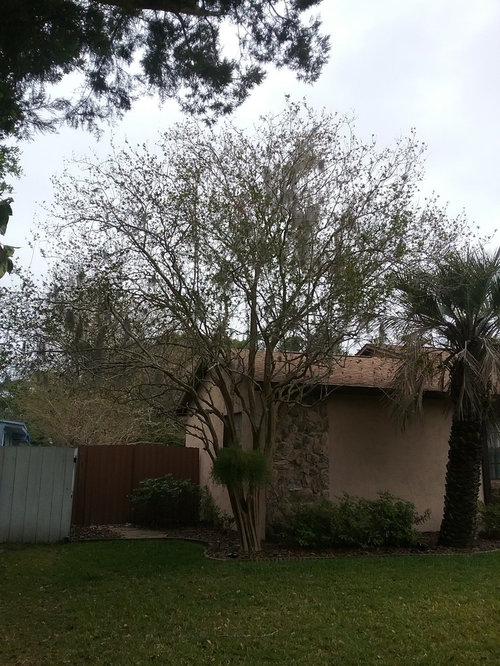
I have a crepe myrtle that has been 'collecting' moss for the past 2-3 years. Recently, I found a few articles about the fact that crepe myrtles can decline (unlike some other trees) from having moss growing in them, and it should be removed. Is this true? Should I find someone to de-moss it? Also, this tree is just beginning to bud as well. Thanks!


Comments (15)

  • 7 years ago

    Moss moss, Spanish moss (tillandsia) or lichen?? Any photos?

    bjp91 thanked gardengal48 (PNW Z8/9)
  • 7 years ago


    Sorry, just now edited to add photos...

  • 7 years ago

    Ball moss grows completely without roots in soil, and will not damage trees. If you look around you'll probably see it growing on power lines.

    I remove mine with a saw on a pole. I scrape the side of the saw along the bark to dislodge the moss. For the more flimsy limbs higher up, you have to climb up and pinch it off.

  • 7 years ago

    I have both ball moss and Spanish moss. So, you do remove as much moss as you can - but, then yours is only ball moss, correct?

  • 7 years ago

    Tree would look better without the lodgers anyway.

    bjp91 thanked Embothrium
  • 7 years ago

    I don't doubt there is probably some kind of decline going on, and I also agree it would look better without the stuff. But, I have also heard that some of the decline can be reversed - or, at least slowed down - by removing the moss, even if there is something else that caused the initial decline.

  • 7 years ago
    last modified: 7 years ago
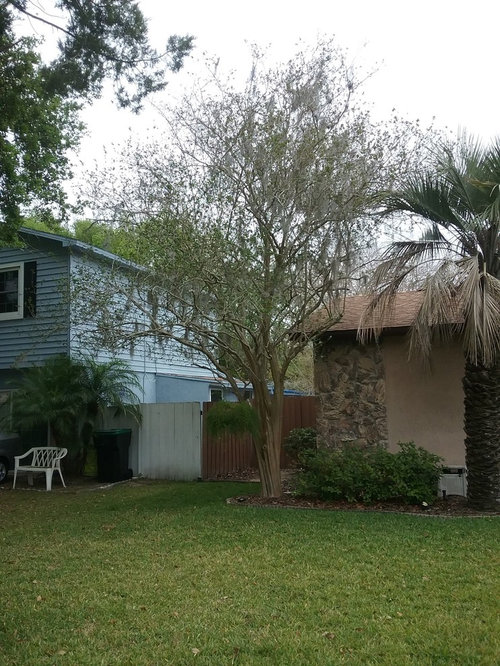
    Try to sleuth out the reason for the initial decline. With crape myrtles it is often an infestation of crape myrtle aphids, insufficient sunlight, use of granular pre-emergent herbicides in a nearby lawn, etc.

    I doubt very much that your tree will rebound at all after you've thinned out the epiphytes. That's not the problem, I assure you.

    bjp91 thanked rhizo_1 (North AL) zone 7
  • 7 years ago

    I have no idea why the moss would create a problem for the crapes when it doesn't for any other sort of tree.......other than crapes being of much smaller stature than the oaks, etc. it typically colonizes. btw, I don't find anything in the literature that supports the contention that the moss will cause or contribute to the decline. It is a harmless organism to all intents and purposes, although a very heavy population (which you do not have) could possibly create a windsail effect or impact photosynthesis to some degree. That looks very unlikely to me in this case.

    bjp91 thanked gardengal48 (PNW Z8/9)
  • 7 years ago

    I have 5 other crepe myrtles in my yard, one in the complete opposite end of the property has moss, the others - which are much closer in proximity - do not. Would aphids only attack some and not all of them? Are the aphids that can be seen with the naked eye?

    I treat my own lawn, so I suspect that is not the issue, and no one is treating the lawn nearest to this tree.

  • 7 years ago

    I cut and pasted this from one of the articles I read - from Tom MacCubbin, Plant Doctor in the Orlando Sentinel (trying to spare you the rest of the entire article on other plant issues):

    Question: I am getting conflicting answers concerning ball moss in our crape myrtle trees. Some say it can harm the trees and others say it is not a problem. What should I do?

    Answer: Both ball and Spanish moss just hang around taking water and nutrients from the air and decomposing organic matter. They are types of bromeliads known as tillandsias. Studies have shown they take nothing from the trees but use them for support. Sometimes ball and Spanish moss can cause plant decline. If the trees or shrubs are not growing as vigorously as they should be, then these tillandsias can become very competitive for foliage sites. When this occurs, it is best to remove a portion of the ball and Spanish moss to allow the trees or shrubs to make needed growth. Also, make sure your crape myrtles have the water and fertilizer they need to make good growth.

  • 7 years ago

    You can spray them with liquid copper and they'll just eventually fall off.

    bjp91 thanked dirtygardener
  • 7 years ago

    Like most trees they slow down drastically the closer they approch their maximum height/ maximum number of limbs that their root systems can support. Cutting them back properly normally stimulates much more vigorous looking growth and bigger flower racemes.

  • 7 years ago

    I have a 30+ foot crepe myrtle in my backyard that does just fine, and contains no moss. The only trimming crepe myrtles truly need is to remove branches that cross/rub one another, or perhaps if they were placed in tight spaces that don't allow them to grow naturally. It doesn't harm them to trim them, but it is not necessary either. I know most people cut them back every year, but it really is not necessary and denies the crepe myrtle it's ability to display it's natural beauty.

    The one in the photo is probably declining because it is in a place that doesn't allow it to grow correctly - crowded by the house and other trees. So, I am thinking it probably should have been cut back all these years solely because of its location.

  • 7 years ago
    last modified: 7 years ago

    If one wants a more architectural tree, not trimming it is best. I've seen the suckers and multiple trunks even fuse together with age making the trunk look almost buttressed but if one wants bigger flower racemes or more dense growth, cutting them will make all the difference. They respond very well to prunning. Some businesses here even pollard them which I know some people like to affectionately refer to as crepe murder. They're planted all over by my city as street trees. Their flower racemes get smaller but more numerous the larger and wider the tree gets and their canopy becomes more open and more airy looking. Mine I cut back regularly because I only grow them for their flowers and so I want the biggest flower racemes possible and dense growth. I have enough large trees on my property.