Software
Houzz Logo Print
ahappycamper

Does rock mulch hurt or help soil in anyway?

7 years ago
last modified: 7 years ago

I know organic matter mulches are best because they continue to break down and amend the soil, retain moisture so it is a no brainer to use it over rock mulches if health of soil is the main concern
.However, if someone insists in using rock, can you expect this to harm or help the soil in anyway relative to if they had just left the ground bare with nothing over it(since organic mulch is clearly superior)? Can it be assumed that rock mulch is better than no mulch at all?
Surely rock mulch provides some moisture retention though again, clearly not as much as organic matter mulch
What about how it hurts the soil? Rock can be heavy, and i wonder how this affects the soil. Over time, is the soil being compacted and suffocated with less air exchange capability because of the weight of the rock especially when its applied in layers the way it is by many landscapers?
I really like the look of rock. I would like go mulch with organic matter but then add some rock on top for some aesthetic reasons but not if the rock takes away from the health of the soil even a little bit

Comments (16)

  • 7 years ago

    Don't use rocks is my advice.

    ahappy camper zone10 thanked wayne_5 zone 6a Central Indiana
  • 7 years ago
    last modified: 7 years ago

    hoovb talked about several things to consider..wayne kept it short and simple and I agree with him..I personally hate seeing plants surrounded by rock..I love rocks but not used as mulch..rocks don't improve the soil..

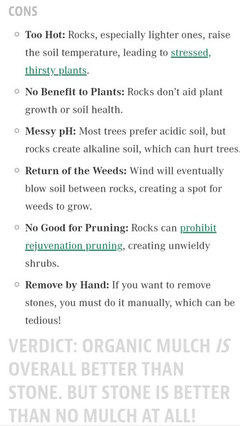
    I found this info..it says "stone is better than no mulch at all"..I disagree and would rather have nothing than stone..fortunately stone or nothing aren't the only choices..I use my own homemade compost..if someone understands could you explain the "No Good for Pruning" reason..

    ahappy camper zone10 thanked nicholsworth Z6 Indianapolis
  • 7 years ago

    I agree with all of the above. But the part I'd underline, triple-underline, is that once you have rock mulch, it's going to be a royal pain to dig or work the soil or get rid of it. And because of that, you're just not going to do it, you're mostly stuck with it (until you get around to the task of getting rid of it).

    I still wouldn't do it, but if you really wanted, a layer of pebble-size gravel would I think do more or less the same and be less disruptive to work with and around, and if you had to dig it in at some point in future, it probably wouldn't affect anything and you could just ignore it and leave it in the soil. Crushed seashells possibly too.

    ahappy camper zone10 thanked armoured
  • 7 years ago
    last modified: 7 years ago

    Just wanted to throw in the two cents that came with our experience. :) My husband had been wanting to do rock mulch over landscape fabric for years, and I fought and fought. I didn’t know if I would like the look, I was worried about how it would affect plants growing in it, and I thought it would be a total pain to work in. Finally, his parents redid their yard (DIY landscaping) using the same thing he wanted: pebbles over fabric.

    I have never seen a garden do so well. It was incredible. Since the mulch looks great by itself, anything you plant in it looks great. And everything just grew like crazy. I was astonished. Their six month old landscape looked five times better than the one I had been nurturing for years. We gave them two roses as a housewarming gift, and I planted a third of the same variety, from the same place, at the same time. Theirs are probably four times the size of mine. They bloomed nonstop, and had no problems with diseases. Mine has struggled along, giving me enough blooms to keep me happy but nothing exceptional, and has fought blackspot. And that is just one comparison. I planted salvia, they planted salvia. Mine is sad, theirs is gorgeous. And on it goes.

    I know that much of this is due to the fact that they gave their plants more water than we did ours, but the mulch helps keep things cool in our baking hot summers, and retains moisture extremely well. Also, I have since learned that pea gravel supplies trace nutrients and is almost a form of fertilizer in a way. Lest you think it a difference in location, they live about ten minutes from us in very similar soil.


    My husband finally talked me into landscaping most of our yard using his method, and I honestly couldn’t be happier. It cuts down on watering tremendously, the plants seem to absolutely love it. If I have something that requires excellent drainage, I plant the finer roots down in the soil, and leave the crown up in the gravel. My lavender overwintered beautifully. If I have something that likes consistently moist soil, I planted a little bit deeper and create a sort of impression. The control over the environment is wonderful.


    I still have a part of the garden that does not have the rock mulch, where I can move things about on a whim, and I am constantly adding new plants and shifting things around. Although the gravel isn’t as hard to work in as I had thought, if I move things around too much there’s no point in having a landscape fabric as there are holes everywhere! Lol. So I have my “real garden” area where I can play around. But the gravel section looks much better :)


    Anyway, I know this is contrary to what you will hear most of the time, and this may not be the experience for everyone, but I was totally apposed and now I love it. Weeds do still occasionally grow, but they pull out very easily as long as you catch them before they reach down in the fabric. And contrary to it hurts in the soil, it seems to very much help.


    Also, we do not actually have “rock mulch”. It’s fairly small pea gravel, rather than rocks 1” and larger. His parents have the larger ones, and it is more difficult to work in. The pea gravel is pretty easy because you just shove it aside. It moves like soil, rather than having to pick up and move individual rocks (if that makes any sense). So if you plan on messing in it much I definitely recommend small stuff.

    ahappy camper zone10 thanked Dillybeansown (6b in the Ozarks)
  • 7 years ago

    dilly, do your husband's parents fertilize in a special way?

    ahappy camper zone10 thanked wayne_5 zone 6a Central Indiana
  • 7 years ago

    Nope. I’m pretty sure that they have never fertilized, actually. I’m sort of in charge of their garden. Other than water they don’t really do much. I even prune and stuff for them, just because I love doing it. :)

    ahappy camper zone10 thanked Dillybeansown (6b in the Ozarks)
  • 7 years ago

    I've declined from responding to this thread upto now but some unusual claims or statements are being made that warrant some clarification.

    To answer the OP's original question, a rock or gravel mulch will not improve soil conditions but neither will it harm it. Observations have been made that a rock/gravel mulch is hard to keep weed-free and tidy (it is), has to potential to sink or mix with the underlying soil (it can, wthout a barrier fabric), and harm plants with absorbed and reflected heat (it does, depending on plant and sunlight exposure). On the plus side, it can prevent mud or water splashing up and damaging plant foliage or spreading disease pathogens. And it has many of the other same attributes we look to for any mulch - moderation of soil temps, slowing soil moisture evaporation and weed suppression. And some plants just prefer a non-organic mulch, like many succulents or cacti, xeric plants and some of Mediterranean origin.

    But statements that plants grown with a rock or gravel mulch do better than those grown without mulch or with a fully degradable organic mulch are not valid without understanding a few other cultural factors, like soil fertility and drainage, sunlight, watering, etc., which will have a far greater impact on plant performance than the type of mulch used!!

    btw, any contribution that pea gravel or any other rock mulch will have on soil nutrients is negligible at best and likely nonexistent for our purposes. For rock to contribute anything signifcant to the soil in terms of trace nutrients requires eons of weathering........nothing that will happen in our lifetime and unlikely in a garden setting :-)

    ahappy camper zone10 thanked gardengal48 (PNW Z8/9)
  • PRO
    7 years ago

    During the recent drought, many homeowners in Los Angeles replaced their lawns with "gravelscapes" to save on water. The water company rebates for lawn removal no longer allow you to use rocks as a groundcover because what gravelscape owners save on water bills, they more than pay out in power bill increases. According to the Department of Energy, during the day, gravelscapes can increase outdoor temperatures by more than 5.4°F. In the evening, they hold heat keeping temperatures more than 22°F higher. Increases in outdoor heat of this magnitude can increase air conditioning costs by as much as 50 percent when compared to an energy efficient landscape.

    ahappy camper zone10 thanked Colwynn Garden Design
  • 7 years ago

    I absolutely do not think that a gravel mulch works better than an organic mulch! Sorry if it seemed that way. :) I much prefer a degradable mulch, and I think it is far superior for improving soil tilth, fertility, and many other things. I was making the comparison between my unmulched beds vs. the gravel beds. The gravel is my husband’s mulch of choice because of the low maintenance. We do use organic mulches, but they wear down and have to be replaced and we got lazy the past few years. The gravel is nice because it’s sort of a one and done thing for a good while.


    And about the nutrients from the gravel, I guess I may be wrong on that. I bow to your superior experience. :) I was just going off of what I had read about “geological agriculture”, or gardening in pure gravel. Have you ever read up on anything about Richard Campbell and his gravel bed experiments? I’d love to hear your take. As far as I understand it, he ran an 18+ year experiment gardening in only gravel (the same gravel) with no added nutrients, and the plants thrived getting everything they needed from the gravel. Going from that, I assumed there would be some nutrients trickling down to my plants under gravel. But maybe not. Or maybe his study was flawed.

    ahappy camper zone10 thanked Dillybeansown (6b in the Ozarks)
  • 7 years ago

    Colwynn, interesting about the heat. We'll definitely be watching for that. How dreadful.

    ahappy camper zone10 thanked Dillybeansown (6b in the Ozarks)
  • 7 years ago

    Considering that gravel or rock can only supply mineral nutrients and not the carbon based nitrogen that all plants require in abundance (and is just not present in any rock), I'd have to assume his study is flawed in at least some respects :-) And whiie some minerals can leach from a rock a little more freely than others, none that do leach are used by plants in any significant quantity so it is difficult to come to any definitive conclusions about the success of his experiment.

    ahappy camper zone10 thanked gardengal48 (PNW Z8/9)
  • 7 years ago
    last modified: 7 years ago

    That’s what I thought, too! But apparantly sedimentary rocks do indeed contain nitrogen (One source: https://www.sciencedirect.com/science/article/pii/0016703762900406 ). I have no idea how much, or if the form is useable, but Campbell seems to think that the nitrogen that is present in sedimentary rocks is in a form available to plants, and was slowly released through contact with water. An interesting read, even if I can’t find the University studies that he apparently collaborated with.

    ahappy camper zone10 thanked Dillybeansown (6b in the Ozarks)
  • PRO
    7 years ago
    last modified: 7 years ago

    Bear in mind, the heat issues are only a problem in areas like SoCal and the Southwest where we get so many cloudless days and strong sun. In more cloudy climates or in a shaded area its probably not as big an issue - I have a gravel walkway on the north side of my home, doesn't get hot because it's in the shade.

    ahappy camper zone10 thanked Colwynn Garden Design
  • 7 years ago

    Puebloan farmers in the Four Corners area supposedly used gravel as a mulch in their fields to retain the precious little water that the region receives (they also planted in depressions, rather than mounds, to collect water). They didn't have access to bales of hay or bags of shreded wood to throw down on their crops. They made use of what they had and what they had in the arid deserts in which they lived, was rocks.

    So can it be done? Yes. It certainly can and can be very successful. The Puebloan people supported a thriving civilization this way after all.

    That being said, I will not be useing gravel or rocks as mulch in my vegetable beds. We have much better options now. However, I do use it in my xeric perennial beds. It looks better than wood mulch in my opinion and retains less moisture and provides more heat than organic mulches, which plants that evolved on the hot, arid prairies and deserts of the West prefer.

    As for energy consumption, replacing plant life, whether it be lawns or gardens, with rocks (what is often called ZERO-scrape) will absolutely do that. A well planned and implemented XERI-scape however will not.

    ahappy camper zone10 thanked ZachS. z5 Platteville, Colorado
  • 7 years ago
    last modified: 7 years ago

    Thank you everyone. Lots of interesting information in here that i need to go through when i get a day off.

    However, maybe i missed it since i omly did a quick scan but i dont think i saw anyone mention anything about possible compaction or gas exchange issues. Obviously if you only apply a small layer im sure this wouldnt be an issue, but often times in landscape designs i see people add like several inches of gravel or rock. It seems equivalent to putting a brick on top of the dirt. Any thoughts on if that compacts soil and affects oxygen access to the roots over time?

    I hear it is not good to place extra dirt over tree surface roots because it affects oxygen uptake and creates compaction. Wouldnt putting several inch layers of rock do this as wel?