Software
Houzz Logo Print
catherinet11

What are these spots on my cucumbers?

7 years ago
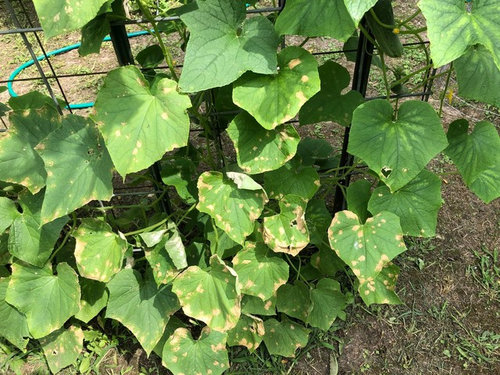
I grow County Fair cucumbers up both sides of an arched cattle panel lined with concrete reinforcing wire. They always do great.

I've recently noticed these spots on them. Could that be from watering them in the morning, and then the sun scorches them? I see no pests. I don't use chemicals.

Thanks.


Comments (18)

  • 7 years ago
    last modified: 7 years ago

    I'm going to call it downy mildew. Needs high humidity and cool temperatures to form. Up north, I think the onset is typically midsummer. Need fungicides. Look up those that work on downy mildew. I think Daconil (chlorothalonil), which is commonly available, will do the job. For organic gardening, copper spray may work. County Fair has some resistance, meaning that it could be worse. Fungicide won't cure affected areas, but will prevent it from expanding to uninfected areas. I would dispose of at least the seriously infected leaves. Your bed is now infected with the stuff, so this is going to be a regular battle.

  • 7 years ago

    Thanks Dan. So I should just cut off the affected leaves and toss them? (burn them). I was thinking about moving the trellis next year, so that's probably a good idea. It's very warm in the day with humidity, then cools off a lot at night........so that's probably why it happened. Thanks for your help!

  • 7 years ago

    If you want to save the plant, it's probably going to take more than disposing of leaves. DO NOT COMPOST THEM. But you can assess whether it is getting noticeably worse. If it isn't, you might be able to just try to hold the line.

  • 7 years ago

    Thanks Dan!

  • 7 years ago
    last modified: 7 years ago

    If you’re going to treat rather than starting over, I should say that I’m pretty sure that’s anthracnose.

    Downy mildew will always colour between the lines, and you‘d get yellowing lesions topside and usually brown, furry undersides.

  • 7 years ago

    Thank you SW. Is there any natural way to treat anthracnose?

  • 7 years ago

    Sorry, Catherine, I don’t think so. Cutting off badly effected leaves and destroying them might slow it a bit, but if you really want to stop it developing further on the plant, you’d have to use chemicals, which isn’t worth it in this case (in my opinion). It wouldn’t cure it, and if your growing season is coming to an end soon anyway, you might consider just letting it be and seeing how much you can get out of the plant.

    The good thing about anthracnose is that it’s not in the soil, so once you destroy all of the plant and scrub down the trellis thing, it should be fine next year. I’m sure it’s still recommended to rotate so if you were going to move it next year that should help.

    Absolute best practice is to choose a more resistant variety as Dan said.

  • 7 years ago
    last modified: 7 years ago

    Fair point about anthracnose, but I believed that I saw in the picture that the brown spots did not cross over the veins. As noted, downy mildew tends not to cross over veins. But that's a good idea to look for brown fuzz underneath. Anthracnose does infect soil, and can overwinter there.

    https://homeguides.sfgate.com/treat-anthracnose-infected-soil-105237.html

    In either case, we're talking about a fungal infection, and prevention and treatment for the two are similar.

  • 7 years ago

    Thanks SW and Dan. It's weird, but it only seems to be showing on the sides of the trellis that face the sun. (It's a cattle panel made into an arch, so there are 2 sides that don't face the sun, and 2 that do.) I find that curious. I grow County Fair cucumbers, since the cucumber beetle doesn't like them. It's the only variety that I can grow without total failure from wilt. I noticed the same type of spots on the young Catalpa trees growing around our big property. I wonder how much the wild fluctuations in the weather have contributed to this? I've never had it before, in the almost 40 years of having a garden here. Well, it is August here, so I guess I shouldn't be too disappointed. It's just that everything is about a month behind, so it seems like it should be the beginning of July, as far as the garden goes. This variety is a pickling one and I pick them small, so I suppose I'll end up getting more before the whole trellis is infected. Just gotta have my Danish cucumber salad! :)

    Thanks again!

  • 7 years ago

    Yeah that is interesting. Total guess, but maybe it’s come in on the wind and hit the plant from that direction. Pretty sure at least it means the seeds were clean.

    If it is indeed the same thing on your Catalpa trees then you’re probably looking at something with a wide host range unfortunately.

  • 7 years ago

    Thanks SW. I was wondering........I tend to plant seeds that are old. They've always seemed to still do well after a couple of years in storage. But.....would older seeds have less ability to fight off certain infections? I'm still thinking this is somehow related to the wide fluctuations in weather we've had....but who knows. Thanks again.

  • 7 years ago
    last modified: 7 years ago

    Hmm.. indeed, that’s really getting out of my knowledge on the subject! I have no idea, sorry.

    Good luck with it! Just a couple more months and I’ll be sowing my own cucumbers for the summer here in Oz. My seeds are pretty old too I think.

  • 7 years ago

    Hi SW. I doubt that older seeds cause those kinds of problems. I've used older seeds for a long time, and they did fine. Good luck with your garden when spring arrives for you. By the time you have cucumbers, we'll be settling in for a long winter's nap. :)

  • 7 years ago
    last modified: 7 years ago

    I don't think seed age has anything to do with fighting off infections. Seed age relates to germination rate, sometimes called "vigor", but once it germinates, it's precisely what you would have gotten with a newer seed. Scientists have now germinated a 32,000 year old seed, and the plant they got is exactly what it would have been back then.

    Fungal infections depend on a load of things. Temps, humidities, moisture on the leaves, and especially what fungal spores happened to be deposited by the wind in your garden. Don't overthink it.

  • 7 years ago

    But Dan.........overthinking is what I'm good at! :) Thanks for the info. That's what I was thinking, since I've used older seeds for a long time and they never seemed to have problems like this. Thanks Dan!

  • 7 years ago

    Catherinet: I also see these spots on my cukes and I am growing 3 different varieties. It doesn't concern me now since they produced abundantly and it is time to give up the ghost, so to speak. I would never compost any cuke leaves though...healthy or not! I have had summers with the wilt and that is much worse.

  • 7 years ago

    Thanks Rebecca. I'm pretty sure this is caused this year from the wide fluctuations in the weather..........hot in the day, much cooler at night.....so there's lots of condensation on the leaves by morning. Hmmm.....why don't you ever compost the cuke leaves? I don't compost tomato plants/leaves, but never worried about the cukes. Maybe it's because you've had problems with them for a lot of years? This is the first time I've had problems. Then again......I only grow County Fair variety, which cucumber beetles don't bother. That seemed to take care of a lot of problems. It seems like such a short season this year because we had such a rainy/cold spring. Everything is about a month behind. But I'm happy to have gotten at least come cukes out of this. Good luck with yours. Thanks for your reply!

  • 6 years ago

    Hi again. Well, whatever it is/was, without using anything on them, my cucumbers powered through it and I got tons of them this year, in spite of those spots. Thanks cucumbers!