Software
Houzz Logo Print
janelleleigh83

Aeonium Repotting Discovery

Good Afternoon. I am in dire need of assistance of repotting my newly bought Aeonium into the 1:1:1 Gritty Mix. Upon partial removal of the original soil and depotting process I discovered the original plug planting size?! I have been working at trying to remove it for a half an hour, however it is so very tightly compacted around I just can't seem to loosen it... and I am almost certain that this is leading to the black spots on the underside of the leaves.. fungal perhaps? I am certain this is part of the quick decline.. Overall, it's root system appears and seems to be healthy enough.. so does Eola have a fighting chance? Has anyone ever seen or experienced this? How did you correct or rectify the situation? All tips and suggestions welcomed. Thank you kindly.

Comments (9)

  • 7 years ago
    last modified: 7 years ago

    If soil is very compacted around the roots, it is most likely peat that became hydrophobic. In that state, it doesn't absorb water at all. Get a bowl and fill with warm water - test on your wrist as you would for baby formula. It will not harm plant. Swish rootball back and forth and hopefully peat will soften up enough to be removed. Use a thin wooden dowel or skewer or chopstick to tease off soil from the roots. Btw, is there a net around roots? I tear it off if I find any. They are suppose to decompose, but I don't think they do - or take awfully long time.

    You'll loose some roots, and any damaged, dried or rotting should be cut off. Plant will grow new and additional roots in new mix. I have rooted number of cuttings with 100% success (so far).

    This may or may not cause black spots on leaves - it would help if you post a clear photo. Aeoniums do not like high heat and humidity and usually look quite 'sad' during such weather. They loose lots of leaves, rosettes often close up, and leaves may have lots of blackish spots - probably from humidity. But they recover with bit cooler weather as Fall is approaching. Some aeoniums are more succeptible than others.

  • 7 years ago

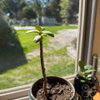
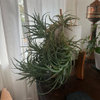
    Photographs

  • 7 years ago

    Picture 1

  • 7 years ago

    Thank you for your prompt reply.. Unfortunately my phone is still in the process of uploading the photos..

  • 7 years ago
    last modified: 7 years ago

    Thnx for the photos. Plant looks much better than I expected from your description - some of mine have more black spots.

    Roots are looking pretty good to me. Tear off that netting, it should come off in pieces. It may loosen up rest of the soil too, and if you 'wash' rest off, you should be ok. After - and if washing - let plant air dry on something absorbent (paper towels, newspaper, rag) in shady spot. Pot into new mix, and slowly introduce into good sunligth. You could also propagate few shoots if you like :)

    PS: is there a name on that tag?

    ETA: if it takes long time for photos to upload, it could be they have quite high resolution. I don't load them from hone but laptop so do not know for sure...but if horizontal pix are over 1500, it takes long time to upload them from laptop. Just my experience...

  • 7 years ago

    Thank you for the additional general care advice. No netting.. I will continue to work with the warm water and swishing and chopstick.

  • 7 years ago

    Oh my.. As much of the soil as possible has been removed and it is resting on a dry towel.. was contemplating removing the lowest 1/4 to 1/3 of matted roots since it is so very difficult to tell if they are even healthy..? I had considered propagation and I was not going to due to it being a bit late in our season.. until a side shoot broke off during the process. I will be making a cleaner cut to it and placing it upright in the mix next to Eola.

  • 7 years ago

    Final Result.. I ended up trimming about an inch of the lowest matted roots.. as well as, removed some additional compacted soil/peat to the best of my ability.. allowing to air dry on a towel as suggested. I also clean cut the stem shoot at a 45° angle and allowed it to air dry as well. I had to prop the slightly top-heavy mama with a skewer as she recoups and regains footing. I will hope for the best. Thank you again for your help and provided knowledge.

  • 7 years ago
    last modified: 7 years ago

    Janelle

    IMO, you did excellent job. Trimming the roots was good too. Propping plant with a stick or rocks until it gets established in new mix is better than taking chance of plant being knocked out :)

    IIRC, I read that best time to take cuttings of aeonium is Spring and Summer - so your cutting should start growing roots soon - aeoniums are winter growers. (That said, I propagated many plants regardless their growing season - not saying you should too :) I am not sure it is neccessary to cut end of cuttings stem on angle - I wouldn't, it creates bigger area to heal - but I am not absolutely sure about that. It may not matter much.

    I would watch watering since it is still quite warm - they need much less water in their dormant season.

    BTW, most aeoniums are monocarpic (same as Sempervivums): if a rosette blooms, it will die after blooms are finished. That is another good reason to start a new plant or two. Your plant may not bloom for a while, or may sooner than you think. I have Aeonium 'Kiwi' (proper name could be Aeonium haworthii 'Kiwi' or Aeonium haworthii 'Dream Color') and couple of others for number of years and they didn't bloom yet.

Sponsored
Miller Woodworks
Average rating: 5 out of 5 stars23 Reviews
Franklin County's Trusted Custom Cabinetry Solutions