Software
Houzz Logo Print
webuser_684990588

House insulation

6 years ago
last modified: 6 years ago

Looking for the best spray foam insulation and hopefully to contact Worthy

Comments (27)

  • 6 years ago

    Worthy I haven’t figured my way around this website yet, is there a way I can contact you by email or vice verca if I have you mine Thanks

  • 6 years ago

    You can contact members who are willing to be contacted by clicking on their name and then clicking on their message" button. Most members have not activated this feature.

    You can also active your message feature and ask someone to message you.

  • 6 years ago

    I’m building a new home in Maryland, poured foundation walkout basement, hardie siding, metal roof over plywood. 3 basement walls below grade, the walkout end exposed . 2x6 framing. My question is. What’s the best insulation route bottom to top. Thanks in advance

  • 6 years ago
    last modified: 6 years ago

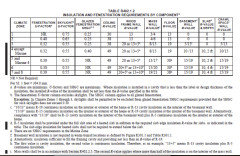
    All but one of Maryland counties (Garrett) are in Climate Zone 4, according to the International Energy Conservation Code, which suggests the minimum amounts of insulation in the table below:


    The basement is the simplest: Moisture impervious insulation around the perimeter; and perhaps under-slab for comfort more than energy savings. (See here, Building Science Corp.) FWIW, in basements, I've used: 1"-2" of extruded polystyrene board (XPS) affixed to the interior walls, followed by fg batts; and closed-cell spray polyurethane foam by itself.

    For the balance, there's no single "best" way.

    FWIW, most recently, I've used XPS boards on the exterior followed by fg batts on the interior and sprayed cellulose on the attic floor. If you plan to use the attic for living or storage space, other approaches would be used.

    For a current project, basement likely with XPS as above. I'm spraying the underside of the roof, as it's flat and only spf will work in the constricted space. (Maybe a layer of XPS under the roof underlayment too.) As for the exterior, it will be a choice of XPS boards or spf on the entire exterior; either way, followed by fg batts to the interior. I will make the decision after the start when I can compare bids.

    Since this project will be immediately for sale, cost is paramount.

  • 6 years ago

    Thanks for the input, is the soy based spray foam worth seeking out or is it much difference

  • 6 years ago
    last modified: 6 years ago

    If green is your overriding concern, SPF is not likely for you. However, new blowing agents have global warming potential down to miniscule amounts compared to just a few years ago. The soy evidently substitutes for sugar in the foam and is as little as 5% of the foam by weight.

  • 6 years ago

    What’s your thought on blown in insulation in ceiling. And what do you prefer

  • 6 years ago

    I've only used blown-in cellulose for non-living space attics in new builds. Started without even thinking about it as it was part of the insulator's house quote. Still seems the right decision for us in Climate Zone 5. See cellulose v. fibreglass.

  • 6 years ago

    In zone 5 , do you insulate the exterior of the foundation before backfill and do you insulate exterior walls before siding is hung ?

  • 6 years ago

    Been looking into blowing in cellulose in my attic too. You can rent the machine at HomeDepot but if you buy 10 bags of insulation the rental is free and then return the unused. There's many youtube videos on this - I noted one below. Cellulose looks like a much better option than fiberglass, and at about an R-value of 3.5 for each inch I'm thinking 16" to get to R-50. A friend just added some and another benefit is noise reduction.

    https://www.youtube.com/watch?v=ABj3TTkZH9c

  • 6 years ago
    last modified: 6 years ago

    do you insulate the exterior of the foundation before backfill

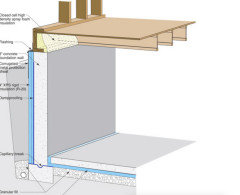
    No, because I can't see how to hide the XPS poking above grade in an attractive way. In the illustration below, note corrugated metal protection is used and flashing above. The illustration also does not provide for a true waterproofing barrier.


    Source: Building Science Corp.

    do you insulate exterior walls before siding is hung ?

    If XPS is used and taped or housewrapped (non-perforated wraps only), then yes. But if the eaves have not been covered, I would hold off in a rainy season or climate.

    Note rim joist area sealed and insulated with ccspf in the illustration above. I understand some builders are still not up-to-date on this.

  • 6 years ago

    well I plan on spf in rim joist and at least a 1/2 inch spf on basement walls for vapor barrier. considering knauf brand bats in wall cavities on main floor . And still trying to figure out attic ? It will have to be bats on cathedral ceiling side . And contemplating spf on underside of roof deck. Anymore help is welcomed!

  • 6 years ago

    About 2 months ago we had open cell foam insulation sprayed in the attic of the entire house, and in the crawl space and walls of a new addition. I looked at Icynene vs. Agribalance (soy based) and decided to use Agribalance because it has a better R value per inch. Total cost difference between the two products was only about $500.

    We have 2x4 walls in the addition because we needed to keep the addition narrow to meet setback requirements, and the Agribalance gave us the wall R value we needed. The contract stated 8.5" for the roof deck in the attic, but they oversprayed enough that I have more like 10" in some areas. They also had an option to spray a thermal barrier over the foam so we could use the attic for storage (code requires it), but the attic has limited headroom so we opted out. The crawl space walls are sprayed with 3" foam.

    I'm located in Alexandria, and the insulation company was Southland Insulation. They were quick, and cleaned up after themselves. We still had to do some clean-up shaving of the insulation in the stud bays as we installed drywall, but it was not a big job. We spent one night out of the house to let the smell dissipate and there was no significant odor by the time we came back the next day.

    Bruce

  • 6 years ago
    last modified: 6 years ago

    It will have to be bat[t]s on cathedral ceiling side . And contemplating spf on underside of roof deck

    One or the other. Aside from the fact that you can't add up the R values of the two separate and separated insulating materials, see here.

  • 6 years ago

    whats better in a cathedral, closed cell or open

  • 6 years ago

    I mean if I spray directly on the underside of the roof deck

  • 6 years ago
    last modified: 6 years ago

    Closed-cell foam sprayed directly on the underside of the roof deck in an unvented assembly is an approach suggested in all climates by Building Science Corp.

    Martin Holladay shows here the results of the approach favoured in the '70s and '80s by a traditional vented assembly.

    Though they are widely used, the trouble with batts in an unventilated cathedral is that they cannot be as closely fitted to the underside of the roof as spf or sprayed cellulose.

    If you are fitting pot lights, speakers and such to the cathedral ceiling, they should be insulated and tightly sealed to the ceiling with caulking.

    Clif Hamburger thanked worthy
  • 6 years ago

    Thanks Worthy! So let’s say this is a vented cathedral ceiling? I’m using a truss within a truss. Mono truss

  • 6 years ago

    Since vented cathedral ceilings have proven problematic, I see no point in building one from scratch. Live and learn!

  • PRO
    6 years ago

    Amen! Vented cathedrals introduce way too many problems for any builder to still be mistakenly constructing them. That’s a deficit in the builder or designer’s education.

  • 6 years ago

    Ok when you say unvented , your saying no soffit or ridge or gable vent on the cathedral side. The other half is flat ceiling and regular truss

  • 6 years ago
    last modified: 6 years ago

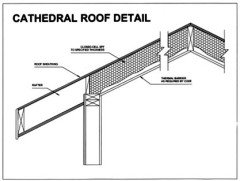
    To be clear, this is an unvented cathedral ceiling/roof:

    If you're considering a half-vaulted ceiling--sloped as above but meeting a flat roof--it would make sense to continue it as an un-vented ceiling as well. Principally, because it's unlikely that there would be the space necessary to create a vented ceiling.

  • 6 years ago

    Going back a few posts - I insulated on the exterior from the top of footing to top of exterior framed wall. The exposed insulation above grade and below siding was covered with a cementitious coating over self-stick netting. It has been a very durable coating that looks like standard parging. I really like the insulation on the outside.

  • 6 years ago

    The key to reliable exterior insulation is keeping it from accumulating water, which attracts pests. See this story of exterior insulation gone bad, and replaced and improved.

  • 6 years ago

    When would one use open cell foam in a cathedral ceiling?

  • 6 years ago
    last modified: 6 years ago

    Only in a warm enough climate zone that you could reach the minimum Code in that restricted space. Definitely not Zone 4. As well, ocspf should not be used in cold climates because it is too vapour open, according to Building Science Corp.