Software
Houzz Logo Print
webuser_625786718

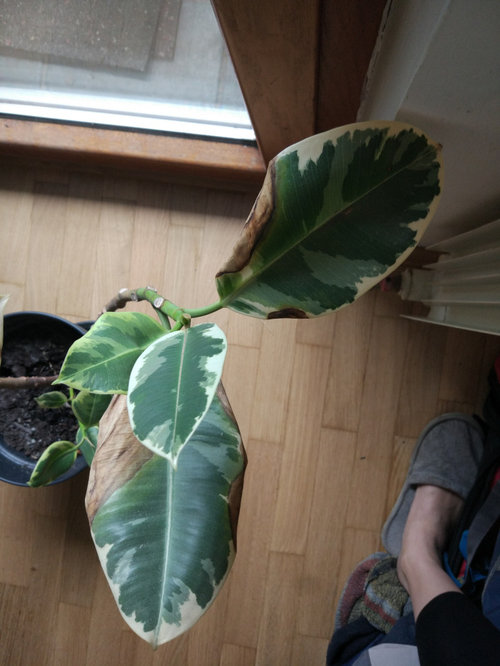
Ficus elastica loosing browning leaves

6 years ago
last modified: 6 years ago
Hi all,

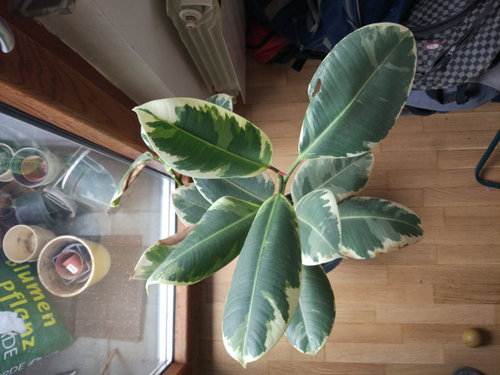
I've found a lot of great info here on container gardening but I'm not sure where to start when trying to save my ficus elastica.

I've had it for a few years (~3-4-5, not sure) and I've mostly potted it up every one-two years (which I now see wasn't such a great idea). In the last few months, lower leaves edges started to turn brown and fall off. I'm not sure what was the cause.

After this initial falling off, my apartment was being renovated so all of my plants were neglected since they weren't accessible. During this period, ficus was underwatered.

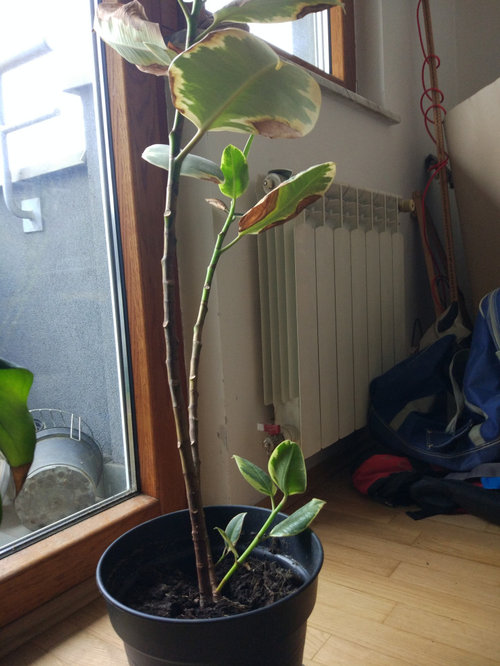
Now, lower two thirds of the plant are leaveless and the soil is quite dry. When I water it, the water quickly flows out through the drainage holes and the soil mostly stays dry. There are some healthy leaves at the top of the plant and also new growth at the bottom of one stem. Help please, what should I do to try to save the plant? Thank you.


Comments (5)

  • 6 years ago

    The soil is overly dry if it's repelling water. I'd put the pot into a bucket or tub filled with plenty of warmish water (like 70F-85F) and let the soil have plenty of time to soak it up. At least an hour... make sure the soil/potting mix is thoroughly soaked.

    AnaSv thanked party_music50
  • 6 years ago

    The dead leaf margins are symptomatic of the plant's inability to move water to its most distal parts. That occurs from over-watering, under-watering, and/or a high level of salts in the soil (solution). Why it occurs from under-watering is self evident. Over-watering limits the roots' oxygen supply so root's cannot function normally, and sets the stage for fungal infections that wreck root health. So in a sea of plenty, your plant can die of thirst.

    Your plant should never be allowed to sit in the effluent (waste water) that exits the drain hole, and it looks as though that might be occurring. When you water, it's best to water from the top until the entire soil mass is completely saturated and at least 15-20% of the container's volume has exited the drain hole. It's best to water in the sink, allow the plant to drain, then return it to the cache pot or the collection saucer. If you can't/don't want to water at the sink, at least raise your pot above the bottom of the collection saucer so there's no pathway by which the salt-laden water you flush from the pot can make its way back into the soil.

    Water moves in and out of plant cells by way of osmosis. Simply put, water moves toward a higher concentration of salts. Too much salt in the soil (solution) makes it more difficult for the plant to absorb water. Salt can even build up to the point where the process of osmosis is reversed - so water is pulled OUT of cells by the same mechanism curing salts create to pull water from ham/bacon/lunch meat cells. This results in collapse/death of the cells, and is called plasmolysis (commonly called fertilizer burn).

    The short of it is, you need to get your watering under control by ensuring the entire soil mass is saturated when you water, and not too much water remains in the soil. The later can be achieved by watering more often, changing to a more productive medium - one you don't need to fight constantly for control over your plant's vitality, or through some very simply (as in monkey-easy) scientific tricks to force water from the soil.

    I think it's ok to soak the entire pot in a tub until the entire soil mass is rehydrated, but it's not the best long term approach. As noted, watering from above is a more effective way to flush accumulating salts from the medium.

    You might like this.

    Al

    AnaSv thanked tapla (mid-Michigan, USDA z5b-6a)
  • 6 years ago

    Al, you are so smart :-) All my years of gardening - and even with a degree in horticulture - I have never encountered the term 'plasmolysis'. That sounds so much more scientific than "fertilizer burn". Lol!!

    Thanks for broadening my knowledge base once again!!

  • 6 years ago

    Thanks, Pam. ...... and I was just subjected to some passive aggressive criticism on another thread by a person who said all that scientific stuff isn't necessary ..... that your plants will get used to you and you would get used to your plants, and then they'll be grand. I was going to reply, "Last week I read something in a thread and thought it the most ridiculous plant advice I'd ever read, but. Now I'd like to change my mind", but I didn't want to get too far out in front of my better angels. ;-)

    Al

  • 6 years ago
    last modified: 6 years ago
    Thank you both for the advice.

    Al, you are right, my plant was sitting in the waste water, I will change that.

    I already read good growing practices, and a lot of your other posts (so glad I found them!) which I immediately started saving so I can re-read them 'cause it's a lot of new information to digest at once. I don't believe how long my plants looked good inspite of everything I was doing wrong.

    But I didn't know where to start with the ficus so I asked here for an advice. I didn't know should I repot it immediately, or if this soil is still usable.

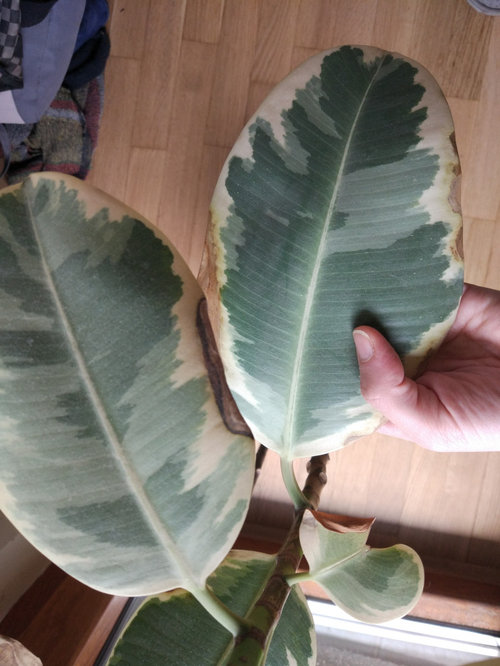
    For starters, I soaked it in a bucket for an hour. Then I flushed it and removed excess water the way you described it in the post on flushing the soil. Then I fertilized it. From now on, should I flush it each time I water it? How often should I fertilize with this commercial soil? If I get the watering under control, what are the next steps? Should I repot it in June? Root prune if neccessary? Pinch it after repoting? How much do I pinch? The plant has two stems, and lower of the two only has 4 leaves, two of which are new and healthy but smaller, and the other two are bigger but with brown edges, so I'm really not sure what to pinch here. When I pinch, there should be some healthy leaves left under the pinched part, correct? Maybe it will have some new growth in two months.

    If it survives (I just noticed some flies in the soil, I need to research what they are and how to handle them), I would definitely like to have some new growth at the bottom two thirds of the plant since it bare now.

    Also, I tried finding some videos on root pruning since it's hard for me to understand just from description which parts should be prooned since I don't know the terminology (plus English is not my native tongue) (ok, I understand the part with circling roots).

    https://youtu.be/fVq6BILoZKY

    Is this ok? The woman just saws off the whole bottom third of the roots plus the sides.

    I'm sorry for the long post, but gardening just got a lot more interesting now that I (kind of) understand what's going on. Plus I want to make sure that I'm interpreting the new information correctly. :)

    Thanks a lot.