Software
Houzz Logo Print
mbert89

Saving a Rubber Tree

6 years ago
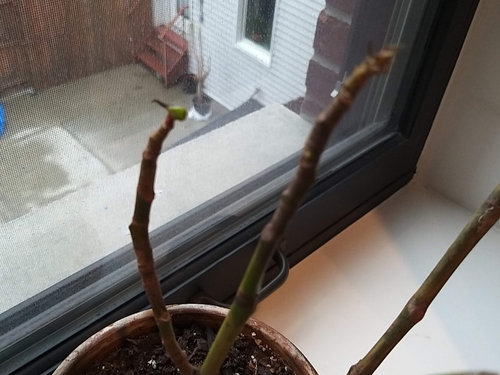
I've recently come across gritty mix and a bunch of Al Tapla's posts. I've read that ideally you should repot a plant around the summer solstice, however I have a rubber tree that is on its last legs. It recently had a few leaves which were yellowing, so I stopped watering it because I thought this was related to over watering. That didn't seem to help and it subsequently lost most of its leaves.


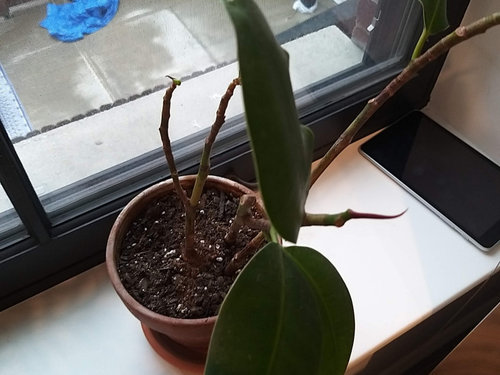
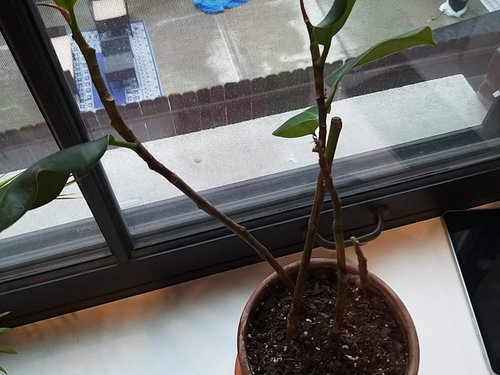
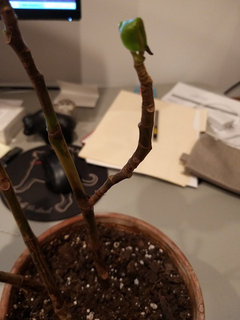
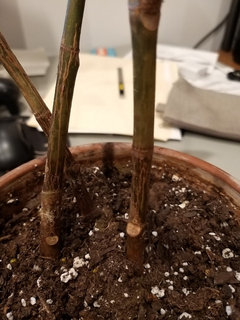
I have included several photos of the plant in its current state. I was planning on repotting it into gritty mix over the next week but was looking for some suggestions. Do people think this is a good idea given the time of year (I am in NYC if that is relevant) and state of the plant? My current thought is that the plant will probably die either way, and so I should just try and repot it on the off chance it can make a recovery. That being said, it does seem like the twig (stem without any leaves) is pushing out some new growth.


Assuming repotting is the right decision, should I also be root pruning, or will this increase the stress?


Any advice is much appreciated!


Comments (11)

  • 6 years ago

    Thanks for the advice tropicofcancer! My understanding of how to check for moisture is to use a small dowel (I have been using a chopstick, but unsure if that is appropriate) to determine if the soil is moist. Just wanted to confirm that is correct?

  • 6 years ago

    Chopstick will be fine as long it is raw bamboo and not coated with something. You want to stick it as deep as possible down to the last 2 inches or so. That way you can also tell if the bottom is saturated with water or not. With normal potting mixes the bottom is often very wet while top is dry. If the stick comes out clean then it is ready for water. If you soil particles sticking to the dowel then it is still wet. Your mix looks quite wet from the picture.

    also, if you tilt the pot at 45 degree and quickly shake it up and down excess water will come out. Another way is to wick the water out of the pot (most of the excess water is near the bottom of the pot). One quick way is stick a moist wad of cotton in the bottom drainage hole or holes. The wad should be big enough so it sticks out and touches the soil inside. Then place the pot on stack of newspaper or a cotton towel. In a few hours the excess water will be wicked out onto the newspaper.

    Leave it in a warm sunny spot and wait for it to recover.


  • 6 years ago

    I don't have much expectation your plant is going to bounce back. The shriveled appearance of the bark low on the stem is indicative of compromised vasculature. IOW, the tissue that conducts water and nutrients appears to be compromised by a fungal infection caused by any of several damping-off fungi - essentially, the plumbing that conducts water movement is plugged and the plant probably can't/won't recover.

    Al

  • 6 years ago
    last modified: 6 years ago

    Al, you have better eyes than I have. I tried after your post but have not been able
    to notice any shriveling of the stem(s). But I would trust your observation.
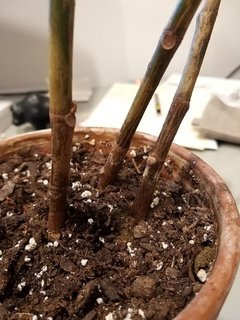
    Under those circumstances best bet I can think of is to start all over using cuttings from the top healthier sections of the stems. mbert: Can you take a closer picture of the bottom of the stems?

  • 6 years ago

    Click to enlarge Mbert's first image and notice what looks like vertical wrinkles on the rightmost stem - looks like 4 internodes are affected. You can also see hints of same on the middle plant that visually bisects the stem on the right. I don't think there's any reason not to try to get a cutting to strike, but there are so many things that don't favor success, chief among them are the high probability of the infection having affected the entire plant, and the fact the plant's energy reserves are likely on 'E'. Let me know if you see what I'm describing. The change in stem color is what made me look closer. In one of the images, the low part of the stem is brown, then as the I moves distally it changes to green, then brown again - another bad sign.

    Mbert - if you intend to use the pot again, you can sterilize it by soaking it in a 10% solution of water & sodium hypochlorite (household bleach) - 9 parts water: 1 part bleach.

    Al

  • 6 years ago

    Thanks Al, I very much appreciate all the information you have put out on container gardening!


    Should I be concerned with the plant being near other plants? I.e. is it possible for the infection to spread?


    Also, just for my own reference do you have any info on strategies for cuttings? I previously looked through the forums but was unable to find any guides.


    Thanks again for all the help! I have uploaded a few other photos for reference


  • 6 years ago

    "Should I be concerned with the plant being near other plants? I.e. is it possible for the infection to spread?" Not particularly, though it is good practice to sterilize pots in which diseases have died. Fungal spores of damping off diseases are ubiquitous, but fortunately it takes more than just the presence of spores for diseases to take hold. Something I wrote about 'the disease tetrahedron:

    Diseases

    There are two categories of plant diseases that affect plants. “Abiotic” diseases have no pathogen, and are generally caused by any of a number of cultural factors. Excess water retention in container media is one of the most frequent cause of abiotic disease(s). Since there is no pathogen, abiotic diseases are not infectious. Cultural factors like light, temperature, soil chemistry/soil structure, air pollution, pesticide/herbicide residue, insect herbivory, ….. can individually or collectively cause abiotic diseases, or, even though not infectious, set the stage for “biotic diseases”, which involve living pathogens. In this case, the OP asks about the infectious/fungal/microbial pathogen, powdery mildew. Fungi are the most common pathogen affecting plants in our gardens, but bacterial and viral pathogens (even though there's a question re whether of not viral particles are living OR microbes – not really applicable to this topic.

    Plant pathologists often describe the disease process using a 4-sided figure called the disease tetrahedron (think “pyramid – 3 sides + the bottom). Each side of the tetrahedron represents an essential part of the infection process. There must be a virulent pathogen (capable of infecting the plant) that is genetically capable of recognizing its host. Either the environment must be conducive to the development of the pathogen, or the pathogen must be able to stress/weaken the plant. The 4th requirement is the time required for diseases to develop and spread. Whenever conditions are such that any one (or more) of the 4 requirements is missing from the equation, there is no immediate threat.

    Since the best medicines are prophylactic, the grower who makes sure plants are healthy and not stressed is ahead of the game. Biotic diseases are better able to overcome the natural defenses of plants weakened by stress that occurs when the plant is forced to deal with cultural conditions near or beyond the limits the plant is genetically programmed to deal with.

    Circling back to the disease tetrahedron, we can see compost that contains the virulent inoculum provides 2 of the 4 essential sides needed for a disease to develop – environment and inoculum. Time, the third essential side will not likely be on the side of the grower, so you can't use that to your advantage. We know there will be potential hosts, but not whether or not the hosts will be susceptible to the pathogen, or weak enough for the pathogen to infect the host.


    "Also, just for my own reference do you have any info on strategies for cuttings?" When to take/make propagules from any given plant varies by species, so does how to treat them after they're prepared. Success depends in large part on the health of the plant from which the propagule was taken, how the propagule was prepared for cloning, and whether or not the method you use suits the plant material you intend to clone.

    For ficus, I generally start with a layer of coarse material (larger than 1/8") in the bottom of a container, then a layer of gritty mix, then a layer of gritty mix + peat, on top of which I hold the cutting while filling in around the cutting with the gritty mix/peat mixture. Make sure the peat has been well-moistened before you fill in around the cutting. You can also use a regular potting medium mixed with perlite, or just plain perlite. Don't forget that Ficus (the genus) lends itself well to air layering - which is close to foolproof.

    Al

  • 6 years ago

    OK. now I see the discoloration and shriveling of the stems. Thanks.

  • 6 years ago

    Thanks Al. I was completely unaware of air layering, your above post lead me to this discussion you wrote which was very informative https://www.houzz.com/discussions/5059015/layering-air-layering-marcotting-another-name-for-air-layering. Am I correct in my understanding that in the flap method you would leave the propagule attached until it strikes, after which you would severe it from the plant and place it upright in a new pot?

  • 6 years ago

    That's correct.

    Al


Sponsored
Schlabach Woodworks
Average rating: 5 out of 5 stars21 Reviews
Franklin County's Reclaimed Wood Professionals