Software
Houzz Logo Print
barmaleyka

How do I know when to feed my tomatoes?

6 years ago

I have about 20 varieties of tomatoes growing in pots on my deck. They seems to grow well but I have very little experience and can not decide if I need to fertilize them. I am not as much concern about size of fruits but I need them to be tasty and sweet. How do I know by looking at the plants that they need extra nutrients? Is there a universal fertilizer which is always good and can not make harm? I was told that fish fertilizer is very good and universal?

Comments (20)

  • 6 years ago
    last modified: 6 years ago

    The tomatoes may need feeding if the leaves turn yellow and you can tell it's not because of a fungus (if you see black circles and stuff like that, it's probably a fungus), or if the leaves get purple on them or look translucent. There is no universal safe fertilizer. They can all be abused. Some are safer than others, though. How safe it is not only depends on how you use it, but also on your plant, your soil, and the growing conditions.

  • 6 years ago

    When the lower leaves yellow first, that signifies a mobile nutrient deficiency (such as nitrogen, magnesium, or potassium). When the new growth yellows first, that symbolizes an immobile nutrient deficiency (such as iron or sulfur).

  • 6 years ago
    last modified: 6 years ago

    Nitrogen, phosphorus, and potassium (N-P-K) are the most important nutrients in a fertilizer, typically. Nitrogen helps foliar growth, primarily, but it does other stuff, too. Too much nitrogen can make the roots and the plant itself weak and susceptible to disease and pests; it can contribute to root rot, and cause the leaves to burn; it can also cause lots of growth with little fruit. Phosphorus helps with plant maturity, flowering/fruiting, leaf size, cold-tolerance, and other stuff. Phosphorus-deficient plants can have purple on their leaves. Potassium helps to strengthen roots and branches, increase fruit size, protect against insects/disease/heat/drought, and other stuff. It's hard to get too much potassium, but when you do, it can inhibit nitrogen (too much nitrogen can also inh inhibit potassium). Zinc can help plants grow faster at times. Copper can help against fungi and help the fruits to absorb water. Calcium helps plants to be strong, increases pH, helps against blossom end rot, and seems to work with nitrogen and potassium. Magnesium helps with heat-tolerance. It's easy to add too much of most things, with potassium being an exception (but there is a limit). Look up the salt index of nutrients, also. Not all kinds of potassium have the same salt index. The salt index helps determine how much of what you can give a plant without it burning.

    Note that lots of water increases nitrogen availability. Cold increases potassium availability and decreases phosphorus availability. Heat increases phosphorus availability and decreases potassium and magnesium availability.

    Note that when plants are first given a nice dose of potassium, their drought-tolerance will be less. They need to absorb water for a couple days or so before the increased drought-tolerance kicks in.

    Sulfur can increase acidity. Sulfur-deficient plants can turn yellow on the new growth, or the leaves can look translucent and purple-ish.

    Iron-deficient plants usually turn quite yellow on the new growth.

    barmaleyka thanked Mokinu
  • 6 years ago

    If you are growing a plant in a container - any kind of plant - then it will need regular fertilization. The reasons are very simple - potting soil contains no nutrients (unless ferts are implanted in the soil mix from the outset) and every time you water (which tends to be quite frequently during the growing season), you are flushing whatever small amount of nutrients may be present out. These must be replaced for the plant to flourish and be productive and that responsibility is yours as the grower

    The above detailed explanation is great when discussing inground plantings but is less necessary when dealing with containerized ones. Precision is not a requirement and you do not need to know the precise nutrients you are providing. Any liquid or fully water soluble fertilizer works and works well and even better are those with all the required trace elements and micronutrients. Fish/seaweed emulsion is good but not great. Both Dyna Gro and Miracle Gro (surprisingly!) are very good, with a full range of nutrients. But there are scores of others.

    And the frequency of application is also very simple - weekly, weakly. That means diluted to at least half strength and applied to the container weekly during the primary growing season. Its best of you do not apply to dry soils....make sure your container has been recently watered before you fertilize.

  • 6 years ago

    I let my tomatoes yellow slightly and slow down on growth, and then I feed them with Miracle Grow for tomatoes. W/in three days, I see them responding. These are in the ground. I always water the ground some first, as I do not like to apply fertilizer when the soil is dry.

    Don't overdo it or do not put them on a schedule... let the plants tell you when it is time.

  • 6 years ago

    It is not really reasonable to make comparisons of tomatoes growing in containers and those planted in the ground......the growing requirements for each are vastly different!!

    Tomatoes planted in the ground are never really without nutrients.......although supplementation may be necessary, there is still that surrounding soil mass to draw on. This is not the case with containerized plants which generally have NO access to any nutrients unless applied by the gardener. And with the frequent watering required with containers, these are routinely flushed out and must be promptly replaced.
    I would never want to stress containerized plants to the point where growth slowed or stopped or the foliage yellowed. That's why you DO want to fertilize on a schedule.....as suggested previously, weekly, weakly :-))

  • 6 years ago

    Thank you all, I love this forum, people here are very friendly and knowledgeable!


    I am seriously concerned only about one plant - it is early girl. Its leaves are yellow at the bottom, I also think the plant does not have enough sun since it grow rigorously but the spaces between leaves are very big. Compare to other plants it much less dense and bushy. I think it lacks of nitrogen. I got a 16lb bag of Jabe's organic vegetables and tomato fertilizer with 2-7-4 and I am concerned that it has low numbers for nitrogen. What would you recommend?

  • 6 years ago

    Organic fertilizers in container growing is no good. Organic fertilizers require naturally occurring beneficials to break the fertilizer down in order for the plant to use, which do not exist in your container soil.

    Gardengirl, I don't mean wait until growth has stopped or the plant turns yellow. Once someone has enough experience with gardening, one can detect a slight color change and slow down in growth to determine when it is time to feed. Both in the ground or container growing.

    When the goal is fruit production, a little plant hunger between feedings will produce more fruit than a plant that is overly fertilized.


    barmaleyka thanked ncrealestateguy
  • 6 years ago

    All organics will have nutrients in low concentrations....that is just the nature of organic ferts. And they are slow release as well and for a variety of reasons not recommended for container culture. For container growing, you are far better off with a liquid or water soluble synthetic fertilizer with immediate availability.

  • 6 years ago
    last modified: 6 years ago

    Can you show a picture of the leaves, please?

    Shaded plants tend to utilize less nitrogen than those in the sun, and it's easier to give shaded plants too much, should they need it; but, in containers, you'll see deficiency symptoms more often than in the ground if they're shaded, unless you're diligent in giving it everything it needs before they show up, or unless you've got a soil I'm not familiar with gardening in.

    Is the entire leaf yellowing, or more around the edges? Does the leaf look like it's decaying?

    If it were particularly low on phosphorus, it probably wouldn't be as leggy; so, I don't think that's an issue. Low light, phosphorus, and warmth all can make plants leggier.

    If it's low on potassium, it should have supple or easily breakable branches, and potentially more bugs eating the leaves and stuff, before it shows yellowing; low-potassium plants also show signs of overwatering and root rot a lot more easily than high potassium plants (potassium helps plants absorb and utilize water, and FYI, is very beneficial to add without nitrogen at transplant time; although the only forms I've used enough to recommend for this purpose are potassium sulfate and monopotassium phosphate—and wood ash, if you're comfortable with the extra calcium that can raise your pH, which many people don't seem to be; wood ash has far less potassium than the other two, but plants utilize it about as quickly, and it easily makes a difference the same day for transplants; it has a similar amount of calcium as eggshells). A plant with lots of potassium will have tough branches and tough leaf stems that don't bend or break easily (the roots will also be tough, but more flexible). Calcium also contributes to plant strength. Early Girl F1 seems to use somewhat more potassium than many tomatoes, in my experience, and can be prone to breaking—at least, the version of Early Girl F1 that was available in 2014: they've probably released a new version of it, by now. Early Girl F1 doesn't need loads of potassium to produce; it can produce well with breaking branches, and may even taste better that way (well, I like acidic tomatoes, and it seems more acidic with low-enough potassium for breaking branches; most people probably prefer milder and sweeter tomatoes instead).

    When was the last time you fertilized, and what with?

    Early Girl F1 is an excellent choice for containers, even though it's indeterminate. I hear it can produce very well with Miracle Gro potting soil alone (which should be pre-fertilized—it should say on the bag, if it is, and how long the fertilizer is good for).

    barmaleyka thanked Mokinu
  • 6 years ago
    last modified: 6 years ago

    so you want sweet and tasty, Jobe's won't do it, wrong NPK and lacks a half doz. micro nutrients.

    You want sweet and tasty, so imagine your favorite dish without half of the spices in it, not good, and the same with tomatoes. ALL of the nutrients required and missing will cause visible problems to the plant, not just nitrogen, and also effect the taste of tomatoes.

    You will need Miracle gro continuous release plant food 10-5-15 and humic acid to get sweet tasty tomatoes. This Miracle gro has the best NPK ratio for tomatoes with all but one micro nutrient added. (see below)

    Take one cup of Humic acid and mix into the dirt. It isn't a fertilizer, but what is left over after organic matter is broken down to the point it can't break down any more . It's mostly carbon, two steps away from being coal. But nutrients will bond with it, hold them in the soil and transport them to the roots, but humic acid isn't used by the plants and can last hundreds or even thousands of years doing it's job as a transporter. Once is all you need.

    Mix the miracle grow in at 1 and 1/2 teaspoons (0,3 oz) per plant until you get flowers and then raise the amount to 2 teaspoons (0.4 oz) every week. After you see a bunch of tomato sets (small tomatoes where the flower was) and starting to grow bigger, (about the size of a dime) raise the amount to 2- 1/2 teaspoons (0.5 oz) every week. do it until you get sick of sweet tasty tomatoes. The average tomato would need about 7 1/2 oz of that miracle grow in one season.

    One size doesn't fit all and you don't feed a baby 3000 calories a day or an adult athlete 500 calories a day, Oh no, well the same applies to tomato plants.

    This isn't for tomatoes going in the ground, only containers and like gardengal said containers are fertilized entirely the ground grown .

    The missing micro nutrient in that miracle gro is Boron. Boron is essential for formation of the cell walls, elongation of pollen tubes and needed in the metabolism and transport of sugars. (you want sweet, right?) If you want to add boron it requires 0.01 to 0.015 grams for the season per plant but this is boron, not borax. Borax is 11% boron and Borax is good to use so you will need 0.09 to 0.14 grams of borax or a 1/8 teaspoon level (1/10 gram), or heaping 1/8 teaspoon (0.14 grams.) This is 1/2 the desired amount but anymore then three times this amount will be toxic to the plant and you may kill it. Mix in a pinch of that 1/8 teaspoon every couple weeks, so learn what a pinch would be and no more!

    Boron deficiency is the most common deficiency of micro nutrients in the world. Note I said world and one of the easiest minerals to leach out of the soil. Seriously don't go stupid with the borax!

  • 6 years ago

    Everyone has their own favorite fertilizer and no one is really "best" :-) I use Dyna Gro's Foliage Pro on ALL the non-woody plants I grow in containers and it works just as well for tomatoes and flowering annuals as it does for any houseplants. And it has a full range of micronutrients.......including boron.

    barmaleyka thanked gardengal48 (PNW Z8/9)
  • 6 years ago

    Mokinu,


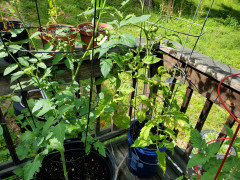
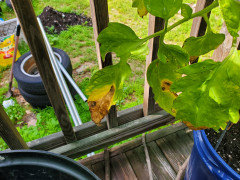
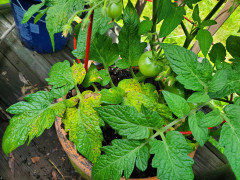
    Whose are the pictures which you suggested. As you see the early girl tomato is in a blue basket in the corner, I would like to repot it to a container similar to the black one which is to the left of the early girl. I think my leaves show some kind of disease as well. I think I got it after I bought 10 plants from a farmer in NY since all his 10 plants had similar leaves at the bottom of the plants.


    Last picture of another plant which has similar problem:


    I think I need to repot early girl and the problem is not only in the size of the container but the soil there is left from a tomato plant of last year and it was only top soil from Lowe's. At that time I did not read any forums and by instinct told me that top soil is what plants need!!!

    I still don't understand what is wrong with organic matter in a container. Why on the earth is it good in garden and not good in container? If organic matter release its nutrients slowly why just don't wait until they are released and seed a plant next year when the soil is ready?


    You buys are giving me so good advice that I can not apply best answer button since all answers seems very informative to me. How important is this label in the forum?

  • 6 years ago

    forget the nutrient deficiency, your early girl has septoria leaf spot, a fungal disease, good luck.

    barmaleyka thanked outpaientzero
  • 6 years ago

    After reading about septoria I realized that I have a very serious problem. I removed all leaves with slightest symptoms of the disease and at the next stage to develop a plan of actions. I planted tomatoes not because of tomato deficiency in a local markets but because I miss a taste of real tomatoes as well as I would like to get healthy tomatoes (not necessarily organic, I am open and even like GMO product but I don't like poison in my food) thus I prefer to restrain to chemically harmful treatment. How do I know what is proven healthy treatment for septoria which will not bring pesticides to my table?

  • 6 years ago

    by the way I don't like poison food either. Check out the link on tomatoes and then to the right is a slide you can look at other kinds of food.

    http://www.whatsonmyfood.org/food.jsp?food=TO

    I will NEVER eat a gram of food grown outside the united states.

  • 6 years ago

    is this the right stuff?

    https://www.lowes.com/pd/Bonide-32-fl-oz-Natural-Copper-Fungicide/50383670

    Do I need several bottles?


  • 6 years ago

    yes that will work if you like getting raped on price. Since you must spray every week a concentrated bottle is a much better value at $17.

    https://www.homedepot.com/p/Bonide-16-oz-Liquid-Copper-Fungicide-Concentrate-811/203911375

    Mix 1/2 oz in a quart spray bottle and you will get 32 of the $10 ready to use bottles you posted. You will save $300 dollars, but you'll need to drop a couple of bucks for a spray bottle, or use a empty recycled bottle, or buy a small tank sprayer.

    Read the instructions, they say 1/2 oz to 2 oz per gallon, go with the max dose but read the instructions.

    "For best control, start spraying before the disease is visible or when disease is first visible on the plant." (from the product label)

    https://www.bonide.com/assets/Products/Labels/l811.pdf

    Did I mention you should read and follow the label?

  • 6 years ago

    lots of great answers here. i am growing many variety of tomatoes and peppers out of containers as well. Everything us lookiny great so far and the fruit is producing!

    I water daily and use Miracle-Gro Tomato Fertilizer once a week. I like to measure the amount of Fertilizer going into each plant so instead of using the hose sprayer attachment, i use a 1 gallon watering can.

    https://www.acehardware.com/departments/lawn-and-garden/gardening/plant-food/72452?store=03755&gclid=CjwKCAjwi_b3BRAGEiwAemPNU87Udn_nTDdU2iLwBW3NXF0wP4C5UHlaPHwz0bxhJEn6K6B-PVd59hoCeegQAvD_BwE&gclsrc=aw.ds

Sponsored
Peabody Landscape Group
Average rating: 3.5 out of 5 stars8 Reviews
Franklin County's Reliable Landscape Design & Contracting