Software
Houzz Logo Print
webuser_781212074

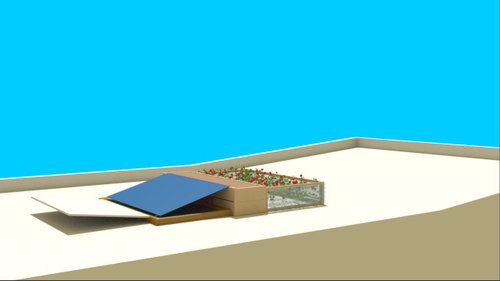
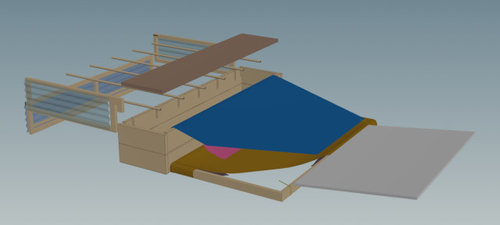
Self-watering wind-protected rain-fed rooftop tomato planter design.

6 years ago
last modified: 6 years ago
Hello,


I'm a novice gardener making my first attempt at growing tomatoes in my condo. I live in Montreal, Canada, where the growing season is approximately April to October. I've already begun growing tomatoes on my balcony, but the space is limited so I want to migrate some of them to my rootop.


My roof has pros and cons as a gardening site:


pro:

lots of sunlight (around 9 hrs)

lots of space


con:

very windy

awkward to access (ladder through trapdoor), esp when transporting materials, including water


I work in computer animation and have used 3d software to design a planter setup that is intended to do the following things:


PROTECT THE PLANTS FROM WIND

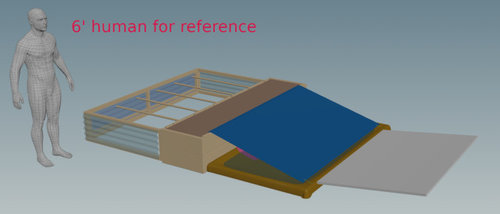
The tomatoes are grown horizontally along stakes elevated 1' from the ground and surrounded by panels made of corrugated transparent plastic mounted on wooden frames. These panels block the wind but let the sun in.


COLLECT RAINWATER

Next to the box that contains the soil, rainwater is collected in a tray made of a wooden frame covered by a tarp (brown). This is in turn covered by another tarp (blue) that is suspended over the collection tray to prevent evaporation, and slanted to prevent water buildup. NOT SHOWN (because it's difficult to model): the blue tarp comes down on the sides and tucks into the tray, so there is no opening for the water to evaporate. Water runs off the blue tarp and collects in the tray. Note that there is also a ramp (support for ramp not shown) that drains into the tray, but I'm not sure if I'll use that in the end because it might be difficult to pin it down and prevent it from being blown away.


"SELF-WATER" THE PLANTS, IE. WICK THE COLLECTED RAIN INTO THE SOIL

An absorbant fabric (pink) - perhaps a towel - wicks water from the collection tray to the soil box, ensuring that the soil is always moist.


This design is not intended to be 100% self-sustaining; I will have to prune suckers + monitor the plants, and I will likely need to manually top up the rain in the tray if it doesn't rain for a long time, but the idea is to have it as low-mainenance as possible.


Here are my questions:

  • Does this general design seem viable?
  • Currently the six plants are spaced 16" apart. Is that a good distance?
  • Currently the box containing the soil is 8' long x 1.45' tall x 2' wide, = 23.2 cubic feet, which is 3.87 cubic feet per plant. Is that sufficient soil in the container?
  • Currently the stakes are elevated about 1' above the ground. Is that a good amount of space to prevent them laying on the roof surface? Or can I just forgo the stakes and have the plants spill across the roof within the wind-protected area?


Please feel free to let me know any other concerns or improvements I could make.


Thanks very much!


Jeremy.


Comments (7)

  • 6 years ago

    First, that is a very interesting design. Second, I have a couple quick questions.


    Are there squirrels? (Mind you, my squirrel ate everything *but* the food plants...)


    Are there community gardens around, that you could get a plot in? No offense but it would probably be easier. (Mind you, often there is a waiting list.)


    And, is there a way to run a long hose out your window to the roof? Or would that upset the landlord (if any)? I don't know that I see any issues, but otoh, water and wood don't always mix. I don't know about a wood box. I wonder if there are gravity issues with running a hose to a roof?


    When you get farther along, there are people who say that a red fabric under tomatoes makes them grow better.


    Very cool though!! It sounds fun!

  • 6 years ago

    Thanks for the feedback Need2SeeGreen!


    Squirrels -- not sure. It's on a roof so it seems pretty hard to access but I know those guys are crafty.


    Community gardens -- yeah I think the waiting list is years, and I don't know that there are any particularly close.


    Long hose -- I was thinking of that... You might be right about gravity issues, but I live on the top (3rd) floor and pressure is fine so I expect it would be ok.


    Landlord -- is me! It's a condo, I have exclusive rooftop access.


    Water and wood -- from what I've read, pressure treated wood is quite water tolerant. Seems the ultra-organic types have some concerns about chemicals leaching from pressure-treated wood into the soil/plants/fruit, but some years ago (2003?) they changed the process to be more food-safe.


    Jeremy.

  • PRO
    6 years ago

    How much is your setup going to weigh, and how much weight can your roof take? What is your roof made of currently, do you know if it's up to snuff to have setup like that on it? What are the average temps on your roof- as in get a thermometer up there and monitor the temps to see how much it aligns or not with the ambient air temp- roofs can get kind of hot sometimes :)

    Interesting setup notion though.

  • 6 years ago
    last modified: 6 years ago
    awkward to access (ladder through trapdoor), esp when transporting materials, including water

    This is a critical consideration, one of the most important aspects of food garden location is that it be convenient. Because of the frequency with which it will be visited.

    And in the case of tomato plants specifically, how many tomatoes (the fruits) do you really need? If you haven't done it before you may find later your existing tiny seeming production area is actually perfectly adequate.

  • 6 years ago

    You know, I was just looking at a different post discussing drainage, and, is your setup in the lowest part of your roof? From the pic, it looks like it. So, did you already figure out if your roof drainage is already working well? Bc it would be a shame if the toms ended up with wet feet. Have you lived there a long time? I don't know if I'd put it all in the middle like that, per the weight issue beesneeds mentioned above.


    Also, is there a parkway that nobody's using? what about neighbors on your street? - believe it or not, sometimes people don't mind if others garden their lot ... esp for a cut of the produce. Esp with the virus, more and more I look at ground and think, some food could be growing in that.

  • 6 years ago

    I hate to be a Debbie downer but I think problems will come your way.

    Does your condo have an association and rules? You may have exclusive access to the roof but building a structure of any type may not fly. Lets say they let you build it.

    Now you have building codes to deal with, and the snow load and live load of the roof will need to be known. The snow loads in Canada are 50 or 60 pounds per square foot. Roof live loads are low at around 20 Lbs/sq/ft and may not of been built to carry and heavy live load, so you'll need to find the live load of the roof and an engineer to certify it will be safe.

    One square foot of your planter will weigh approximately 60 + lbs per square foot, or in excess of 960 lbs on 16 sq. ft. This will dead load only and snow load can't be used to determine safety, snow load is for snow load only.

    Anyway good luck, and 16" apart will work if they're smaller plants. Farmers plant processing (bush) tomato plants in their fields spaced 18" apart.