

Lawn Disease. Total Exasperation.
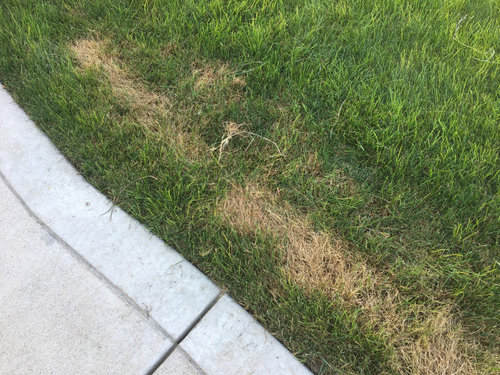
Been plagued with this for 3 years. Obviously disease. Not sure if Dollar Spot, Red Thread. Fungus sprays and treatments do nothing. Sometimes adding a little nitrogen helps.
It produces or might be caused by explosive undergrowth that needs power raking or aerating. I aerate twice a year though.
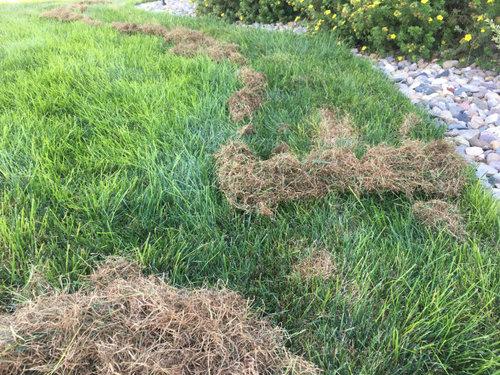
I'm in Northern Indiana. Kentucky / Bluegrass / Ryegrass mix. I water 2 maybe 3 times a week deeply in the morning, never overnight. I keep my blades sharp and decks clean of clutter. I just started cleaning them to stop spreading any of this. I fertilize 3-4 times a year, not even full dose and it's slow release.
This is just destroying my yard. When I power rake some patches just pull up at the root. I've dug in a few spots to check for grubs. Nothing.
Thanks.
Comments (22)
 6 years ago
That...doesn't look like a disease, actually. Does this show up every summer, usually around July when things get really hot?
What's your irrigation schedule and feeding schedule on this lawn, and when do you aerate and power rake this for thatch, if you do?
D V thanked UserD V
Original Author6 years agolast modified: 6 years agoYes, it's come last few years. Irrigation is not set to auto. If it rains heavy I leave it off a few days. If no rain I water deep maybe 2 times a week, maybe a 3rd if it is scorching hot. Feeding is early spring with crabgrass preventer, late Spring with nitrogen for growth, once in Fall and right before winter. I usually don't give it a full dose. I can say each time I hit it with fertilizer it looks hungry and growth is slow. I used to only aerate in the Fall, but I've started having to do it in the Spring as well. Power raking is just in spots, Whole lawn needs it, but I usually just aerate so I don't tear up the roots. Hate the thought of aerating a third time a year. But the undergrowth or dead material just chokes everything out.
PS: If it's not disease can you help me figure out why it's in streaks the direction I mow? Thanks.Related Professionals
Kansas City Landscape Architects & Landscape Designers · Bennington Landscape Architects & Landscape Designers · Santa Fe Landscape Architects & Landscape Designers · Gaithersburg Landscape Contractors · Greenville Landscape Contractors · Williamsburg Landscape Contractors · Ogden Landscape Contractors · Sedalia Home Builders · Jackson Home Builders · Rocky Mount Home Builders · Charlottesville Home Builders · New Bedford Home Builders · Gallup Home Builders · Pocatello Home Builders · Cornwall Home Builders 6 years ago
I get a strong sense that you are loving your lawn to death.
Why do you think you have to aerate in the fall and in the spring? My experience with aerating was that it did nothing...at all.
Why do you think it needs to be power raked? Do you think it's thatchy?
Define deep with respect to your watering. Does that mean a full 15 minutes? Longer? Have you done a can test for the sprinklers?
As for the streak of dead grass in the first picture, what is the profile of the soil right there? Is that a low spot, high spot, or perfectly level with the rest of the soil out to the concrete?
Have you ever used organic fertilizer?
D V
Original Author6 years agoI always used to just aerate in the Fall. The past two years I did it in the Spring because of heavy thatch build up. I have no way of bagging all the thatch. In the Spring when I aerate then fertilize the grass looks great, grows well, but by July it is choked out by thatch again. You would think maybe this is over fertilizing, but I don't fertilize to the recommended amount and I try to only fertilize when I can tell the gras growth has slowed and looks hungry / discolored.
I think it needs to be power raked because with all the thatch I don't think water or nutrients are getting to the ground.
Watering. I have 4 zones. The front two are medium size and back two are large. Totally is between .5 - .75 acre. Front two zones about 30 minutes or more each. Back two zones about an hour each.
Never used organic fertilizer.
The streak is all the way around the house. I suspect the streak is due to a faulty Edgegaurd on my spreader. I think the thatch is coincidental because that is all over the lawn. So I think the streak may be solved, now only to solve the thatch.
My last lawn I fertlized twice a year, Spring and Fall and sometimes in the Summer if it was hungry. This new lot the soil is totally different. The guy who put my lawn in came by to do a neighbor's yard one day a few summers ago and came over and said, "You know your lawn is starving to death, right?" And he fertilized it for me.
About two years ago I had a lawn company do my yard. They had a 5 step plan which I thought was too much. After one of their treatments I started noticing issues. I had a few thin spots and they came and overseeded. Don't know if they might have overseeded way too much, but that was like 2 years ago.
So I'm wondering if I need to do early Spring with pre-emergence, a light Summer application if it's starving and then just winterizer. I've tried the nitrogen and other nutrient home test kits and they never work.
- 6 years ago
Yeah, that thatch is the sign of a misbalanced micro-herd (the bacteria and fungi in the soil), probably from repeatedly trying to kill a disease that doesn't exist. The marks are characteristic of a dry spot from being near pavement and the pitch does look a bit different from the surrounding grass as well.
Feeding organically--in spring, particularly--would help.
Lawns should only rarely need aeration, if ever. Mine's never seen an aerator since I have quadrillions of living ones doing the work for me. That takes some years to get going, but works better than the mechanical ones.
And definitely never fertilize in summer on a northern lawn. It's only going to go to more thatch buildup and, if you do have any tendency toward diseases, make them worse.
If you want to go with a soil test, use Logan Labs. Home test kits are useless, tell you very little (pH? That's...interesting, but exactly what is that pH composed of and what is one supposed to add to fix it?), and are notoriously inaccurate even in the hands of those who think they're accurate. - 6 years ago
Are you sure you know what thatch is? It is not simply built up grass clippings. You need to take a shovel and push aside a cross section so that you can see the transition between the grass and soil. That's how you see thatch.
D V
Original Author6 years agoSo where does one get organic fertilizer then? I did a Google search in my area and found nothing. Also, unfortunately I applied regular fertilizer about a week or two ago because in the past during disease outbreaks I had better success with it than fungicides which are $$$ and gave me limited results. So I guess I messed up adding fertilizer , but I didn't know. It was before this thread. THANKS.
 6 years ago
Seed meals - corn, soybean, etc. - and other organic products that work as ferts bit not necessarily sold expressly for that purpose (alfalfa meal or pellets) are usually available at feed stores or farm supply outfits.
D V thanked gardengal48 (PNW Z8/9)D V
Original Author6 years agolast modified: 6 years agoAnd these will grow the lawn, but what about pre-emergence in the Spring and weed control and winterizing. WIll they do anything for those?Plus will these plant like weeds and start corn or soy plants in the grass?
- 6 years ago
Not as a general rule, although, amusingly, there's occasionally a corn plant starting here or there. Soy, never, you get it post the soy oil process.
You'll need to use a pre-emergent separately--as one should do anyway as we tend to discourage combination products as being timed incorrectly--to control weeds. Which one is up to you. I like Prodiamine, sprayed, in early fall at the high rate to control P. annua, which is a problem in my lawn. It also controls crabgrass as I can spray at the 9-month control level and winters simply don't count. Long story, though.
Alfalfa is also a bit of a long story and should be limited to around 20 pounds per thousand square feet per year, not really enough to fully feed the lawn. Soybean meal tends to be the recommended heavy-hitter for that purpose. Corn is also a more speciality product for other purposes due to its low nitrogen levels, although there are no practical limits to the levels one can apply, cost and mass become their own limiters.Other options also include Milorganite (available at your local Big Box store), and several other Big Box options depending on where you live--generally pricier than grains, but also generally more available, but will vary by what they happen to have at the time. Right now, my local store features one based on spent brewer's grains and soybean meal. It's a little pricey, but not actually that bad for what you get.
However, if you fed already in summer, you already let the horse out of the barn, shot it several times, forced it to run the marathon, then kicked it when it lost before shooting it a few more times. Proverbially speaking. The above looked like mowing a bit short combined with a seasonal heat burn that would reverse in fall. Feeding just tends to make that worse, but it'll reverse naturally as the season turns.If you want to feed in September, I'd go organic and start the ball re-rolling in that direction, then do so again in October and late May next year. Keep a hands-off feeding policy next summer. Don't expect massive improvement, and see where it goes as the years wear on.
If you really wanted to get into it, there are other things to do but...in this case, it doesn't sound like this is something you want to become a hobby?  6 years agolast modified: 6 years ago
my thoughts are that burn is possibly due to the sidewalk and what's underneath the soil, if it is indeed recurring. More problematic, your pictures suggest a high level of poa trivialis contamination to my eyes. Especially affects those who water too frequently and through the summer. frequent core aeration can also affect spread.
D V
Original Author6 years agolast modified: 6 years agoBurn was due to the faulty edgeguard on my fertilizer spreader, like 99% sure of it. Removed thatch today. SERIOUS THATCH.
I like the idea of organic, but I don't have a way to spray pre-emergence and separate weed killer. I did a bunch of searching around locally and could not find anything organic at least not yet. There is one hardware store that has a guy who used to own a feed supply and greenhouse. I'll ask him.
So to recap, organic fertilizer just once in the Spring and Fall?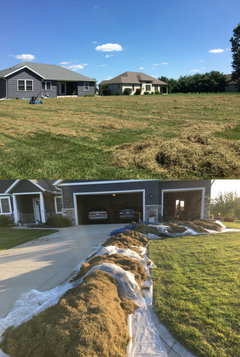
- 6 years ago
Yes, burn with synthetics is also common when applied in the (hot, dry) summer.
Application of fertilizers is spring and fall. To simplify the schedule:Memorial Day, Labor Day, October 1, and November (when you do the last mow). The first three can be organic. The last, November, feeding has to be synthetic (it's too cold for organics by that time).
You can purchase a spreadable pre-emergent like Dimension 0-0-7 (which does contain a tiny amount of potassium, which is fine) rather than spray. I simply choose to spray because I prefer to.
That is not thatch. That is the damaged leaf and accumulated leaf mass from inappropriate feeding, which would have decayed off when rains resumed, feeding the soil with its organic mass. Now it won't do that, you've just removed it from the soil's carbon cycle. Permanently. Which it does seem you do every summer. This also damaged the crowns of the grass, which are already stressed from being fed at the wrong time, and that are currently experiencing the end of summer.They'll recover. But the best advice for June, July, and up to August 15, is, "Mow, if necessary. Water, if you wish, deeply and infrequently. Treat disease if it crops up. And other than that, keep your hands off it."
If I did that on my lawn, I'd get about a fifth that (my microherd and worms are active), but also no thatch because my lawn doesn't develop thatch. And I have a much thatchier lawn than you do--the second-thatchiest grass, point in fact.
I also suspect a bit of a soil mis-balance, but start with the organics because I really don't want to deal with a soil test read this year yet.
- 6 years ago
Yes, I told DV 6 days ago that he probably does not know what thatch is. Some people come here for advice and then go ahead and do whatever they were going to do in the first place.
@DV: I don't think your lawn is going to be affected significantly one way or the other if you use organic fertilizer. If you can't get it don't obsess. You just removed at least a pound per ksf of natural organic fertilizer in the form of grass blades. If you water and fertilize at the right times and MULCH MOW the lawn I'm sure the lawn will look great. Oh, and do what morpheus says! - 6 years ago
Andy always calls that "BBDL" or, "Brown Blades Down Low." We all get it, and the longer the grass, the browner the blades down low and the more of them.
Right now, my BBDL reaches to the top of the lawn in some areas as I have dormant patches, although fewer than I did last week after nine inches of rain since last Sunday. Seriously. We got 2" just out of one day's rain, 5" from a tropical storm, then another 2" just from another day's rain.
I had to mow.
Right now, other than that, I'm pretty much ignoring the lawn, though. I dropped the organic feeding (early, but I use a pure grain, so early is fine; it won't be available until after Labor Day anyway).
"Some people come here for advice and then go ahead and do whatever they were going to do in the first place."Yep.
Amusingly, a lot will ask advice, then go to the Home Depot, and take the advice of the guy there. Then come back to me and complain that their lawn does not look like mine yet again. When questioned, the fact that they followed Ted's advice from HD comes up.
"So what does Ted's lawn look like?"
"I don't know."
The wiggled eyebrows are usually met with a confused look as the logic flash never seems to connect. D V
Original Author6 years agoWell I appreciate all the advice. I'd like to switch to organics IF I can find them and IF I can afford them. So far what I've found on Amazon and such are 3-6X synthetic. I'm hoping this guy who used to own a greenhouse has a connection to affordable, local organic fertilizer. As far as not taking advice and doing whatever, it's been a tough summer dealing with COVID problems and our home having water and mold damage. I'd like to do everything everyone tells me, sometimes it comes down to trying to pick the best advice I can and doing what I can. I've had all sorts of different opinions on this issue from various forums. But again, my takeaway here is I need to do organics. I'm going to do my best to make that switch except for winterizer and also try and find the pre-emergent mentioned. Thanks.
D V
Original Author6 years agoBy the way, morpheuspa (6B/7A, E. PA), when you say it isn't thatch, you're the expert, but whole sections of my yard were dying out. If I power raked sections of that stuff out those sections sprang back to life within about a week. If I aerated those sections like earlier this Spring, they sprang back to life. My neighbor came over and told me same thing in his yard. Whatever that layer was technically it seemed to block all nutrients and moisture from going down deep or choked the growing grass. The other thing it did was seem to matte everything up so that disease spread more quickly. I guess it doesn't matter now since the deed is done. I'll try to follow your organic fertilizing Memorial Day, Labor Day, October 1, and November (last mow synthetic).
1. Would cooler Indiana weather skew that a bit? We usually fertilize step 1 around when the ground has been 50 degrees a few days. That is traditionally late March/ Early April with pre-emergence. 2nd treatment with weed control is usually late May. 3rd is usually mid to late July. Then the Fall ones are late Sept/early Oct and Winterizer in November.
2. Where do you get Dimension 0-0-7 and when do you use it?
Thanks.- 6 years ago
1) The feeding schedule is pretty inflexible from the Texas-Oklahoma border to the Maine-Canada border (northern lawns, so to say). For pre-emergent application, it does change year to year and locale to locale. We usually say to drop pre-emergent for crabgrass and spring weeds when the forsythia (that yellow spring shrub) blooms. That'll be as soil temperatures are rising past fifty--although it's a rough estimate at best.
Personally, I use a different chemistry and different timing, but there are multiple ways of doing things, multiple types of weeds, and multiple times of application depending on what you want. I'm giving you the spring/early summer coverage.
2) Most big box stores (Home Depot, Lowe's, but it's going to depend on what's local to you in your area...Tractor Supply for some folks, too, and I'm not very familiar with a lot of midwestern stores). And use it when those forsythia blossom in spring, or, really, any time in spring. Later application can be useful to suppress summer crabgrass, or you can use it when the forsythia blossom (probably around April 10 for you) and again around June 10 to cover the crabgrass. Using it twice a season should be OK, but check the bag.
No number) Yes, raking out the dead lower grasses and watering will bring the lawn back and force the issue. It forces the lawn back out of its summer slowdown and natural slump to repair the root and crown damage that was just done. Seriously, lawns want to slow down during summer. Where they're native, the high plains, they turn into brown, blasted stands of what looks like wheat. Which is unsurprising as wheat is related.
I don't think I posted this...er, these...photos. From last week, the absolute end of what I always call High Summer, and today, really into Solar Fall (which started August 5th) and the point where our summer turns to Late Summer. Temperatures begin to fall off their highs, rainfall increases, and we turn back to the temperate rainforest we seem to want to become lately.
At my feet there's the blasted area (the southwest of the lawn). It hasn't rained in two weeks at this point, with little rain for the two weeks before then. The month before that wasn't rainy either The gardens look OK because they're irrigated. The lawn is on its own as I don't water it ever. You can see the spotty dormant areas to the right as well, where the house reflects sunlight, and the deeper greens to the left where the Thuja shadow the grasses.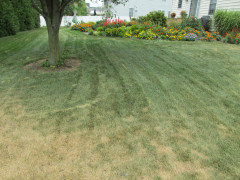
Two weeks and nine inches of rainfall later (a tropical storm, two days of thunderstorms...) Lower temperatures as well, in the eighties. The blasted area hasn't woken up and won't until September when temperatures fall further and it's certain that dry weather won't return--dormancy costs a ton of energy. Doing it twice can be fatal. The gardens are hitting their peak for the year, which is not spectacular in any sense.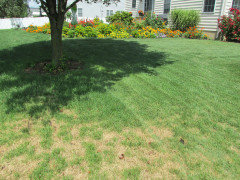
- 6 years ago
DV it is confusing. Sometimes you have to learn by doing, but you still need the voice of experience. You thought triggering growth in August by raking was good and morpheus described why it really isn't.
I'm just saying let's at least get the terminology straight. Look up "thatch." It is not dead grass. It is matted root mass that forms between the surface and the soil, sometimes caused by frequent shallow watering. If you stick a shovel in the ground, lift up a little while pushing it forward and remove the shovel, you will see a profile of the roots and soil. Even then it can be difficult to tell what is harmful thatch and what is a good mass of healthy roots.
Have you looked for biosolids like milorganite? There might be a municipal waste center in your area that sells it. In NJ we have Oceangro. See if you can find that on google as it can be quite cheap. Soybean meal is actually more expensive in my area or else I'd use more of that. - 6 years ago
As I think about it, I've been a bit unfair and I apologize. I've been dealing with my own sh...er, crap-storm relating to the COVID disaster these last couple months and I was a little short with you here, DV. I'm sorry.
Yeah, getting out to get stuff is a real PITA right now. If you can't, you can't, and that's that. I'm dealing with that as well. If it can't be delivered to our door or picked up on our once-monthly required trip to the grocery store, we don't get it. Period.
Home Depot does deliver--for free on orders over $45--as does Lowe's although I'm not familiar with their policy. They sell Milorganite, which is a very good organic, if a tad pricier than a straight grain.
HD sells Organic Plus Lawn Food. It's rather pricey, but would do: https://www.homedepot.com/p/Kellogg-Garden-Organics-20-lbs-Organics-Lawn-Food-3011/204701381
Also, Purely Organic, a better deal: https://www.homedepot.com/p/Purely-Organic-Products-25-lb-Lawn-Food-Fertilizer-LFJRDK1/204279747
I've used the Purely Organic, it's a pretty good choice. Milo is better, but often can't be delivered due to the bag weight (36 pounds is over the weight limit for a box).Curb side delivery might be another option; they'll deliver it to you at the curb at the store, you load it into your car, the delivery is reasonably contactless.
If price is an option this year due to the fact that these are out of line with soybean meal (I pay about $15 per 50 pounds at a grain mill), I get that.I'm at-least-currently unemployed due to this crap and watching a completely incompetent House, idiotic Senate, and intransigent President argue like four-year-olds as the economy slides into free-fall. I'm sure not spending anything non-essential as my current income covers only essentials and I'm not counting on being recalled to work.
So pardon me, please, if I seem a bit stressed at times.




dchall_san_antonio