

Pro style range hood selection
Hi everyone! I think I am pretty set on the appliances and layout of my kitchen, but the range hood is giving me some challenges finding what I want.
It will hang over a Bluestar 36" RNB range with four burners and 12 inch griddle, with max output rated at 113,000 BTUs.
I am looking for a wall mounted "pro" style wall hood, all stainless, 42 inches wide, 18 inches tall and I would prefer 24 inch depth but could go 27 inches if necessary. Ceiling height is 8 feet. I would like to use a roof mounted remote blower to reduce noise as much as possible. I can accommodate 10 inch round duct but it will need to make two 90 degree bends along the exhaust run, with total linear length of 11 feet. I can also accommodate an 8 inch round duct for make up air.
My ideal range would be 42 inches wide, 18 inches tall, 24 inches deep with removable and dishwasher safe baffles, infinite adjustment for motor speed and light dimming, and two heat lamps for stainless wire shelves I will be installing on the back splash. The closest I have found so far is Wolf, which seems to have all of those specs but in a 27 inch depth, but not sure if its strange to have a Wolf hood over a Bluestar range. Another option, local for me, is Prestige which seems to have all of those things except the heat lamps. If they offer heat lamps I would go like to go with them for sure. I reached out to them but haven't heard back yet.
Any thoughts or potential products that could work for me would be greatly appreciated.
Thanks!
Comments (46)
 6 years ago
24 inches front-to-back will perform well if the hottest greasiest cooking is performed on rear burners.
A silencer in the duct path will lower blade-tip turbulence noise from the blower and duct turbulence noise from between the silencer and the blower. (Note that with VaH the blowers are in the hood and no silencing is possible. Also, they aren't "Pro" style because that requires some emulation of commercial hood characteristics in the design.)
My Wolf hood came with a stick-on emblem, so if that is still true you could just leave it off.
Be sure to read the hood threads here and get enough blower for your hood aperture area.
Also read MUA threads here for perspective. There is much that needs to be considered when establishing the flow-down of MUA requirements to actual construction.
Related Professionals
Mobile General Contractors · Macon General Contractors · Saint Marys General Contractors · Jonesboro Home Remodeling · Queens Home Remodeling · Wilmington Bathroom Remodelers · Bangor Bathroom Remodelers · Santa Barbara Kitchen Remodelers · Denver Kitchen Remodelers · Marietta Kitchen & Bathroom Designers · Kalamazoo Kitchen & Bathroom Designers · Seattle Kitchen & Bathroom Designers · Decatur Kitchen Remodelers · Louisville Custom Countertops · Toms River Custom CountertopsDave H
Original Author6 years agoYes I saw on Ventahood's website they have remote blowers but everything I look at on the hood side shows integrated blowers which I do not want.
My setup will look something like this, with no HVAC system to hook up to for the make up air. The make up air vent can be about 2-3 feet to the side of the hood at the top of the wall.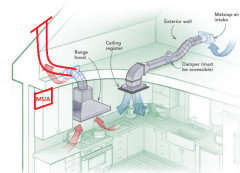
This is an old leaky house so per the calculations I have done the make up air doesn't fully have to account for the CFMs of the blower, but I would still like to provide as much capacity as possible and over engineer the capacity if possible. There is also easy access for maintenance and updates on the opposite side of the wall where the hood and make up air vent will be mounted since its the attic of an addition. Neither hood nor make up air will open to the attic, the ducts will just pass through to get to the roof.- 6 years ago
If dumped close to the hood, MUA should exit via a diffuser aimed away from the hood so as to minimize turbulence and drafts at the hood . If some distance from the hood such that the flow can expand and become more laminar-like, then the diffuser can aim at the hood. See Hart & Cooley for a vast scope of designs.
It is desirable that any MUA deficit not lower house pressure such as to significantly degrade the hood blower's performance. It is critical that any MUA deficit not lower the house pressure such as to back-draft any combustion appliances. If present, they should be defined here with respect to type and whether connected to the kitchen air or supplied with their own MUA.
- 6 years agolast modified: 6 years ago
Your Bluestar dealer did not give you any suggestions?
Dave H
Original Author6 years agoI went to four retailers on Friday and none seemed to know anything about ventilation, and most didn't know much about the Bluestar. After that I've been trying to reach out to the manufacturer directly and hopefully get some answers this week.
- 6 years ago
For perspective from the commercial side (that "Pro" residential equipment hopes to achieve), see https://www.tagengineering.ca/wp-content/uploads/2015/02/KVSApplDesign_catalog.pdf The first dozen pages or so should be sufficient for the big picture.
The California Air Resources Board has publications related to commercial kitchen venting.
For a partially complete but needing reorganization initial attempt at a revised FAQ, see https://www.houzz.com/discussions/5161173/hood-faq
Some of my and others' comments in other threads may prove useful.
- 6 years agolast modified: 6 years ago
As kaseki alludes to, you don't want to introduce MUA in a manner that short circuits the air flow and never assists in cooking fume capture. Dumping it right next to the hood is a bad idea. Better to introduce across the room (if it has to be at ceiling level) or at the toe kick.
- 6 years agolast modified: 6 years ago
... or at the toe kick if everyone wears socks. (Fixed it for you, Michelle.) The OP intends to use unheated MUA, as I recall.
More importantly, in a year or so earlier thread, a toe kick issue was raised where the air from a toe kick MUA register reflected off of facing cabinets and caused a lot of turbulence at the cooktop, resulting in plume spillage. Use toe kicks if necessary only under cabinets somewhat distant from the cooktop. Normally, MUA taken from the roof would more naturally be fed to the ceiling; MUA taken from a basement fed exterior cap would more naturally be fed to toe kick areas, and MUA fed through a wall to a mud room or such would naturally be fed to a wall area.
Dave H
Original Author6 years agoThank you everyone! This is a huge help. After some of your referenced reading and ideas I came up with a new plan using two 3.25x10 ducts going down through the walls to either side of the range, where I can come out of the wall near the floor. This gives 65 square inches of duct area for the make up air, larger than an 8 inch round, and also deposits it right under the range, behind the cabinets on either side.
If I needed to I may be able to fit a third 3.25x10 duct behind the center of the range itself which would exceed a 10 inch round duct equivalent, it would just be rough to fit the angle under the 10 inch round hood exhaust duct.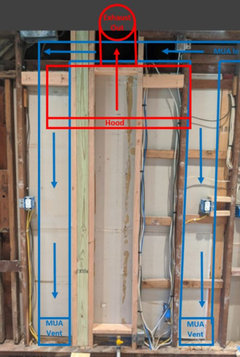
To do this I just have to move a wall outlet and some drywall blocking out of the way. Does this seem like a promising idea?- 6 years agolast modified: 6 years ago
How cold does it get where you live?
Generally, spreading out the MUA in this manner should help, although I would use a ceiling diffuser and aim it away from the cooktop if the ceiling framing was in the budget. One thing to think about is that if the MUA is very cold, moisture could condense on the outsides of the ducts going down. (It could also condense on a ceiling diffuser if the MUA is unheated.) A second issue that comes to mind is that there was a report here of a residential range manufacturer objecting to dumping MUA into the space under the range. I don't know the reason.
Dave H
Original Author6 years agolast modified: 6 years agoIn in the Philadelphia area, average low below freezing about three months per year.
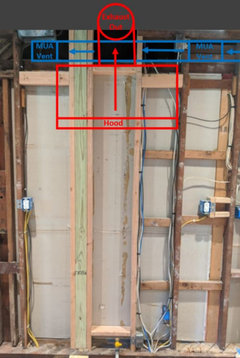
A ceiling diffuser isn't an option due to joist orientation but I could do two wall diffusers all the way up touching the ceiling on either side of the hood in the same locations as shown for the floor registers, the left side would have to be slightly smaller though, and it would restrict me to a 42 inch hood for sure.
- 6 years ago
If the diffusers are vaned, and the vanes either pointed away from the hood or to direct the flow along the ceiling, then I don't think there would be much turbulence below the hood, and the draft on the cook would be somewhat closer to room temperature as the MUA propagated into the room and back toward the hood. This would also shorten the fairly narrow ducting, which will have more resistance than one might think using just cross-sectional area as a measure.
Dave H
Original Author6 years agoExcellent, that will make it easier. I could have an 8 inch round to the right and an 6 inch round to the left for a 10 inch round equivalent matching the exhaust. Its ok for me to use regular insulated flex duct for the make up air run, correct? That would make this even easier... The ventilation ducting will all be rigid.
Dave H
Original Author6 years agoGoing into specifics of the system, if I do go with the Wolf pro wall hood in 42 inch length and 27 inch depth, should I go with a remote blower like they sell, which would either be 1200 CFM or 1500 CFM, or an inline blower from Fantech FKD 10 XL, which would be 1267 CFM. Then would either one of these solutions pair with the Fantech MUAS 1200 make up air system?
I am figuring I could go with the Fantech for at least make up air and pre-run wire that could support an in line heater, which I could add later if it gets uncomfortable. I need to run a line for a NEMA 14-50 receptacle through that space anyway, and I assume 50 amps / 250 V would be sufficient for a heater as well as long as it wasn't used at the same time as charging my car. 6 years ago
Dave, we just installed our 48" range hood yesterday, and our make up air isn't fully wired in. It will be also a passive one, with 10" ducts both ways...that is what the inspector said that they look for...matching duct size and dampers in both ends. Ours will dump from ceiling about 15' from the range into an open space. We will use insulated flex duct for MUA but the hood duct is rigid. I tested the hood last night (to see if broccoli soup really does not stink up the house anymore) and cracked a window open for a temporary MUA. Good luck!
Dave H thanked lucky998877Dave H
Original Author6 years agoThank you lucky! That sounds similar to my layout with 10" duct in and 10" duct out. For the MUA wiring are your referring to the damper?
I would love to just use a passive MUA system but I am concerned about my wood burning fireplace, which I anticipate being used the same time as the ventilation at least on holidays. I would rather go too far than not go far enough, especially when any additional retrofits would require tearing my new kitchen apart....- 6 years agolast modified: 6 years ago
A few comments to the various points added above:
- Flex should be OK for MUA; after all it is not getting greasy and it is not filing with lint.
- For the hood blower, take the aperture area in square feet, multiply by 90 to find desired volumetric air flow. Multiply by a further 1.5 to find the blower rated flow rate (zero static pressure flow rate on the fan curve).
- Is the MUA active (with blower) or passive (no blower)?
- Find heating power (BTUh) needed from this graph (use actual/required flow rate, not blower rated flow rate) (click to enlarge):

- Find electrical power (W) by multiplying by 0.293. (This is just simple formulaic physics and doesn't account for any heat leakage or secondary effects of air density changes.) Divide by your likely voltage to get amperes.
- Fireplaces can have very low back-draft pressures, depending on chimney height, house and terrain features, and how hot the fire is. Back-draft pressures as low as 3 Pa have been asserted. (1 Pa = 0.004 inch w.c.) This is a very small differential pressure that would be difficult to measure due to wind affecting the exterior sensor, among other factors, even if the sensor is enclosed by a vented part of the house, e.g., the attic. You may need an active MUA for tight control. Whether it can control itself this close to zero pressure difference or should be set for slightly positive pressure will depend on too many variables for me to speculate upon. I don't know the nitty-gritty details of Fantech's MUA solutions.
- Wiring should account for the MUA heating and MUA flow control being on separate breakers unless an integrated system is used. See example MUA unit in this image:

- MUA air intake should be at least 10 ft from the hood blower, lower on the roof if possible, and in the direction of the prevailing wind relative to the hood blower.
kas
Dave H
Original Author6 years agoThank you kas! The system is starting to take shape. I am thinking the Fantech 1200 MUA system should work well for me, but I would like to know if this system works with Wolf's hood and remote and/or in line blowers, or would I also have to get a Fantech blower? It looks like the MUA system has to take inputs from the exhaust blower to match flow rate appropriately. It looks like Fantech has a couple of options for a 10" duct exhaust blower in the 1200 CFM range although once getting into the options labeled "electronically commutated" the options get more limited.
- 6 years agolast modified: 6 years ago
If Fantech MUA needs data from the hood system blower, then likely you should use the Fantech hood exhaust blower. However, the Wolf hood-mounted control for this blower may or may not be compatible with the control for the Wolf/Broan (induction motor) blowers. On my Wolf (made by Independent ca. 2007), the blower control is a simple diac/triac control such as a bazillion 20th century GE technotes describe. You need to contact Fantech on this point.
It is possible that their control can be inserted into the hood control volume. It is also possible that Fantech have a differential pressure control system that allows multiple exhaust fans (and fireplaces) to operate independently and doesn't require connection to the hood system blower. In that case, a Wolf/Broan, Abbaka, or a Fantech blower may be used (to name three).
If a Fantech hood-system motor blower is used and has the 10 Vdc control feature, then it would not be difficult for an electronic tech or engineer to modify the Wolf hood control electronics to provide the needed signal in lieu of the supplied phase chopped 120 Vac motor power feed.
Dave H thanked kaseki - 6 years agolast modified: 6 years ago
Dave,
I have a heated fantech MUA system with a Zephyr hood and there were no issues with being different brands. I believe the way it works is that it reads how much current your hood is drawing and then adjusts the flow rate accordingly. Your hood, however, may need to be on its own circuit. I noticed there were times where the MUA would come on very low if the hood lights and oven lights, but not the blower were turned on. Once we moved the range to its own circuit the problem went away.
My HVAC guy said Fantech was really good with providing support for the installation as this was his first residential install of MUA. He also commented that the Fantech would probably outlast everything else in the house.
Dave H
Original Author6 years agoExcellent to hear Paul, thank you! I think I will just go that way for simplicity sake. Of the hoods I have seen go with the Wolf 42" with 27" duct and remote 1200 CFM blower, and then the Fantech 1200 CFM make up air system. Thank you everyone!
 6 years agolast modified: 6 years ago
kaseki,
Does the blower speed control on your Wolf hood control the speed/CFM of the Wolf 1500 CFM blower continuously from maximum down to zero output?
The reason I ask is that the Wolf 1500 CFM remote blower appears to be identical to the Best by Broan EB15 as well as the Broan/NuTone 336.
On the Broan/NuTone 336 web page (https://www.broan-nutone.com/en-us/accessory/336?bvstate=pg:2/ct:q), in the Q/A section, the manufacturer states that the blower can be speed controlled between 1500 CFM and approximately 750 CFM:
------------------------
"NuToneCustomerService-5 years ago
Thank you for your question on the model 336 externally mounted exhaust fan. The 336 is designed to be used with a solid state speed control so you can vary the speeds and CFM from 1500 CFM down to approximately 750 CFM."
------------------------
I am considering purchase of a 42" Wolf Pro Island hood with the 1500 CFM remote blower and would like to have the option of running the blower at less than half speed.
- 6 years ago
There is an element of deliberateness in having a minimum blower speed that is relatively high. For baffles to perform their grease collecting function, there is a minimum air velocity in the double U-turn baffle scheme that will perform centrifugal extraction.
There is also the issue of turning on the blower with the control and turning the control to minimum immediately; this may make motor starting difficult if minimum is too minimal.
I have measured air velocities under my Wolf hood from my 1500 CFM Wolf/Broan-NuTone roof blower with passive and filtered MUA and no other exhaust fans operating and believe that the approximate volumetric air flow is 1200 CFM at full power and 400 CFM at minimum power. (See my comment approximately half-way down the Hood FAQ started by @opaone.) (https://www.houzz.com/discussions/5161173/hood-faq#n=67)
Note that my Pro Island hood is the largest size and has a 10 square foot entry aperture. Yours would be only 7 square feet and likely can use a smaller blower unless you have a particularly restrictive (higher pressure loss) duct path or MUA path.
The Fantech motors operating with 10V control signals likely have multipole motors driven by synthesized waveforms with pole position feedback (I'm speculating here). Like their historical antecedent -- the dc torque motor -- they may well operate to near zero RPM due to having high torque over the speed range.
What is your purpose in being able to operate near or at zero RPM with the control on?
Dave H
Original Author6 years agoThe Fantech MUAS 1200 arrived last week, and the Broan 335 should be arriving by Friday. I'm excited to get it all set up but unfortunately the hood itself is backordered until the end of October. Hopefully I can get it all up and running in the next month!
- 6 years ago
Dave H, will you please revive this post once you are up and running? I'm not ready for a reno, but plan on the same Bluestar configuration.
I've read many discussions, but still have a hard time grasping how the MUA is installed (and possibly heated) if there is no HVAC ducting to tap into, and how remote blowers are situated outside. (Not to hijack, but range on outside wall, 2 story house, can't go thru ceiling).
Every now and then I go back to that hood post but it's beyond me. Any links to MUA for dummies appreciated. Thanks to all who continue to give advice on this subject. Dave H
Original Author6 years agoCertainly! Will do.
My layout is a little unique where my range is against the old exterior wall of the house, but a previous owner built an addition on the other side of the wall with a pretty spacious attic. So I can install all make up air and ventilation equipment in that attic with some room to spare.
the Fantech system isn't small, you really need an attic/basement/crawlspace to be able to fit everything.
 6 years ago
@TBL from CT, is this an older house w/ a boiler?
There are a number of options for conditioning MUA. Electro Industries and others make MUA's with built-in electric heat and separate inline duct heaters. If you do have a boiler then hydronic duct heaters are a good option. There are also gas fired MUA's and duct heaters. Likewise there are a variety of cooling options from mini-split type systems to evaporative chillers.
If your house lacks ducting then you've a few options. It can simply ducted in to the nearest conditioned space. Ideally though it'd be ducted in to the kitchen or very close.
A good HVAC person (difficult to find in the U.S.) can steer you in the right direction.
- 6 years ago
opaone, it is an older home with a 30 yr old oil fired hot air furnace w AC. So, there's ducting, but I can't imagine opening walls to access it. House is not yet purchased and I've never had a hot air system.
Now I'm a hijacker.
"A good HVAC person (difficult to find in the U.S.) can steer you in the right direction." This is the problem. I want to educate myself so I can choose someone who knows what they're doing. It's small town New England, so few choices.
Can anyone direct me to simple diagrams illustrating how MUA works and flows?
Once we close on this house, I'll start a discussion. Big concerns with what seems to be a very old 36"commercial Wolf range and a dinky hood. At least it directly exhausts out the back, but I'll be opening a window for a while. New furnace is prioritized but I don't know how all this should work together.
Thank you - 6 years ago
An MUA is simply a way of bring a lot of fresh outside air in to a house to replace the air being exhausted by the hood. This is better and much healthier than sucking the air through cracks in walls, windows and doors. It also improves the performance of your hood.
At its simplest then a MUA system is simply a bit of duct from outside to inside with an inline blower to pull fresh air inside. This air can be ducted to any number of places such as a hallway or in to the existing duct system of the home.
MUA's are typically located in the mechanical room with the furnace and AC.
- 6 years agolast modified: 6 years ago
kaseki,
The reason for wanting the option to be able to lower the blower speed below 750CFM is to be able to more easily address potential noise and MUA issues.
The reason for choosing the 1500 CFM blower is the possibility of higher than normal pressure loss in the ducts. Having an actual CFM range of between 400 to 1200 would be perfect. I am replacing an existing, poorly performing island hood (loud internal blower, flat bottom baffles with essentially no capture volume).
Here is a CAD rendering of the ducting for the existing hood:
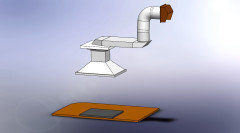
The 90 degree, round to rectangular transitions are Broan 424 hood to 10" round duct adapters (https://broan-nutone.com/en-us/accessory/424). I am using them on both ends of a short 4.5" x 18.5" rectangular duct that fully fits between the second floor joists (4x6's on 24" centers). This gets the duct to the exterior wall where it goes vertical into the corner of a second floor closet and then out to the vent cap that is high enough to clear the top of a carport roof. Note that the Broan 424's are mitered elbows which is the reason for the pressure loss concern.Here is a photo of the actual horizontal duct section during installation:
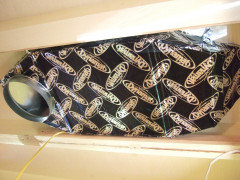
Here is the duct layout with relevant surrounding structures: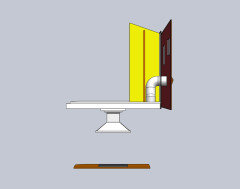
The replacement hood will be a Wolf 42" Pro Island with a Fantech LD 10 silencer placed vertically in the closet and the 1500 CFM blower mounted on the exterior wall.Here are some CAD renderings of it:
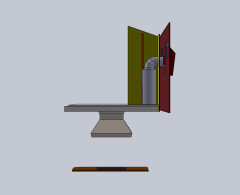
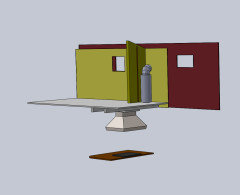

Any comments or suggestions that you might have would be great! - 6 years ago
Higher CFM is the wrong way to deal w/ both problems. You'll potentially end up with a very loud poorly performing system with a lot of turbulence and increasing grease buildup in your ducts.
You first need to calculate the static pressure of your duct system and then choose a blower with an appropriate fan curve to give you the resulting CFM's.
Two other things;
- Keep in mind that rectangular duct requires greater cross section volume than round duct for the same throughput.
- The transition above the hood is OK (Ideally you'd have round all the way but I'm assuming you can't fit a round in that space?). The other end has potential for a lot of noise, high static pressure and grease dumping turbulence. This one s/b a much smoother transition like perhaps curving the rectangular up and then transitioning to round.
- 6 years ago
According to the equivalent duct diameter rule of 4 times the sectional area divided by the perimeter, your rectangular duct is equivalent to a 7.2-inch circular duct.
If we take a WAG at the pressure losses at the likely actual flow rate, we might estimate 0.7 inches for the hood transitions and baffles, 0.05 to the circular duct and to each of the three bends [as if they were circular], and 0.1 to the rectangular section, then the total pressure loss with perfect MUA would be 1.0 inches (at 800 CFM). More exact numbers can be found on the Internet, but keep in mind that the values change with the flow rate so the analysis is a bit recursive, and you would have to contact Wolf for a pressure loss vs. flow plot of the relevant hood.
The Broan 336 can flow over 1100 CFM at the estimated pressure loss, so a lot of room will be available for error, the reality of your transition elbows, and MUA pressure loss. Operating at less than full power can also reduce noise and in this case still provide the 630 CFM you likely need for hot cooking.
You can wrap your duct (and silencer) in vibration absorbing material to further reduce blower motor noise propagated to the hood as duct vibration. I used auto body related "Q-Pads" available from your friendly auto parts store that deals with the trade, strapped on with long Ty-Raps.
If you want to change the limits on the blower control, that may be possible depending on how complex the circuitry has evolved to since Independent made my hood for Wolf. (My hood's diac/triac control may not be the lowest EMI bull in the rodeo and some force majeur might have imposed some changes since 2007.) Before installation, pulling the panel cover inside the hood above the controls and photographing the schematic that might be in there would be a good idea while the hood interior is easily accessed.
If the duct is to be covered by a chase in the closet, I would be sure to have a removable panel, and also plan on using some (preferably low in obnoxious fiberglass irritation) insulation between the duct/silencer and the chase internal surfaces.
 PRO6 years ago
You can also have a custom hood fabricated to your dimensions.
- 5 years ago
Dave H-sorry if I missed it. Did you use an internal or external blower? Did you look into silencers? Just learned of this form this post. Now I have more to look into!
TBL from MA- I am in western MA and in the same situation. All this MUA and hood choices are overwhelming! Every one has a different opinion. Thankfully my HVAC company seems to know a bit about MUA. Plus our house already has a system but I haven't fully understood it all yet. Dave H
Original Author5 years agoNo worries jas3150. I am using an external blower and also got a silencer from Fantech. I also have a silencer for the makeup air system, also from Fantech. Currently I have everything installed except for the hood itself, which I expect to received next Friday. Hoping I can have it all operational in the next two weeks.
- 5 years ago
Thanks for the reply! Would love if you could update how it goes and whether is is louder or quieter then you expected? I will be placing my order in a few weeks and have so much to decide. Thanks!
- 5 years ago
I'm going to go out on a sequoia limb and bet that when the air velocity into the hood is 100 ft/min (750 CFM for 7.5 sq. ft.), you can converse in a normal voice in front of the hood. The only unknown here is how much noisy turbulence the rectangular duct on the cook's side of the silencer generates. Otherwise, I expect you will hear mainly baffle hiss, just as I do with mine.
Dave H
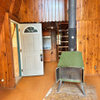
Original Author5 years agoThe hood and range are now installed and seem to be working very well! I was a bit nervous about the makeup air system since it is fairly complicated with a lot of parts and wire connections but it all worked the first time I powered it up. Just need some fine adjustments to balance the system. It moves a lot of air and is fairly quiet. There is still the duct cover to install on top of the hood, and the wall registers for the make up air ducts on either side.
No cooking yet, still need cabinets and counters, as well as plumbing, but its starting to look like a kitchen!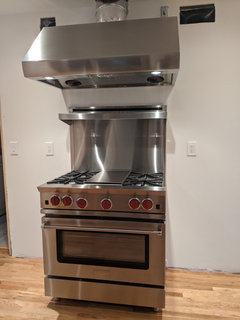
- 5 years ago
If those sheetrock holes are for the MUA, I recommend that you use diffusers (Cooley - Hart) with fins that can direct the airflow to skim the ceiling before the MUA falls into the overall room volume. You don't want turbulence close to the cooktop.
Dave H
Original Author5 years agoYep! I have some ready to go, thank you for all of your help in setting this up!
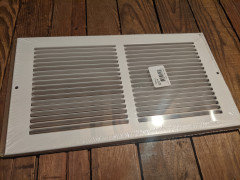
Dave H
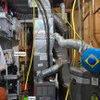
Original Author5 years agolast modified: 5 years agoAlso here is a shot behind the scenes. Still some final work to getting everything cleaned up and insulated but the hard part is over.
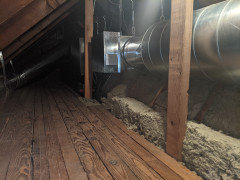
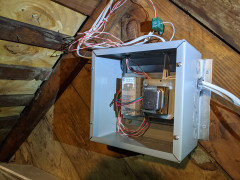
- 5 years agolast modified: 5 years ago
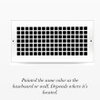
That is commonly called a register, not a diffuser, although some diffusion surely takes place. The device commonly called a diffuser has larger, fewer blades, and will be less turbulent on the output, more directional, and less restrictive. Examples start here:
https://www.hartandcooley.com/grilles-registers-and-diffusers-grd/commercial-grds/ceiling-diffusers
One specific type is this:
https://www.hartandcooley.com/products/are/aluminum-louvered-ceiling-diffuser-flat-margin
And within this collection, type 1L without damper would be my off-the-cuff suggestion as a relevant example.
https://www.hartandcooley.com/assets/files/59/sd-9303.pdf
Choosing will require more effort than I have put into it!!!
Generally, you can adjust the blades to flow near perpendicular to the face or variously off axis to parallel with the wall you mount it on. You may also find more applicable/aesthetic units. I can't tell if there is something about the physical shape that would preclude your using it on your wall interfacing with your ducts.
I have a 3 x 3 foot unit of this type on a hallway ceiling aimed to flow down the hallway toward the kitchen.





kaseki