Software
Houzz Logo Print
webuser_459768251

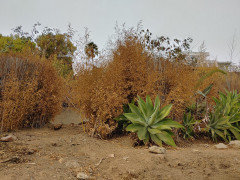
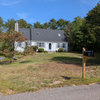
how should I maintain this backyard steep hill?

4 years ago
last modified: 4 years ago

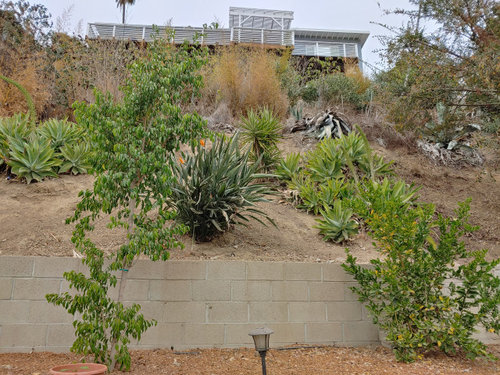
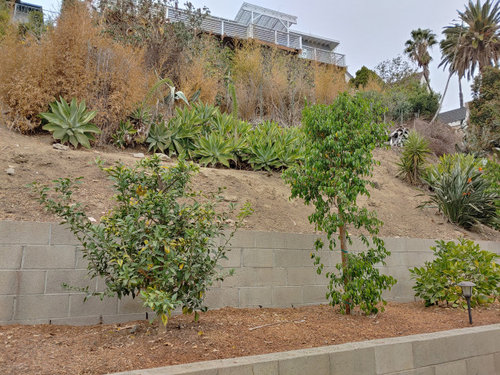
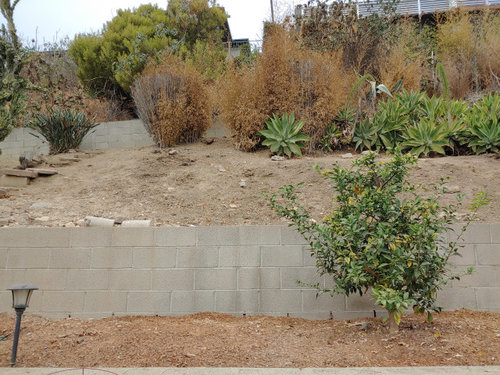
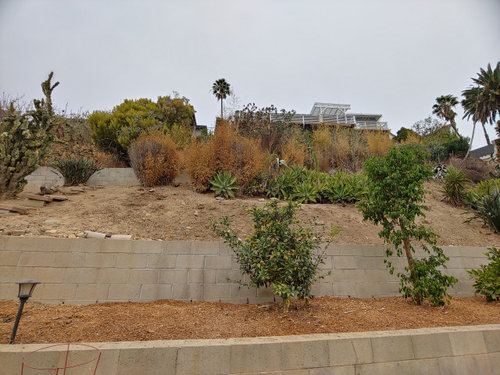
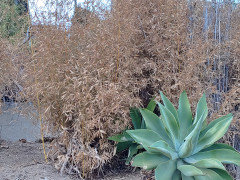
I I just moved into my home and have this upper hill area in my backyard that has a bunch of dried shrubs with desert plants and what appears to look like bamboo (probably isn't).
I don't really care to do designer landscaping up there. It's too steep for me to want to go there on a regular basis. What I do care is that the integrity of the hill is maintained so there's no landslides or anything like that (notice there's a house with their deck above mine above the hill).
Would you suggest I clean up any of these plants/shrubs or do something else?


Location: Los Angeles/Pasadena area in Southern California


Comments (40)

  • 4 years ago

    May we have your city and state for better recommendations? (If it's in your profile, sometimes some can see it and some can't).


    Overall, I can see some holes that might be improved, but there are some elements in there I kind of like. Off the cuff, I can suggest some rock gardening on the slope in a nice ochre color (or a white), and something to cover that wall, if you like--but what, precisely, would wait for your locale.


    Congratulations on your new home!

    Jin Duy thanked User
  • 4 years ago

    Can't tell well enough from the photos what might be dead or what is merely seasonally dormant so don't really have any suggestions on what needs to be removed.

    But a drought tolerant groundcover suitable for your area would help with slope stabilization. Will take a while to fill in and become dense and will require some irrigation during this establishment period. Something that roots as it spreads would be good.......like ice plant or chalk fingers.

    Jin Duy thanked gardengal48 (PNW Z8/9)
  • 4 years ago

    California, near Pasadena/Los Angeles

    if I were to seek professional help, would I just search for "landscaping" on yelp? I'm totally new to home ownership.

  • 4 years ago

    You could, or search for "landscaper Pasadena California" on Google.


    Personally, I'd ask the new neighbors. It would be a great icebreaker even if you don't end up taking their advice. Look at their plants. Ask what they are. Write it down, and ask about local nurseries. Get to know the folks (from eight to ten feet away...)


    Do you need a landscaper/designer? I'd say no, but... That depends on how confident you are doing this yourself. I couldn't put in or design my patio, preferred the landscaper handle the major plants, but did the more minor ones (and the year-on-year gardens) myself. I'm kinda the creative sort on weekends anyway, so...

    For a job like the above, as I said, I think you can do it yourself at the local nursery.

    Hint: Lincoln Avenue Nursery, 804 Lincoln Ave

    Armstrong Garden Centers, 352 East Glenarm St

    Bellefontaine Nursery, S Fair Oaks Ave


    ...just the first three off a quick Google search of your immediate area, Pasadena, California.


    Talk to them and, with the lists you'll get here (like yucca, ice plant, manzanita, blue-eyed grass, whatever, I'm partial to the penstemons you have, myself), see what you can source and check the tags. The people there will be a lot of help with what will actually work with what you have (microclimates can be a bit different than what we might think, no matter how expert we think we are--I get horrendous winds compared to the rest of the city, peculiar only to my part of it). Again, your neighbors can help you here.

    Planting a plant is easy, the instructions are usually on the tag. :-) Care will also be on it, or look it up on the Internet by searching "care of (plant name)." Or ask here.


    Seriously, this isn't astrophysics.

    Jin Duy thanked User
  • 4 years ago

    That does look like very crispy bamboo (it might come back with water but that doesn't mean you should let it). Is there an irrigation system up there that's been turned off? The other plants seem to be doing well without it.


    Just a wild guess, but perhaps the previous owner put in the bamboo hoping it would hide the house up the hill in spite of it needing more water than the other plants. I'd remove the bamboo and put in more of the low-water plants. On the lower levels, you'd put more "fun" plants like citrus and roses and things.


    Instead of Yelp, join your local "Next Door" website. And ask your neighbors--it's a good way to meet them anyway. Hmm...I guess that's trickier now that we are avoiding one another...

    Jin Duy thanked Fori
  • 4 years ago
    last modified: 4 years ago

    It looks like bamboo to me. Dried up and maybe dead bamboo. A closer picture would help. The water obviously was shut off during the change of ownership. I bet someone wanted to hide the deck overhead.

    To alleviate your fear of landslides and minimize the need for maintenance and for you to go up there, you need to cover the ground with plants. Desert plants are your friend.

    I see Bird of Paradise and Agave attenuata already planted. Plant a LOT more of that to cover the hill. You can get a LOT of divisions for new plants from what you already have. Plant a LOT of a cheap and easy to find aloe to fill in the rest.

    Cover the dirt completely with low to no spine desert plants. Yucca filamentosa and Hesperaloe parviflora would make nice additions to the mix.

    Jin Duy thanked Christopher CNC
  • 4 years ago

    The only thing that's going to provide reliable protection against slippage during a seasonal deluge is an effectively built architectural solution such as an additional wall, between the two that are already there.

  • 4 years ago

    There might not be a problem beyond needing tidying up. How long has the house been here? What do the slopes in the yards next door look like?


    Is there any reason to think the slope is actually unstable? It's likely mostly rock.

  • 4 years ago

    Here in PA, I've held an entire pretty severe slope just with common orange daylily. Now, Pasadena sure ain't Pennsylvania, and your rainfalls--and rare deluges--also aren't what we have to work with. So again, as always, check with local resources.

    As Fori noted, check to see how much topsoil you actually have. It may not be all that much to begin with. Or it could be a lot. Or that might be all rock with a wee bit of dust atop it. :-)


    After some thought:

    You'd want to look more for the above-mentioned groundcovers, and things with more surface-rooting and mat-like rooting. Self-spreading if possible, so you don't have to get spendy with it, and cheap to start with, xeriscape (not requiring much water).


    https://www.wildflower.org/expert/show.php?id=5037


    Here are a few initial suggestions, assuming decent soil. Check with local sources to see what they think (I've never lived nor gardened in Pasadena, but I'm sure some others have lived close and might help).

    Yes, yes, I never trust second-hand information. Unless somebody actually lived there and did it, my watchwords are "prove it." This causes the occasional problem and argument with the overly self-righteous, but heck with it. I'm a hands-on person unless there's no other choice. This is why I do my own chemistry experiments, half the time. :-)


    There's a repeater thread for Southern California here and a sloping hillside. From the description (the photo is long gone) the hill was a severe slope, which you really don't have. We should note that ice plants grow here in PA, too. Pretty, but they're right about the competitiveness--it doesn't compete well with weeds. That will be less of an issue in your area where rainfall is rarer.


    https://www.houzz.com/discussions/1936871/how-to-maintain-plant-this-sloping-hillside-ideas

  • 4 years ago

    @Christopher CNC Here are some closer photo attempts. If it helps I can take closer ones tomorrow (some drizzling today made me not want to climb up). Thank you for identifying the plant names. I'll check out your other suggestions. If you have any more, would love to hear about it! Thanks!


  • 4 years ago
    last modified: 4 years ago

    @User Thanks for the suggestions. Yeah I've been meaning to check with my neighbors for tips as well (just been tough b/c of social distancing). How do I check how much topsoil I have? Do I just dig with a shovel for a feet or 2 deep? I am guessing it's pretty deep because my neighbor has a sizeable tree.

    @Fori There's no irrigation system up there. I'm surprised the other plants are flourishing and are apparently very drought tolerant! I'm guessing the bamboo was up there for cover as well. Yeah, we plan to put citrus on the lower level.

    House has been here since the 1950s. I'm the 3rd owner. The second owner was here for only 4 years, so I don't think they did much upkeep at this level. When you say "tidying up", would you mean to get rid of all the bamboo and dead dried shrubs? I just hope I don't let things grow out of control.

    The slope looks like pure dirt to me, but that's just based on my inexperience eyes. The neighbor to my right has sizable trees which would imply the root goes somewhat deep I would guess.

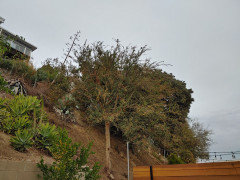
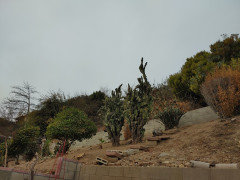
    Here are photos of my neighbors' hills to the right and left, respectively.


    Right: Sparsely covered with plants and mostly trees. Their hill seems more mulched and seems slightly steeper.


    Left: Some very large cacti. Small tree/shrub looking plant. I do see they have gardeners coming every month or so to chop away at these plants to keep them down in size. Noticeably more barren and visible dirt. Also their slope is lower than mine.


  • 4 years ago

    This is being answered on a cheap phone at a socially-distanced Christmas Eve party in the middle of a torrential rainstorm under an umbrella trying to look through wet glasses and a mask that's sliding. Please pardon any mistakes. :-) I should probably put it off but eh, I'm tired of having to yell to be heard from ten feet away (as close as I'll get) and tomorrow will be a zoo of Zoom calls.


    Yep, just dig down. When you hit hardpan (where you can't dig) or rock, that's your base. Trees can root in surprisingly little, most of their rooting is in the top six inches, but they go very, very wide. Those that throw taproots can drive em through rock in some cases, just a bit of a crack is needed.

    More-solid soils won't move easily in rains, but consistent rainfall can soften a soil, loosen it, and make it move like shaken Jello--see any good California mudslide for that one.

    There are easy ways to lighten and loosen soils chemically, but they're not really recommended in arid areas as you already have other considerations this will most likely make far worse, and I wouldn't do them in Pasadena. If I see them recommended here, I'll snap in with the chemical recommendation of "no" even if I have to contradict somebody (which is somehow not taken well in some cases).


    And now it's a minor thunderstorm, so I think we're packing it in.

  • 4 years ago

    I would determine the integrity and capacity of your retaining walls. How have they functioned during deluges? Where does the water go? I don’t see any weep holes. Are they vertical or leaning? Bowed anywhere? How old are they and who built them? More intel from neighbors on this too.. prior owners may be helpful. Often sellers reveal nothing helpful about a property fir fear of jeopardizing the sale but wil be forthcoming once it’s gone through. Good luck with everything going on in SoCal right now. As a New Yorker I know the horror.

    Jin Duy thanked kitasei2
  • 4 years ago

    I would indeed worry about the integrity of the slope during a rainstorm. California doesn’t get much rain but when you do, it’s a lot all at once. Get enough rain, then some of that slope could slide since there’s nothing there to stop it. You can either add a couple more retaining walls which is big bucks or add trees and big plants with root systems that would hold the slope together. Plantings will be the cheaper option but you’ll need an irrigation system to keep them alive. If you are able to build retaining walls, you’ll have the bonus of added terraced living space if you include stairs.

  • 4 years ago

    Yes that is dried up bamboo. It is not going to be happy without irrigation. If you have no plans to irrigate, just cut it to the ground. The lack of water will kill it off soon enough.

    The house has been there since the 50's. There are 3 retaining walls I can see. The threat of a landslide is rather remote. At best you would have some erosion from a hard rain because of all the bare ground.

    Tidy up means to remove the dead and unwanted plants for a cleaner slate for more planting. Common ordinary Aloe vera makes a nice thick groundcover and comes in a large yellow flower and smaller red flower form. In your part of the world I would think it would be easy to get by the garbage bag full.

    If you need some height to hide the house above, Pencil cactus, Euphorbia tirucalli (no thorns, not a cactus) and Spanish Bayonet, Yucca aloifolia, (careful -sharp leaf tips) are both small tree height.

    Cover the slope completely in big drifts of short, different colors and textures of desert plants and you will have something nice to look at with minimal maintenance and no water needed.

  • 4 years ago

    Have not read thru all the threads, but whatever you plant up there will need irrigation (at least at first), unless you are going with all xerics.

  • 4 years ago

    Your succulents look happy, so I would go with the desert look. Agaves, yuccas, aloes, cacti (there are opuntias with almost no thorns, if that's an issue for you) and some nice gravel with decorative boulders.

    It's amazing how gravel can tidy up a place immediately and add some color.

    Succulent roots grow right under the surface like spokes in a wheel, so they are good for keeping slopes in place.

    You can probably get away with no additional watering, other than the first year after planting, so no need to mess with irrigation and high water bills.

  • 4 years ago
    last modified: 4 years ago

    Remarkably destructive weather events and other unwelcome occurrences never are a problem until they happen.

    And anthropogenic climate change is resulting in things being different in big ways from what people around now are used to. So for instance maybe later this winter or next winter sometime Pasadena has the hardest and heaviest downpour ever recorded.

  • 4 years ago

    The best investment for you would be to hire the services of a landscape designer & specify you desire low maintenance, waterwise plants ( there are many appropriate for your area ). Money well spent.

  • 4 years ago

    You have several resources at your disposal. Descanso Gardens is a treasure of local gardening expertise as is the Huntington Library and Gardens. If you visit the Huntington gardens, don't be a fool and miss the library. Original artwork, famous stuff, is right there. Another resource is Cal Poly in Pomona. The university was built into a hillside and happens to be an agriculture research school. They are always trying something new. The road behind Encinitas Hall up to Los Olivos commons used to be bordered with an avocado orchard up the steep hill. Other hills were covered in ice plant and some in unmowed creeping red fescue. Just drive around the campus to see how they cover their hills. If you get out to walk, watch for poison ivy (ask me how I know).

    Example of avocados on a hill.

    Examples of ice plant on hills. If you use ice plant you will not be able to climb the hill once it is established. If you need to get up there, build some real steps into the hill.

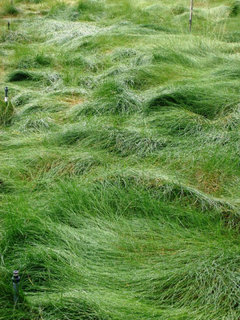
    Example of red fescue on a hill


    Jin Duy thanked dchall_san_antonio
  • 4 years ago

    It looks like you will have a lot of nice plant stakes once you get through that bamboo. :)


    Can anyone ID those 2 treesy-cactusy things downhill from the bird of paradise? Very interesting.


  • 4 years ago

    The '2 treesy-cactusy things downhill from the bird of paradise' are a Euphorbia of some sort. Possibly a contorted form of E. ammak.

  • 4 years ago

    Plant some native stuff that can tolerate that slope without any irrigation in the future. Arctostaphylos glandulosa, Artemisia californica, Ceanothus leucodermis, Quercus berberidifolia. Those droughts are not going away.

    Jin Duy thanked Skip1909
  • 4 years ago

    Oh boy that's xeriscaping if I ever saw it. Look on pinterest for xeriscaping lots of gorgeous plants grow perennial without water. Basket of gold comes to mind

  • 4 years ago

    Why would I go to Pintrest when I have Houzz?

  • 4 years ago

    Better photos, excellent tolerance for alternate but equally workable advice, they actually enforce their policies without playing obvious favorites or being completely lazy about it, a much wider subject base, a much larger user base, more on-tap experts....

  • 4 years ago

    Perfect spot for a bunch of manzanitas—low groundcover types, medium sized shrub types, and larger shrub / small tree form types. Many are ideal on slopes. They thrive on no water and neglect once established, after the first year. Iconic west coast plant that can't be grown in other parts of the country. Beautiful year round. Mix with some native grasses (festuca californica, festuca rubra, etc) and you're set! You'll never have to maintain or water! Email Greg at Xera Plants for recos, too. He's from California originally and now owns a wholesale and retail nursery in Portland, OR. He's a manzanita and low/no water expert, and is extremely friendly and helpful. Xera has a full section on the site dedicated to manzanitas. https://xeraplants.com/arctostaphylos/ 

    Also peruse the site for no/low water, and things that catch your eye color/foliage wise. Can't go wrong with anything you find on their site: https://xeraplants.com/biome/low-water/

    Jin Duy thanked Justin Holbrook
  • 4 years ago
    last modified: 4 years ago

    As someone who has benefited greatly from their advice, educational services and native plant nursery, may I suggest you check out the Theodore Payne Foundation? They can provide you with a list of landscape professionals who utilize California natives. Native plant species in the hills around you have evolved to live here with no help from humans. There are so many beautiful California native varieties that are adapted to grow on slopes like you have with little to no water or assistance once they are established. Also, note that Iceplant (Carpobrotus edulis) is an invasive plant in California. There are many beautiful succulents to choose from (some are even endangered and could use a good home) that are native to the San Gabriel Foothills.

    Jin Duy thanked L
  • 4 years ago

    Are there any drought tolerant, reseeding annuals that bloom that can be planted in drifts and would add to your palette of color? Herbs? I am not familiar with your area but there must be something that would be low maintenance and give you spring flowers.

  • 4 years ago

    There are indeed some amazing California native spring flowers, like the famous poppies or bluebells. They look especially beautiful on hillsides.

  • 4 years ago

    Sorry for the delayed response. Really appreciate everyone's input and learning a lot here.


    I think my next step is to research everyone's advice as well as visit some big nurseries and see what recommendations they have and go from there. I'll try to ask my neighbors if they know any more about the hill (and how deep the soil is) and any advice they have to maintain it.


    @Cathy Anderson I never heard of that word. That's exactly what I need!


    @Justin Holbrook I will look into your suggestions.


    @L Sure I will check it out.


    @ken_adrian Adrian MI cold Z5- The wall is not that tall. It's about 3 feet so I just climb it.


    Thanks!

  • 4 years ago

    Xeriscaping (ZEER uh scaping not ZERO scaping) might work for you. Basically you're planting plants which should never need supplemental irrigation beyond what the rain can provide. Typically what I see is people tend to not tend to the garden. Weeds grow up along with the target plants, and it looks messy. Whatever plants you choose should, first and foremost, be suited to your location. Again, Descanso Gardens and Huntington Library are excellent resources and right in your neighborhood.

  • 4 years ago

    ice plants probably compete better with weeds than succulents and flowers...in our back yard they do. about half the ice plants died after the drought 7 years ago.

  • 4 years ago

    The wall is not that tall. It's about 3 feet so I just climb it.


    ==>>> I UNDERSTOOD THAT.. FOR THE PIX ... oops ... but if you are going to do significant work up there.. carry water.. tools.. plants .. etc ... imo... you need a safer walkway .. rather than a bunch of loose stacked stones and patio tiles ..


    anyway... just be safe ..


    and do understand ... that even drought resistant plants need water/care the first year or two... to get established.. and grow into their drought resistance ...


    good luck... and stay safe... ken

  • 4 years ago

    "Also, note that Iceplant (Carpobrotus edulis) is an invasive plant in California."

    There are a variety of plants that are commonly referred to as 'ice plant' that are not invasive:

    Delosperma, Lampranthus, Mesembryanthemum, Drosanthemum, etc. Most are South African natives that thrive in hot, dry climates.

    Ken's point is also valid. Nothing is immediately drought tolerant or very xeric after planting. You will still need to rely on manual irrigation to get things established.

  • PRO
    4 years ago
    last modified: 4 years ago

    Clear out the dried/dead plantings, if there is irrigation up there you could seed the space with bermuda grass or something of the like, a fescue. This would help with any soil erosion.

  • 4 years ago

    Bermuda grass is evil except in yard/lawn mowing places. It sends out runners and refuses to die when it gets in your flower beds. And you would have to mow it on the bank, not easy.

  • PRO
    4 years ago

    True. It didn't appear that steep in the photos. Maybe a reel mower or a good lawn crew perhaps. Xeriscape with a hearty ground cover and rock it perhaps?

  • 4 years ago

    ice plant labelled invasive- and I think in cultivated area if nearby neighbor, I guess concern. But in separated area, not much.