Software
Houzz Logo Print
webuser_809602282

Replacing heater control valve

5 years ago
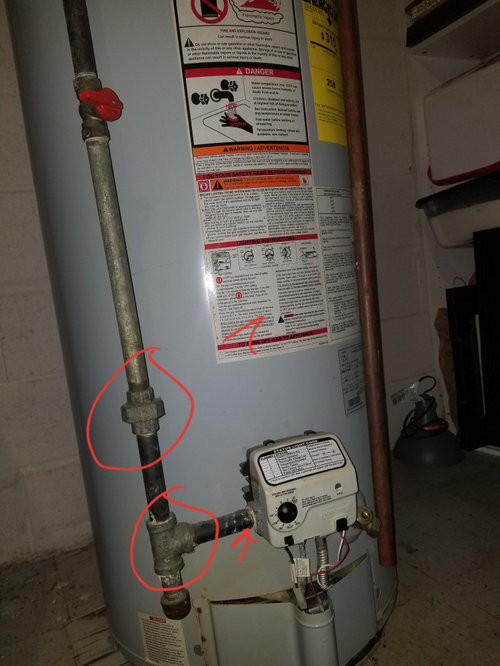
Hi. I am replacing my Honeywell control valve unit. I have plenty DIY experience and saw a few reliable videos how to do it. Just wondering where the best place do disconnect the gas pipe would be with the setup I have. Also, some people recommended using both thread tape and compound. Would you do that as well and if so would the compound go first or tape first then compound. Thanks for your time.

Comments (13)

  • 5 years ago

    Work through the disassembly in your mind. There is only one location to begin disassembly of the gas piping, and the drip leg doesn't count.

    -

    -

    -

    -

    -

    -

    The pipe union.


    I've had a Teflon taped joint leak. Real PIA. Pipe dope, it's the only thing I'll use.

  • 5 years ago

    Thanks that's what I figured as well since the union is meant for that. I found a video with a similar setup to mine and how they worked out disassembly

  • 5 years ago

    How old is this hot water heater? There are signs of rust on the bottom left which usually means a water leak. Maybe you should put the money towards replacing the hot water heater instead of trying to do a repair.

  • 5 years ago

    Mike, it's 10 years old and looks in great shape. I think the Honeywell controller valve is leaking and shorted the sensors (I got a temperature sensor failure code). Outside of a tiny leak from the controller the tank itself looks in great shape.

  • 5 years ago

    Please post an update when you have completed the replacement. This would be useful to others who have a hot water heater with a failing Honeywell control valve.

  • 5 years ago

    Will do. Just FYI for others to know. Honeywell, which made my original control valve had a few models they said can replace the old one while my water heater company (AO Smith) recommended only one model as a replacement for that model. I am not sure if they are all good and AO Smith is just pushing their brand but I'll err on the side of caution and safety and go with what they recommended.

  • 5 years ago

    Especially if you have hard water, a 10 year old gas water heater is past or at least approaching the end of its expected life. Something else to think about is that (at least in my area) the pipe connected to the pressure release valve (copper pipe on the right) can't for safety reasons simply discharge on the ground next to the appliance. In my area, that drain pipe needs to be routed to the outside.

  • 5 years ago
    last modified: 5 years ago

    I agree with @mike_home and @Elmer J Fudd.

    10 years is a little premature to replace a water heater - but I'd just replace the entire thing if the control valve was bad and it was 10 years old - esp if you have hard water.

    It looks to me like black pipe before the shutoff, and a mix of galvanized and black pipe after. You want to use black pipe with natural gas.

    So, typically yellow Teflon tape is used for gas - or pipe dope approved for gas. Pipe dope is more foolproof.

  • 5 years ago
    last modified: 5 years ago

    I hadn't noticed the galvanized pipe. That's a no-no for gas lines in my area.

    A DIYer who's unclear as to which junction to open may not have the experience to do this work effectively and safely. The extra pipe segment, the use of galvanized in the existing install, etc. don't give me confidence that the original work was properly done.

    It may be time to call a licensed plumber to clean this up. Good luck.

  • 5 years ago

    Again, I agree with @Elmer J Fudd^^^^ and that was my first thought.


    Replacing a gas water heater isn't terribly difficult -- but you have to do it right. The gas and the venting can be serious problems if done improperly.


    I'm not seeing a basic understanding on the part of the OP on how this should be done - from not knowing about the union, to not knowing about the thread sealant. In addition, it looks like there was bad work done previously that wouldn't be recognized by someone who doesn't know what they are looking at.


    The other big concern would be the venting. OP - would you want to show us what the venting and plumbing on top looks like?


  • 5 years ago

    Hey Jake/Elmer and all, thanks for your comments and constructive criticism. Much appreciated, especially concerning home safety. The water heater pictured was installed by an excellent professional plumber ten years ago. They had zero concern about the pipes. In addition, the control valve I was asking about here was also installed yesterday by an excellent licensed plumber who is very safety conscience and they too had no concern. Not sure if the codes here are different or something else. As far as my experience, I have done my share of successful DIY projects, way more complicated than a water heater and have good understanding all around. Working on gas lines is new to me so even though I know what a union is and what its for, as well as using tape/thread for dozens of projects, I asked anyway from those who have more experience. I take no chances with safety. Always more to learn and I'll be sure to keep asking when I have a question. For now we have hot water and I greatly appreciate everyone's help.

  • 5 years ago
    last modified: 5 years ago

    That's a good outcome, take a shower for me. And if you're somewhere without the water use reduction requests we currently have, take a long one!

    I was concerned for you and am glad you did it the right way. I don't know enough of the reasons for the pipe spec but I do know black pipe has to be used here - though for the last few feet, a flex connection is okay here and as I think about it is probably required because I'm in an area (California) where there are code requirements specific to seismic protection. Tank-style water heaters also need to be securely attached (but with a multi-inch air gap conforming to the manufacturer's setback specs) to a wall. So as not to topple over when the ground decides to rock and roll.

  • 5 years ago

    Lol. Thanks Elmer. Thankfully we had a place to shower next door or I'd be sleeping outside last week! No rocking and rolling where I am so we don't need flex pipe or to anchor it with straps etc to a wall but I am still going to ask my plumber about that pipe. I appreciate the help!