Software
Houzz Logo Print
victoria_marie53

HOA covenants for outbuildings

4 years ago

Hi all. My husband and I recently moved into a new build home in June. The neighborhood only has about 20 lots and the houses are within the 400-600k range, all on lots larger than 1 acre. They are all custom homes. This is in Indiana and in a somewhat rural area.

All of the lots have been sold, so ownership of the HOA was passed to the residents of the neighborhood. At our first meeting, most everybody agreed that the restrictions for outbuildings were too strict. They currently state that the outbuilding must be the same material as the primary residence… i.e. if you have a brick house, you must build a brick pole barn. Can get expensive.

They created an outbuilding committee to change the covenants, which my husband is part of. They are trying to ensure that the outbuildings still stay nice without requiring a brick home to have a full brick outbuilding.

Does anybody have sample covenants that would fit this need? All of the houses are either hardy board, stone, or brick. We’d like to keep color requirements to be similar to the residence, and require painted wainscoting or something of the like. We are also working with the lawyer representing the HOA but wanted to get this community’s opinion, or see if anybody has ever worked with similar covenants.

Thanks!

Comments (24)

  • PRO
    4 years ago
    last modified: 4 years ago

    Perhaps the HOA can require only a portion of the outbuilding be brick. That way there is a visual connection between the house and its outbuilding, and keep cost to a minimum.

  • 4 years ago

    Hmm, our neighborhood sounds similar to yours in Indiana and we aren’t allowed any outbuildings, except those housing pool equipment. Be very careful in writing these requirements, because homeowners tend to push it to the limit of reason in my experience. I know many disagree with HOA’s rules that overstep, but at least some consistency is maintained.

  • 4 years ago

    It should allow Home Depot/Lowe's and Amish sheds.

  • 4 years ago

    This could be a fun topic, if no one gets personally offended anyway.


    I live in a community with an HOA and sheds/outbuildings are a very hot topic.


    The challenge is that eventually someone will let their shed start looking like heck. The plastic crap from big box stores doesn't even look nice on the first day they are plopped on the lot, and they look a heck of a lot worse after a few years in the elements.


    If you are already certain this is what you want to allow, I won't try to talk you out of it. All I would say is drive around town and take note of what nearly all sheds look like - and it's not pretty. At all. Which is why most HOAs don't allow them.


    But if you're going to do it, put some thought into what makes a shed "look nice." And then understand what your HOA can do, legally, when someone decides they think your rules are stupid and are going to let their rat-infested unpainted T-111 shed rot into the ground. Not that I have experience with that or anything. :)

  • 4 years ago

    We live in a similar small neighborhood (2.5 acre to 10 acre lots) and our covenants do say any outbuildings have to match the house. Believe me, you want that requirement - every outbuilding (and almost all of the homes have one) looks like it belongs - the last thing you want in your neighborhood are sheds (sorry summersrythm) or ugly buildings that look out of place.

  • 4 years ago

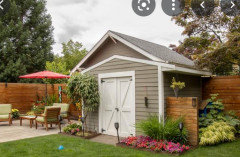
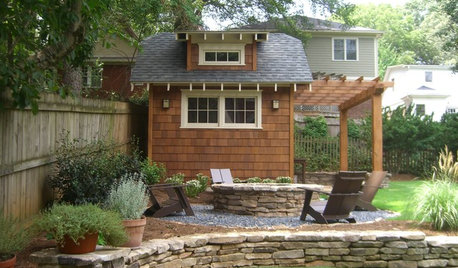
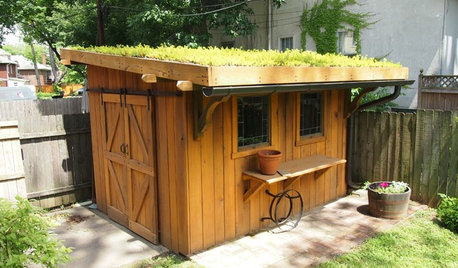
    This is what everyone THINKS they will get:


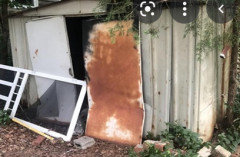
    HOWEVER, this is what most of them end up looking like:


    PRETTY, yes?


    Good luck forcing a neighbor to deal with it, once it starts looking like the above.

  • 4 years ago

    The house we owned 2 houses ago in MA, was also a small neighborhood with around 40 lots. Our lots were 2-3 acres. Our HOA had few rules and one of them was no outbuildings. The other important one was no parking of boats or RVs on the properties.

  • 4 years ago
    last modified: 4 years ago

    I've lived in a neighborhood with a homeowners association for a long time and I appreciate the benefits. Covenants are like so many other things, having too many that are too restrictive to work with is as bad as having too few. If this is a nice, upscale neighborhood, I'd oppose rules that allow the junky kind of structures and purchased sheds that so many people have.

    HOAs exist to protect people from their own bad judgement and bad choices, and to protect neighbors from such acts of of their neighbors. Don't needlessly weaken them.

  • 4 years ago

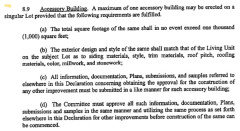
    Here’s ours…we have 2.5-5 acre lots and are limited to one building at 1,000 sq. ft.

    I assume you are referring to accessory structures and not garden sheds. Our buildings reflect the home like Mark said earlier. It does say ”match” in section ”b” but we just require it to be complementary to the home.

    Our issues:

    1. The county does not enforce covenants and allows much larger structures and will issue a permit. This leaves the HOA to enforce the covenants.

    2. I would like to see our covenants changed to include a statement that the accessory structure can not sit forward of the primary residence. Nothing worse than large buildings in the front yard.

    3. Our covenants require review by the Architectural Committee. I have seen covenants with financial penalties included for homeowners that do not submit or follow the architectural committees recommendations. We have struggled with this with non-compliant homeowners.


  • 4 years ago

    Also on my previous post-I think matching the roof pitch is critical to the building looking cohesive. We have had people wanting to put their same Hardie siding on a Tuff Shed… just not the same.

  • 4 years ago

    You will need to define types of accessory buildings. Garages, barns, storage sheds, she rooms, etc. Each will have it's own definitions and limitations. Be as specific as possible. This will save both questions and lawsuits. I suggest that the HOA consult a real estate attorney. Let them write the covenants. You want them to be legally enforceable and easily understood.

  • 4 years ago

    Our HOA has slightly vague definitions and that is how they designed them. It allows them to turn you down because they "feel" it doesn't fit or they don't "like" it, even if you followed the rules to the word. They also never clarify a rule and just let you guess what it means and then turn you down based on feelings and likes. Great neighborhood otherwise, but the HOA approval process is very dependent on who the 6 people on that committee are at that point in time. We have a miserable and rude 84 yr old man that everyone hates, but most will not call out his behavior, because you might have another project he has to approve!

  • 4 years ago
    last modified: 4 years ago

    I’ll second Home Chef’s suggestion to have an attorney who is familiar with local and state laws write the rules to be sure they comply with the law and are enforcable. Finding out in court that your ”self written” HOA rules or any contract is unenforceable or maybe just plain illegal is never good

  • 4 years ago
    last modified: 4 years ago

    I agree the covenant is unnecessarily restrictive but why did you and the "many" others who don't like it buy in to begin with? Could it be possible some of the others whom aren't in the "many" category liked the covenant as written? Yep, can't please all the people all the time and in HOA's a lot of people lose what they had . HOA's suck.

  • 4 years ago

    Covenants are written to sell homes. Once the builder is gone, the association is left to manage itself. Agree with above that you consult with an attorney versed in HOA law.

    Over time, homeowners change and neighborhoods change and there’s a process in the covenants to change them to reflect what the majority wants. Some people may be disappointed, but there’s no guarantee that they will never change.

    We’ve found much of our covenants vague with no recourse for individuals that don’t comply.

  • 4 years ago
    last modified: 4 years ago

    "Our HOA has slightly vague definitions and that is how they designed them. It allows them to turn you down because they "feel" it doesn't fit or they don't "like" it, even if you followed the rules to the word."

    That is what you don't want. This is a lawsuit waiting to happen. One of my professors predicted that HOA's are the next goldmine for litigators. They are a cornucopia of discrimination suits. Nor can your HOA deny a request without pointing to specific non-compliance.

    A good rule of thumb is HOA's must allow anything they have ever allowed and must deny anything they have ever denied. So, in my opinion, the best covenants attempt to guide people rather than restrict people. We have a rule against outbuildings but they have been allowed for years and now we can't take any action to remove them. Had we just had guidance for outbuildings we would have more control than we do now.

    ETA: HOA rules are generally not enforceable by municipal governments. However, any member of the HOA can take action to enforce HOA rules, not just the board of the association.

  • 4 years ago
    last modified: 4 years ago

    "Our HOA has slightly vague definitions and that is how they designed them."

    chispa, HOA covenants and restrictions are often written broadly to allow for flexibility as times and homeowners change. If you think about it, if every provision were spelled out explicitly, some objectives would be very hard to describe in words, would require interpretation anyway, and would make the documents 2 or 3 or 5 times or more larger.

    I gently learned a lesson many years ago that has served me well that you maybe should consider. I was grousing to a neighbor one day about a Board action I disagreed with and his response was a form of "put up or shut up". If you don't like it, do something about it.

    So I did - I got myself nominated for the next vacancy election, was elected, and wound up serving two terms. I enjoyed the experience very much. The invaluable lesson I learned was how difficult the process is of managing a common interest organization with over 300 homes. Each owner thinks only their opinion matters and feels aggrieved at any action contrary to their views. No matter what was done, there was always a small double digit percentage of owners who would complain. At least in my HOA, I found the Board members had honest motives, tried their hardest to do what was in the best interests of everyone in the aggregate, and continued to serve in the face of ceaseless criticism.

    I bought a second/vacation home a few years ago in a different neighborhood (in a different area) with an HOA and I find that it too does a pretty good job of looking out for the common good.

  • 4 years ago
    last modified: 4 years ago

    "Covenants are written to sell homes. Once the builder is gone, the association is left to manage itself."

    HOAs can be put in place in a development to oversee or regulate the conduct and actions of homeowners, and are required when there are portions of a neighborhood that are jointly owned and shared. So-called common interest areas that need management or maintenance that need to be paid for. In my neighborhood, that includes the private roads, road drainage systems, the security patrol, a pool and recreation area, drainage gullies and creeks that run through the neighborhood and a few other features. .

  • 4 years ago

    I have a friend that erected a fence. He sincerely believed that he was complying with the HOA rules, even though his home was not included in the development HOA. Anyhow, they asserted authority, he fought it, he lost, he ended up losing his home to the HOA because he stubbornly believed he was right. We told him to settle and replace the fence right at the start. To this day, he contends he was right and losing his home was the "honorable" thing to have happened.

    I just encountered another case of a set of covenants where a property owner wanted to subdivide his land. In order to do so, he needed approval of the other owners. They said no, he didn't get it. Part of the confusion was whether the deed restrictions were still in place. It's important to place a date of expiration and an automatic renewal without intervention. Otherwise, no one is protected twenty or thirty years later long after the original owners are long gone. New owners can remove an obstructive covenant, but it will require a vote.

    All of these could have been prevented by a good set of covenants written by a competent real estate attorney.

  • 4 years ago

    @bry911, yes we are talking to lawyers because what they have turned down has been done in neighboring properties over the last 25 years. If they asked us to make it X% smaller, or adjust in some way, we could work with them, but all they say is they don't like it. We have gone 2 rounds with the same response and are now escalating. One more round and the attorney will take over. We read all the bylaws carefully and only bought because they allowed what we wanted to do and we saw other properties that had that feature.

  • 4 years ago

    "That is what you don't want. This is a lawsuit waiting to happen. One of my professors predicted that HOA's are the next goldmine for litigators."


    My experience contradicts this. Lawsuits used to be more common in the association I've been in for a few decades than they are now. State law has changed too. I believe right now there is mandatory arbitration step before a homeowner can file a suit and in cases where the association is the prevailing party, the homeowner must reimburse the association for all costs in defending itself in the legal process. That alone stops people who are legal suit trigger happy.

  • 4 years ago

    I also don't think HOA's "suck." I am reasonably happy with mine.


    I completely agree they are not right for every person, and if you think HOAs suck then I fully support your right not to buy in one. :)


    Part of the reason I like my HOA is that sheds, like the oh-so-pretty picture I attached above, are not allowed. I had a very bad experience at a past home, with a neighbor who erected not 1, but TWO sheds, within a few feet from my property line. He then didn't take care of them, they quickly became decrepit, and rats moved in. It was wonderful....


    There is a continuum of people - from the people who want to do whatever is legally allowed on their own property and don't want anyone "telling them what to do", to those of us who are willing to agree to more restrictive covenants (give up some of our "rights"), in return for a more satisfactory living experience. You know, hopefully anyway.


    What drives me batcrap crazy are the people who hate HOAs but buy in one anyway, and then spend way too much time whining about rules which were there to read before they bought. I am not talking about anyone on this thread, I'm talking about people in my real life community. If you don't like the rules, don't buy in the community. Or heck, buy and then try to change the rules through the agreed-upon process.


    But please, for the love of squirrels, don't buy, ignore the rules, and lose your poo because you violated a rule and the HOA responds accordingly.

  • 4 years ago

    What an entertaining choice of words!. Well done.