Software
Houzz Logo Print
paul_andmegian

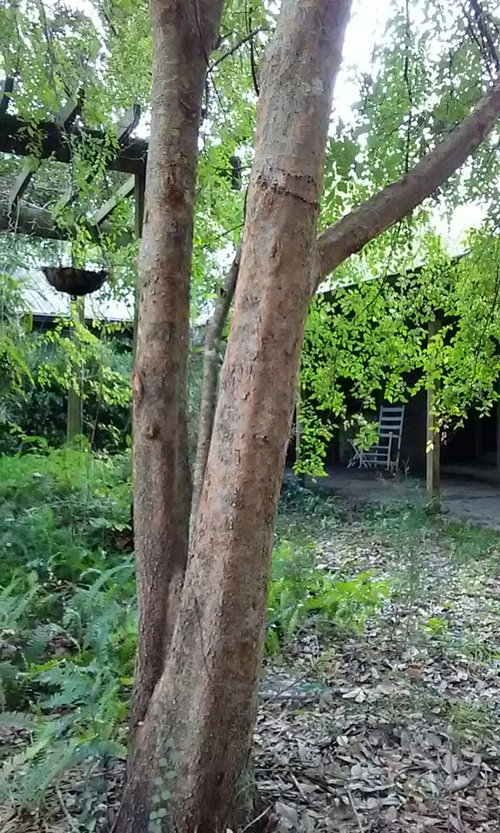
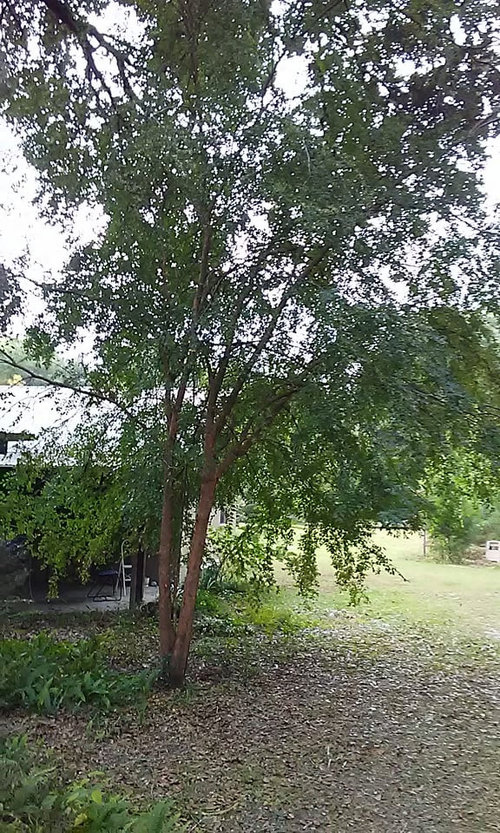
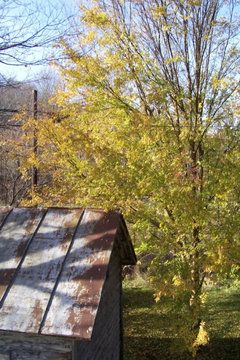
weeping tree with flower like seed pods

4 years ago
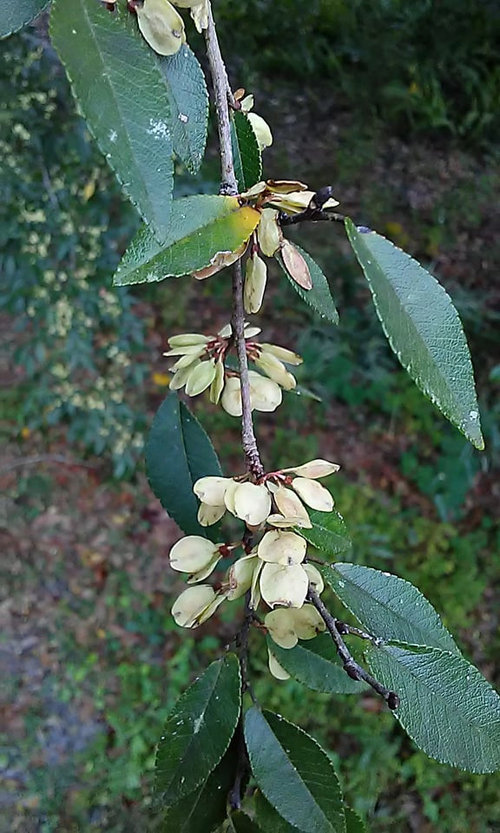
this tree is some 30+ feet tall and grows in partial shade under my huge oak tree. In the fall it gets these white/greenish seed pods that almost look like leaves. Anyone know exactly what this tree is called?


Comments (13)

  • 4 years ago

    through my google searching i think it's some sort of elm tree, chinese, siberian, lacebark, but for sure an elm.

  • 4 years ago

    I agree. Perhaps UImus parvifolia.

    Paul and Megian thanked carol23_gw
  • 4 years ago
    last modified: 4 years ago

    Yup for the first 2 comments. It flowers in autumn so the seeds ripen and disperse in late autumn thru winter. Mine has oodles of seeds like shown but no seedlings as it has no pollinator and the seeds are infertile.


    Paul and Megian thanked bengz6westmd
  • 4 years ago

    Lacebark elms are self fertile (have perfect flowers) and do not require a pollinator to produce viable seed. As a result, it is a listed invasive species in a number of states.

    Paul and Megian thanked gardengal48 (PNW Z8/9)
  • 4 years ago

    Ulmus parvifolia is very invasive. The next door neighbor had a couple trees and every spring there were thousands of elm seedlings in all my gardens. Please cut it down, or do it for your neighbors. Their roots go deep, very quickly, and then it's a chore to dig them out. A lot of people with vollunteers probably give up trying, which means more plants contributing to the seed banks. Lacebark Elm is about as horrible as White Mulberry, Morus rubra and they both originate from the same clade as figs, cannabis, and hops. They all have extremely powerful root systems in common. It's an insult to an Oak to have such a tacky invasive growing underneath it.

  • 4 years ago
    last modified: 4 years ago

    Funny, mine produces thousands of seeds and not ever a single seedling. OTOH, Siberian elms 100 yards away and thousands of seedlings.

  • 4 years ago

    Correction for Jay's comment: the insidious White/Asian Mulberry is Morus alba - not Morus rubra which is the friendly native Red Mulberry.

  • 4 years ago

    Per that publication: "It is reported invasive in DC, NC, NE, NJ, VA, and WI."

    From the same source re: Ulmus pumila: "It is reported invasive in AZ, IA, ID, IL, IN, KS, KY, MA, MD, MI, MN, MO, NE, NM, NV, OH, OK, OR, PA, TX, UT, VA, WA, WI, and WV."

    Pretty darn obvious which is the more serious invasive threat!

  • 4 years ago

    Good to see you back, Embo. I’m sure GG has missed you too 😉

  • 4 years ago
    last modified: 4 years ago

    Wow...the shady side of floral_uk? Now I've seen everything!

    I'm all for people removing things they are truly invasive. It burns me up that the dunderheads in Cecil, Harford and Baltimore Counties of Maryland let hideous Celastrus vines clamber through their ugly leylandii hedges but there's nothing I can do about it. Honestly, there should be a law about that plant. I'm serious. I've been gardening since I was a kid and that means almost 40 years, it's the scariest invasive I know of.

    But I must report my Ulmus parviflora 'Emer II' is now about 40' tall, has been fruiting for over a decade, and I get MAYBE one or two seedlings a year. In what is probably one of the best climates for it imaginable, in the CONUS. High rainfall and I have nice long autumns that are freeze free until mid-November, the seed has plenty of time to mature. By this measure, Japanese maples have 10X to 20X the invasive potential...I see scattered ones in the woods around my property...should we ban those and rip all of them out? Also, the seedlings are super easy to pull out compared to various other weed trees.

    We need to take a more pragmatic approach that simply saying "something is invasive in some part of the country, rip them all out, replace with natives". As I've said before the entire landscape of the "northeast corridor" is so permanently altered, it can never be "right" or "balanced" again, and that should factor into how we consider the ecological balance in a given area. I'm using the reference to the Amtrak rail right of way as a synecdoche for the entire region. So that is why I specifically cited those counties: Amtrak creates a long open clearing that would otherwise not exist. When they got ARRA money from the Obama presidency, they began a massive campaign to clear their right of way of Celastrus and Ailanthus, which was a exactly the right thing to do. BUT, the 'native alternative' to a forced opening like that is going to be massive poison ivy vines filling in, so I'm glad they continue to spray to stop those! I guess my point is there are often complex issues of thoughtful landscape/garden maintenance and stewardship that seem to be getting lost in the debate over natives/non-natives. They see promotion of natives as some magic bullet that will 'make everything right again'. But it would be just as hideous if the leylandii hedges had poison ivy vines creeping through them...and I do see it once in a while. (or hedges of a native like Atlantic Cedar!!!) But the bigger picture is invasives thrive because people are too damn lazy to maintain their properties (or in the case of Amtrak, underfunded) , and that's really more the "root cause" of the problem than the presence of invasive seeds in the local biome.

    Roadways are not immune either. The I-95 corridor is allowing a 'native', Baccharis halimifolia, to spread north of its native range. Does that make it an invasive ;-)??? JK - I approve of the way the MD DOT SEEMS to be handling their roadway verges though. Looks like they've been spraying Albizias and Ailanthus to get rid of them, but leaving the Baccharis. At least they aren't wasting their time pulling. Bless their hearts but it cracks me up to see flyers in DC and Baltimore for urban bobos to come "pull invasives" in a park or whatnot. What a silly, pointless waste of effort. They need to be sprayed by trained herbicide applicators. 1000X more efficient way to deal with the problem and it's what Amtrak and highway departments do. But, teh chemicals is dark-sided!!! DARK SIDED! According to urban bobos. Twice in Australia I saw crews spraying for invasives. It's wonderful that they take the problem seriously, while at the same time, celebrating the excellence of non-native plants.

    EDIT: I should probably explain that I have ridden the commuter rails to DC on and off for years so that is why I have been able to observe the ecological evolution of the Amtrak right of way!

  • 4 years ago
    last modified: 4 years ago

    davidrt, nice measured rant. What I've read is that 50% of the NA weeds -- perennials and annuals, are "exotic" now. The ecosystem gets along with most of them fine.

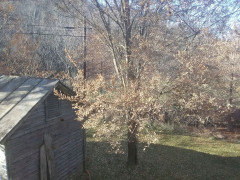
    My Chinese elm is also about 40', with an American elm form. Leaves are gone, all the brown seen are seeds. Still, never seen a seedling -- apparently all the seeds are duds.


    And davidrt, Maryland puts sawtooth oak (Quercus acutissima) on the invasive list! Because it's reseeded itself a couple times at very visible places along the interstates?(where they were originally planted and nowhere else) Complete and utter nonsense.


    PS -- Thanks for the reference to "bobos". Another more general word for them is "doomers".

Sponsored
Wannemacher Interiors
Average rating: 5 out of 5 stars26 Reviews
Customized Award-Winning Interior Design Solutions in Franklin Cnty OH