Software
Houzz Logo Print
m0nini873

Is My Ficus Lyrata Dying?

4 years ago
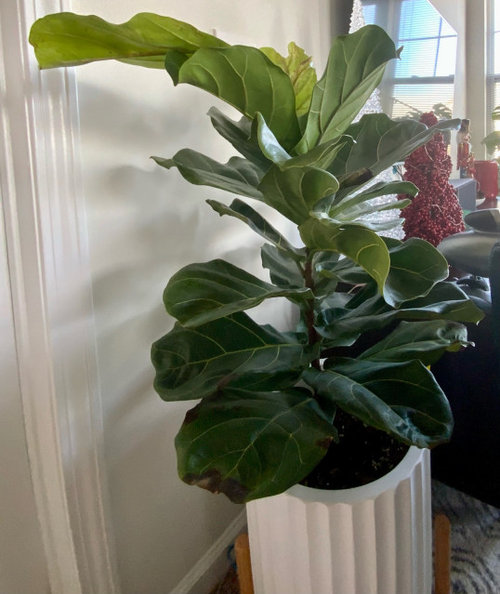
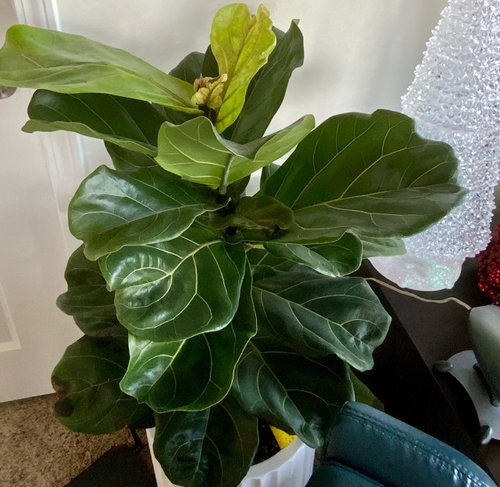
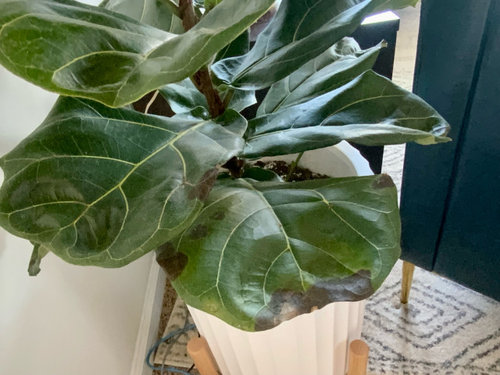
I have had this ficus lyrata for a while, and I have noticed that the leaves at the bottom seem to turn black in spreading patches limited to one or two leaves at a time, and eventually die off. The process is usually slow, but I need to know how to stop it before I lose all my lower leaves and have a bare base!!

Here are some images to help you plant parents out there to diagnose the issue. Overall, it doesn’t look terrible, as there are healthy new leaves sprouting periodically from the top, but the bottom leaves are again starting to blacken (as you can see in the close up).

I don’t over water my plants to my limited knowledge; if anything, I probably underwater a bit because I am so paranoid about overwatering. The pot has good drainage, where water can freely drain out. The plant is in bright indirect light a few feet from west facing windows with blinds that are usually open, and seems to be growing well otherwise.

Please help!

Thanks in advance!

-Monica

Comments (6)

  • 4 years ago

    no plant holds it leaves forever ... and annual loss of the oldest leaves is normal.. and usually cyclical ...


    as day light wanes into winter.. is a good time for such to happen ...


    fresh new growth at the tips is a sign of a happy plant ... focus on that after you snip off the old leaves ...


    a plant will wilt when it really needs water .. and its a great tell as to when to water ... to avoid over watering ... imo.. your plant shows no sign of over watering ...


    it is a plant.. not a child.. we are not parents .. and we are not helicopter parents ....


    when i want to see what the future holds.. i do something like this.. and scroll thru the pix:


    https://duckduckgo.com/?t=ffcm&q=Ficus+Lyrata&iax=images&ia=images


    and in doing so .... i would say you have a 75% chance of a bare trunk .. and i would suspect the other 25% were taken from a greenhouse and taken in the house for the pix ...


    beyond watering.. you are going to have a hard time.. indoors ... providing perfect growing conditions across all the plant culture variables ... so odds are.. you will continue to have the annual shedding and over the next 10 years or so.. you will end up with a bare trunk ..


    but by that time.. your child will be ready to go off to college.. and it wont matter .. lol ..


    ken


    ps: you missed the houseplant forum .. no need to replicate this over there.. just a hint for future posts ... about your houseplants ... welcome and come back often ...

  • 4 years ago

    Those black patches aren’t normal leaf ageing. And they do look like a condition connected to watering to me. And when a leaf dies age it is best snapped off at the petiole rather than snipped. If you cut you leave a section of petiole to possibly rot. A normally ageing fig leaf yellows uniformly. It doesn't get necrotic patches. Pick a problem here: https://edis.ifas.ufl.edu/publication/PP308


    Does that white pot have a drainage hole? How do you water? Are there drafts or temperature fluctuations?

  • 4 years ago

    Thanks for the responses. I agree that they do not appear to be normal aging. The pot does have a drainage hole that is pretty large, and the soil is a well-draining, coarse mix. No drafts nearby.

    It does appear to be spreading upwards. Should I cut off the blackened leaves before it keeps affecting each leaf higher and higher on the trunk?

  • 4 years ago

    How do you water and how do you determine when to water?

    tj

  • 4 years ago
    last modified: 4 years ago

    "fresh new growth at the tips is a sign of a happy plant" "Fresh new growth at the tips" may not even represent true growth, let alone serving as a reliable indicator of a happy plant. True "growth" is measured by the increase (in weight) of the plant's dry mass. Plants are organisms that shed parts in response to stress. If the dry weight of the shed parts is greater than the dry weight of newly added parts and thickening, the plant is losing weight and going backwards in terms of growth; so, new growth at branch/stem tips means no more than the fact the plant is managing to find a supply of nutrients sufficient to allow branch extension. The plant might be securing these nutrients by cannibalizing its own organs, because that's what plants do.

    "a plant will wilt when it really needs water .... and its a great tell as to when to water" And, a plant will wilt when it's over-watered, which means wilting is not a reliable indicator signaling the plant needs watering. Wilting while the grower can still detect moisture in the grow medium should raise a red flag, and it's a good bet it would over-watering causing the wilting.

    Hi, Monica. This doesn't look at all like a disease pathogen, but it does look like a physiological disorder linked to adverse cultural conditions. IOW, I believe you're over-watering; and, it's likely the only change you need to make to correct the issue is alter your watering intervals based on moisture levels deep in the pot. To do that, I suggest you make/use a wooden "tell" to "tell" you when it's time to water. See "Using a Tell" below.

    A couple of "tricks" that will limit how much excess water the grow medium can hold;

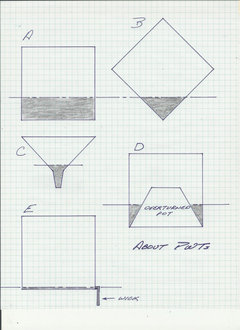
    1) After watering, tip the pot at a 45* angle. It has a notable impact on how much water can remain in the pot. Use the line drawing to compare B to A for an accurate representation of how much difference it can make.


    Figure D illustrates how valuable using an overturned pot as ballast can be, and E illustrates how much difference using a wick can make.

    Using a 'tell'

    Over-watering saps vitality and is one of the most common plant assassins, so learning to avoid it is worth the small effort. Plants make and store their own energy source – photosynthate - (sugar/glucose). Functioning roots need energy to drive their metabolic processes, and in order to get it, they use oxygen to burn (oxidize) their food. From this, we can see that terrestrial plants need plenty of air (oxygen) in the soil to drive root function. Many off-the-shelf soils hold too much water and not enough air to support the kind of root health most growers would like to see; and, a healthy root system is a prerequisite to a healthy plant.

    Watering in small sips leads to avoid over-watering leads to a residual build-up of dissolved solids (salts) in the soil from tapwater and fertilizer solutions, which limits a plant's ability to absorb water – so watering in sips simply moves us to the other horn of a dilemma. It creates another problem that requires resolution. Better, would be to simply adopt a soil that drains well enough to allow watering to beyond the saturation point, so we're flushing the soil of accumulating dissolved solids whenever we water; this, w/o the plant being forced to pay a tax in the form of reduced vitality, due to prolong periods of soil saturation. Sometimes, though, that's not a course we can immediately steer, which makes controlling how often we water a very important factor.

    In many cases, we can judge whether or not a planting needs watering by hefting the pot. This is especially true if the pot is made from light material, like plastic, but doesn't work (as) well when the pot is made from heavier material, like clay, or when the size/weight of the pot precludes grabbing it with one hand to judge its weight and gauge the need for water.

    Fingers stuck an inch or two into the soil work ok for shallow pots, but not for deep pots. Deep pots might have 3 or more inches of soil that feels totally dry, while the lower several inches of the soil is 100% saturated. Obviously, the lack of oxygen in the root zone situation can wreak havoc with root health and cause the loss of a very notable measure of your plant's potential. Inexpensive watering meters don't even measure moisture levels, they measure electrical conductivity. Clean the tip and insert it into a cup of distilled water and witness the fact it reads 'DRY'.

    One of the most reliable methods of checking a planting's need for water is using a 'tell'. You can use a bamboo skewer in a pinch, but a wooden dowel rod of about 5/16” (75-85mm) would work better. They usually come 48” (120cm) long and can usually be cut in half and serve as a pair. Sharpen all 4 ends in a pencil sharpener and slightly blunt the tip so it's about the diameter of the head on a straight pin. Push the wooden tell deep into the soil. Don't worry, it won't harm the root system. If the plant is quite root-bound, you might need to try several places until you find one where you can push it all the way to the pot's bottom. Leave it a few seconds, then withdraw it and inspect the tip for moisture. For most plantings, withhold water until the tell comes out dry or nearly so. If you see signs of wilting, adjust the interval between waterings so drought stress isn't a recurring issue.

    Questions?

    Al