Software
Houzz Logo Print
cgbr22

what is wrong with my tomato plants?

4 years ago
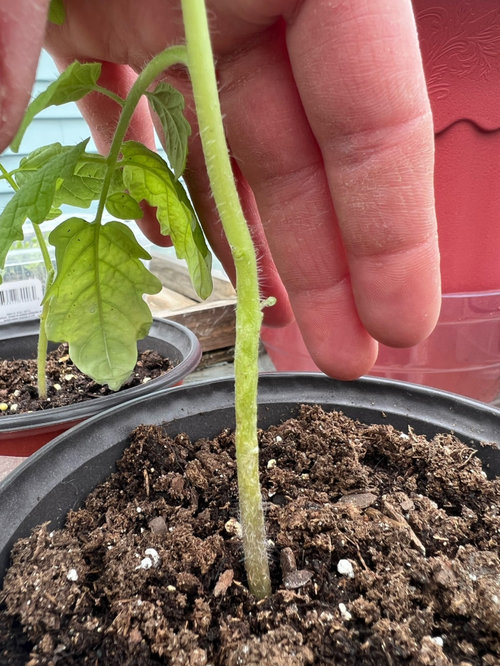
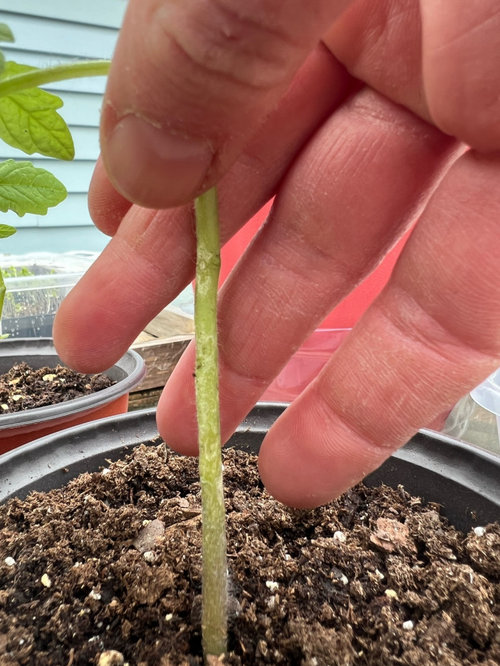
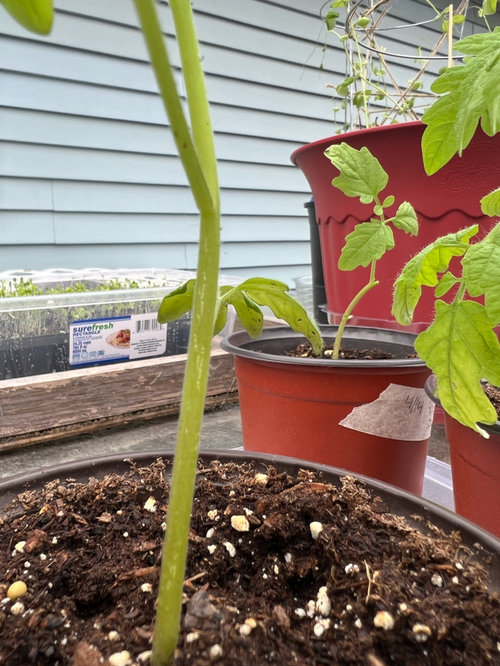
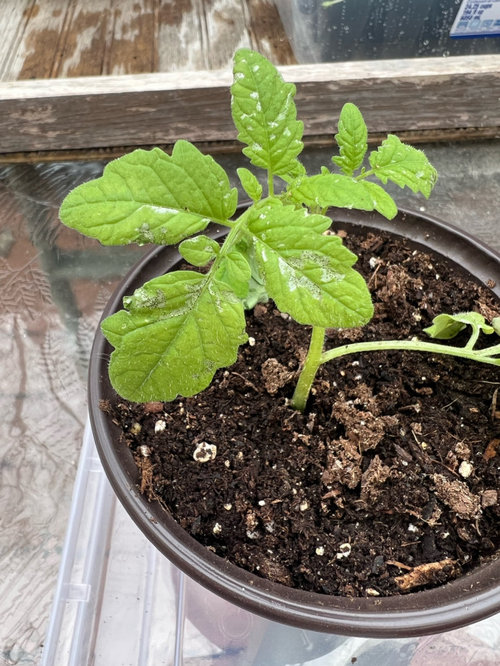
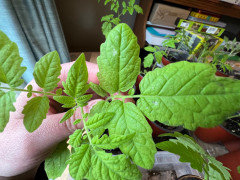
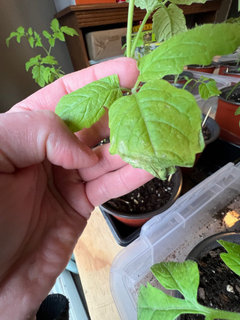
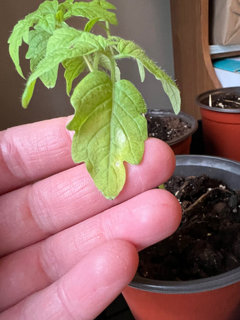
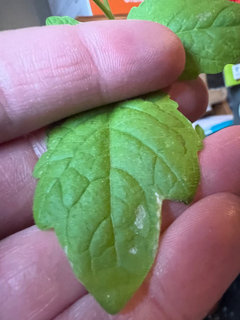
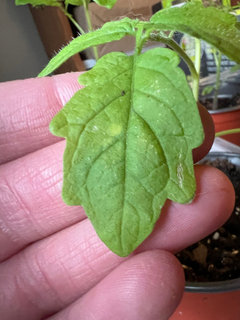
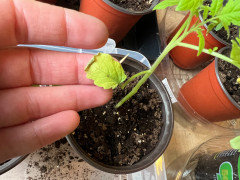
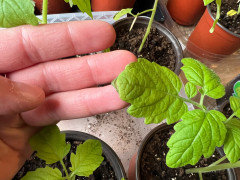
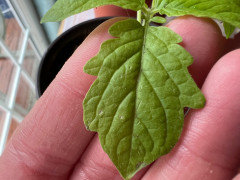
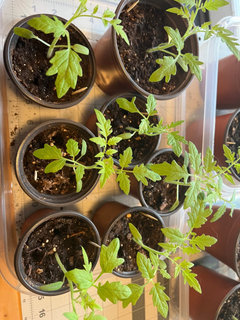
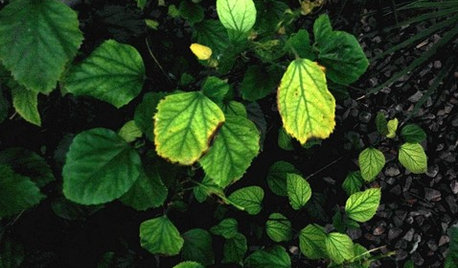
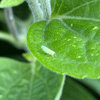
I have about 35 tomato plants which are roughly 6wks and 3 weeks old. I have about three that look crappy and want to know what is wrong with them so I know if I need to worry about the rest of my plants. The first two picture with my hand behind the stem are from plant 1 just different sides of the stem. The other stem picture is plant 2 and the picture of the leaves are from plant 3. Thanks

Comments (24)

  • 4 years ago

    They are very light green in color. To me the most likely things are lack of plant food, especially nitrogen, lack of sunshine or lighting, and perhaps too much watering.


    Have they always from the start been that pale or is it a more recent thing?

  • 4 years ago

    They have always been pale like that. The leaves have always been very soft too which I thought was strange. Another weird thing is that their first set of true leaves died off like the cotyledons.

  • 4 years ago

    I use a moisture meter when watering them and sometimes the soil looks well watered to me but the meter says it is borderline dry.

  • 4 years ago

    Are they all the same variety? Whatever they are, it might be wise to isolate them in case they are diseased. Another question is, did you use a different potting mix for some of your seedlings? There's a possibility there could be something weird going on with that......

  • 4 years ago

    Moisture meters measure EC (electrical conductivity), not moisture. To validate: clean your tool's probe, partially fill a clean cup with distilled water, insert the probe into the water, note it wants you to believe the water is 'DRY'. Sprinkle a bit of table salt to the water and watch the needle move to 'WET'.

    The presence of ions in distilled water should be so low it doesn't register on the "water meter" gadget. The extraneous ions that come with the addition of table salt provide a pathway by which electricity can move through the water, and the probe measures the efficiency with which it moves. Technically, the inexpensive moisture meter gadgets are far better at measuring fertility levels than moisture content.

    Don't be too quick to discount Wayne's suggestion that the issue is nutritional. I agree. The loss of the first set of true leaves also fits well with the idea you're dealing with a fertility problem. Whenever one or more of the nutrients considered to be mobile in the plant (nitrogen, phosphorous, potassium, magnesium) are deficient, the plant is programmed to rob (usually the oldest) leaves of the nutrients and other biocompounds they contain in order to fuel new growth, which might not really be growth at all. True growth is a measure of increase in a plant's dry mass. If a plant is growing a leaf or pair of leaves and shedding a leaf or pair at the same time, it might not be growing, even though you can see conspicuous extension of the stem or branches.

    Suggestions:

    * Start using a "tell" to "tell' you when it's time to water, instead of the meter gadget

    * Fertilize regularly

    * Read your fertilizer label to make sure your plant is getting all the nutrients essential to normal growth. As you might guess, 'essential' means the plant cannot grow normally without an adequate supply of all nutrients normally absorbed through the root pathway.

    Are you by any chance using a grow medium that contains more than about 10% coir or CHCs?

    Al

  • 4 years ago

    This is the first time I have ever planted anything so I used miracle gro all purpose potting mix. I have used Espoma liquid tomato and vegetable fertilizer with an NPK of 1-3-1. I was using it at half strength. Considering I am a beginner, is there something else I should be using?

  • 4 years ago

    The fertilizer wouldn't be my first choice. Reasons: Inert ingredients make up 95% of the product. It contains only 1% nitrogen, the most used of all the nutrients. It does not report inclusion of magnesium, iron, zinc, boron, manganese, copper, molybdenum, or chlorine, all of which are essential to normal growth, so I wouldn't be surprised to learn there are deficiencies of several nutrients, in light of both the absence of a number of nutrients and the fact you're using a half-strength solution.

    What I might suggest re fertilizer depends on whether or not these plants are going into the ground or are destined to live in pots. While they are in pots, I would suggest you use Dyna-Gro - Orchid Pro 7-8-6. Don't be put off by the label. A fertilizer should be selected because it closely matches the NPK %s at which the plant utilizes the nutrients. I use Foliage-Pro 9-3-6 for tomatoes, but I add other ingredients to increase the P and K levels. I'm trying to simplify things for you by suggesting the Orchid-Pro 7-8-6. It contains, in one package, all nutrients essential to normal growth, and gives you complete control over what nutrients your plants receive and when they receive them. Control is important for container culture, but once the plants go into the ground, how you fertilize should best be based on a soil test, otherwise it's just a shot in the dark.

    MG grow media are generally viewed as very water-retentive, so it's important to monitor moisture levels carefully while plants are in pots. I mentioned using a "tell" in my post above, but left you hanging and wondering what a "tell" is. Sorry about that.

    Using a 'tell'

    Over-watering saps vitality and is one of the most common plant assassins, so learning to avoid it is worth the small effort. Plants make and store their own energy source – photosynthate - (sugar/glucose). Functioning roots need energy to drive their metabolic processes, and in order to get it, they use oxygen to burn (oxidize) their food. From this, we can see that terrestrial plants need plenty of air (oxygen) in the soil to drive root function. Many off-the-shelf soils hold too much water and not enough air to support the kind of root health most growers would like to see; and, a healthy root system is a prerequisite to a healthy plant.

    Watering in small sips leads to avoid over-watering leads to a residual build-up of dissolved solids (salts) in the soil from tapwater and fertilizer solutions, which limits a plant's ability to absorb water – so watering in sips simply moves us to the other horn of a dilemma. It creates another problem that requires resolution. Better, would be to simply adopt a soil that drains well enough to allow watering to beyond the saturation point, so we're flushing the soil of accumulating dissolved solids whenever we water; this, w/o the plant being forced to pay a tax in the form of reduced vitality, due to prolong periods of soil saturation. Sometimes, though, that's not a course we can immediately steer, which makes controlling how often we water a very important factor.

    In many cases, we can judge whether or not a planting needs watering by hefting the pot. This is especially true if the pot is made from light material, like plastic, but doesn't work (as) well when the pot is made from heavier material, like clay, or when the size/weight of the pot precludes grabbing it with one hand to judge its weight and gauge the need for water.

    Fingers stuck an inch or two into the soil work ok for shallow pots, but not for deep pots. Deep pots might have 3 or more inches of soil that feels totally dry, while the lower several inches of the soil is 100% saturated. Obviously, the lack of oxygen in the root zone situation can wreak havoc with root health and cause the loss of a very notable measure of your plant's potential. Inexpensive watering meters don't even measure moisture levels, they measure electrical conductivity. Clean the tip and insert it into a cup of distilled water and witness the fact it reads 'DRY'.

    One of the most reliable methods of checking a planting's need for water is using a 'tell'. You can use a bamboo skewer in a pinch, but a wooden dowel rod of about 5/16” (75-85mm) would work better. They usually come 48” (120cm) long and can usually be cut in half and serve as a pair. Sharpen all 4 ends in a pencil sharpener and slightly blunt the tip so it's about the diameter of the head on a straight pin. Push the wooden tell deep into the soil. Don't worry, it won't harm the root system. If the plant is quite root-bound, you might need to try several places until you find one where you can push it all the way to the pot's bottom. Leave it a few seconds, then withdraw it and inspect the tip for moisture. For most plantings, withhold water until the tell comes out dry or nearly so. If you see signs of wilting, adjust the interval between waterings so drought stress isn't a recurring issue.

    Al

  • 4 years ago

    Need to know if these plants are destined to spend their lives in pots or planted out?

    Al

  • 4 years ago
    last modified: 4 years ago

    Skipped down to note that what I see looks a lot like damage from sucking insects - leafhoppers or similar. This time of year here, those populations are increasing, not sure where you're located...? Insects will often move in on stressed/weakened plants too, accelerating decline.

    And what variety of tomatoes? Some do better than others, some are more susceptible to disease and insects than others. I look for flavorful hybrids with a lot of disease/pest resistance.

    I use Espoma or other organic granular fertilizers and add a spoonful to the top of the soil surface when seedlings have their second set of true leaves, being careful to keep it away from the stems, so they don't get burned. I use compost tea and seaweed extract as well.

  • 4 years ago

    Could be Oedema, kinda looks like it. Over watering, high humidity and low light intensities are factors which favor the development of oedema.

  • 4 years ago

    Some will move into 5 gallon buckets and some into the ground.

  • 4 years ago
    last modified: 4 years ago

    I noticed the insect (arthropod?) activity and figured the leaf markings looked like slime trails.

    I don't think we're seeing oedema. Oedema lesions turn corky soon after cell contents leak into intercellular spaces; so, if it is indeed oedema, it would have to have been caught on camera after the leakage and before the transition to cork/ callus, and odds are stacked steeply against that occurring.

    If you are growing cherry tomatoes, I would try to fill the containers with those first. O/a, cherry tomatoes do better in containers than their larger counterparts, soil volume being the primary reason.

    Ask if you don't understand this: IF you can find a way to make sure the containers are resting directly on soil and there is continuity of the soil column such that the soil column is in contact with the soil below the container, it changes the containers to raised beds, from the perspective of hydrology (how water behaves in the containers). This arrangement turns the earth into a giant wick, so all or nearly all the excess water in the grow medium will be 'pulled' into the soil below. This allows you to use grow media that would otherwise be too water-retentive to use effectively.

    As far as a "beginner-friendly medium", and predicated on your ability to find appropriate pine bark, you won't likely find anything (commercially prepared) easier for beginners or experts to grow in than the 5:1:1 mix. It would require some effort on your part, but it doesn't require much in the way of knowledge.

    Al

  • 4 years ago
    last modified: 4 years ago

    I know that this isn't your tomato problem (most likely not) but your stressed out plants look very similar to my tomato plants after they got beaten up by a recent hail storm. If I had not been at home to see the hail coming down I would be wondering why my plants look so weakened. They have since recovered nicely.

  • 4 years ago

    In what conditions have they been grown so far? Were they inside? Were they outside during cold nights? The other plants did well in the same soil? Have the older plants been sitting around waiting to be planted?


    To simplify, if they get good sun/ light tomatoes grow pretty easily if not over watered/ under watered. If those plants got less light and were in soggy soil conditions, that can lead to problems.

  • 4 years ago

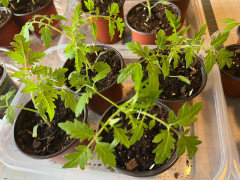
    They have been grown from seed indoors. When it isn’t raining or windy I put them out on my deck in full shade for about 40 min. If any longer, they wilt bad and the damage on the leaves becomes worse (even though they are in full shade). Here are pictures of various leaves on different plants. The stems on all of these plants look normal. I have throughly inspected the leaves under and top side, stem and soil with a magnifying glass and cannot find anything moving. There is nothing that rubs off of them to indicate a powdery mold either. I feel so helpless like I am watching them die and do not know how to fix it. These plants are cherry tomato and cocktail tomato. The lighting in the picture makes them look a tad more lime green than they really are but not by alot.

  • 4 years ago

    More pictures

  • 4 years ago

    Last group of pictures

  • 4 years ago

    In addition to nutritional issues, you're over-watering. The excess water is making it impossible for the plant to take up an adequate measure of Ca(lcium) (very common in a high % of plants). This type of deficiency is called a cultural deficiency, and vcan occur even when there is more than enough Ca available for uptake. Ca must be in the nutrient supply if cells/ tissue are to form normally. Deficiencies of Ca cause cells to be poorly and abnormally formed, symptoms of which present as a number of malformations, poorly formed leaf margins, hooked leaf tips, lesions - holes - cracks left when cells leak their contents into inter-cellular spaces.

    I left a short piece above, about using a "tell" to "tell" you when it's time to water. You shouldn't need this with the light plastic pots you're using, you should be able to tell when water is needed just by the weight of the pot and plant, but it will be much more difficult and critical to monitor moisture levels in larger pot, especially when using a water-retentive medium.

    Al

  • 4 years ago

    I have wooden grilling skewers that I thought I would use for a tester. Is there anything I can do outside of holding off on water right now? I am going to try your 5:1:1 mix that I found in another houzz post.

  • 4 years ago
    last modified: 4 years ago

    Those newer pix actually don't look all that bad. Perhaps they're languishing from too much coolness right now and just may perk up when the weather is better and they can be in full sun all day. I even spy what looks like some cold damage on the leaf in the 2nd photo.

  • 4 years ago

    I have wooden grilling skewers that I thought I would use for a tester. Perfect for the shallower pots. Is there anything I can do outside of holding off on water right now? Learn all you can about growing tomatoes in particular, and in general about growing things under conventional container culture. You might find some help in this short Overview of Good Growing Practices, which focuses on conventional container culture.

    Plants are genetically programmed to tolerate a fairly narrow range of conditions on either side of their sweet spot. Any cultural influence that qualifies as the sweet pot for that influence (temperature, light levels, fertility levels, the soil moisture:air ratio implies that it is not the source of stress. Stress comes from the plant being asked to deal with cultural conditions at or near the limits of what it's genetically programmed to tolerate, and at any given time, the most stressful cultural condition is the one that impedes growth. Our job as growers is to identify those influences which cause stress, and to alter those conditions where possible and to the greatest degree we deem reasonable in order to relieve the stress it causes. This requires a working knowledge of soil science and how plants work, which brings us full circle to learning all you can about container cultural and whatever it is you have chosen to grow.

    Al

  • 4 years ago

    Thank you I appreciate all of the information and the time you have taken to respond to my questions. I am definitely going to read over the information in the other post you suggested. There is so much information on the web that it makes it somewhat confusing on what to believe and what not to believe, and what might work for one person will not work for another given the area the live, and other factors. I know so many people on here speak very highly of you and you are so helpful which makes this a little easier and less confusing.

  • 4 years ago

    ..... very kind words, and I thank you for them.

    I think back to the time when my depth of knowledge and experience could only be described as 'running on empty', and unfortunately I had been bitten by the bonsai bug and felt an urgent need to learn how to grow those beautiful little trees. Since this was pre-internet, also unfortunate, I struggled through many texts that were over my head until I eventually gained enough knowledge to allow me to keep my trees alive and healthy enough to withstand the stress of being manipulated. Fast forward to my discovering what the internet was and the wealth of knowledge it put at our fingertips. When I realized I could share what I had learned with others and help them avoid all the pitfalls that befell me, I adopted it as a natural extension of my own growing experience, and here we are. There are others on GW who have always been credible. If I check, I find they have many more followers than others I think are less credible, so credibility sells and it has to be earned. It didn't take long to understand credibility was the currency to hold if I truly wanted others to buy into what I was saying, so I decided it was essential that I always operate within the limits of my knowledge if I'm to maintain that credibility. That decision has helped me help others more than anything else I can think of.

    This is an excerpt from something I wrote on a thread Friday. It has some thoughts that might help you determine what sources are worthy of your confidence and trust:

    My experience is, it's actually much EASIER to generalize, more difficult to be specific, because specificity requires the information provider to qualify the information being offered, which means the info provider must have greater command of the topic. It's easy to say 'automobiles run on gasoline', but we immediately see the answer is not always true. It would be fine to say most automobiles run on gasoline, however, some are powered by diesel fuel, some by LP gas, some use electricity which is stored in an onboard battery, and experiments are being performed which explore alternate fuels unmentioned herein. The fleshed out statement is well enough qualified to get almost anyone past most would-be critics, which can't be said of the former general and unqualified statement.

    A lot can be determined about how well someone knows the subject by the way (s)he qualifies what's being said. Speaking in generalities is often an indication someone wants to be heard, but doesn't want to be held to account for what they are saying. It's safe to make generalizations, then say, "That's not what I meant at all" when content accuracy is questioned.

    Thanks again.

    Al