Software
Houzz Logo Print
sara_mir82

Loud A/C after moving duct

3 years ago

What can we do about an excessively loud A/C intake vent? Looking for any advice — just knowing what questions to ask our contractor would be useful.

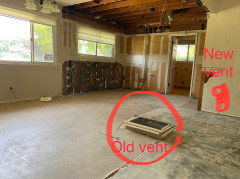
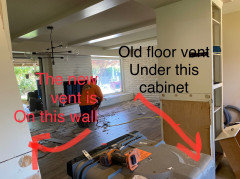
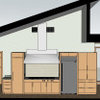
Our original kitchen layout had an air intake vent in the ground, and there was an empty cabinet covering it. Was odd…every contractor we interviewed told us so. We are on slab foundation so had planned to tunnel it over to a perimeter wall so we could open up the space where the random cabinet was. But apparently when they dig in, there was a t-joint (??) so they didn’t even need to dig. They just sealed the T and filled in the hole with cement. The new vent is now on a dining room wall that has garage on the other side.

But it’s SO LOUD. We never heard the A/C before….now, we can barely hear ourselves talk when it’s on. And as we are in CA, the A/C is not optional for 6 months a year.

No idea why it should be so different. I don’t know what to ask or how to phrase my questions. We are over a month past the promised completion date for our renovation and still not actually moved back in because stuff keeps getting pushed back. But this seems like a major issue and I want to raise it before we move back In and make final payment.

Thanks for any advice.

Comments (10)

  • 3 years ago

    In addition to what sktn said,by restricting return flow effeciency and longevity of ac has been reduced and that's b a d.

  • PRO
    3 years ago

    It's not clear from the OP's description how the air was making its way to the return before the alterations. I suspect the resistance to air flow has been reduced, resulting in a greater air flow rate and more air noise.

  • 3 years ago

    Ok I’m trying to understand the replies. I don’t think we lost a return, we had 2
    And we still have 2 just that one was moved from the kitchen floor to the dining room wall.

    The other one is still on the other side of the house.

    But these are good questions for me to formulate for my contractor, thank you very much!

  • 3 years ago

    I'm not sure how well equipped you are to seriously discuss this but we shall see.

    You said "But apparently when they dig in, there was a t-joint (??) so they didn’t even need to dig. They just sealed the T and filled in the hole with cement. The new vent is now on a dining room wall that has garage on the other side".

    What do you mean "APPARENTLY" ? I need to know if there is a tee or not unless you intend to rely on apparently rather than certainty. What size was the pipe on each of 3 joints? Which was sealed and where do remaining 2 joints go?

    You said they sealed the tee then you said there's a new vent on dining room wall but you never said where new vent originates in system. Tell me where,how,what size pipe and how many feet of new pipe was installed for new vent on dining room wall?

    The reason I know air flow was restricted by whatever was done is from years of experience of what causes excessive noise at a vent when there was little or none previously.

  • 3 years ago

    Klem1 — thank you!!

    There was a tee that we didn’t know about until they dug out the concrete. It was explained to me as highly unusual and unnecessary because it just detoured from the main duct (?) that led from the furnace unit in the garage to the hallway intake vent on the other side of the house. I will need to ask about the size of the pipe.

    What was sealed was the hole (???) that allowed the flow from the main duct/pipe (??) to the kitchen floor vent. So now the vent the dining room wall is on the same duct (??) as the vent in the hallway….no more detours. I don’t think new pipe was installed but will check.

    (???) indícate I’m not sure if that’s the right term

  • 3 years ago

    ??? Says you don't understand basic common sense and neither does Charles Ross Homes so just seal the noisy vent to quite the noise and increase return air flow. Fewer "detours" = better air flow. Raises the question why ac contractors install all those "unneccessary detours" throughout homes in the first place. According to the "PRO" CRH maybe detours are installed so a few can be sealed later if more air flow is desired. My head hurts,I need to go lay down. Carry on CRH and you other "PROS".

  • PRO
    3 years ago

    @klem1,

    The ability to assist posters remotely via forums like this one on houzz.com is often limited by a lack of photos or poor descriptions. That is how I would characterize the OP's post. You might consider the following excerpt from their post:

    "Our original kitchen layout had an air intake vent in the ground, and there was an empty cabinet covering it. Was odd…every contractor we interviewed told us so"

    I can't quite picture what it looked like, which resulted in my comment:

    "It's not clear from the OP's description how the air was making its way to the return before the alterations."

    It might have been better stated as a clarifying question. In either case, it seems return air flow is less impeded than previously and an assumption of increased flow rate and attendant noise is not at all unreasonable.

  • 3 years ago

    I think that it being less impeded makes a lot of sense. In that case, there’s really nothing to be done then, assuming we want the vent? Do we need the vent??

    I admit I don’t understand mechanical systems (call it common sense, whatever). This has been a helpful discussion.

    I’m adding pictures in case you have other suggestions.

  • 3 years ago

    Thanks for everyone’s help on this issue. Resolution:
    The contractor messed up. Apparently the vent is unnecessary. It used to exist bc the kitchen was a closed off room. But the renovation before my ownership opened up the kitchen but left the random cabinet for the intake vent. My contractor just assumed it was necessary without actually calculating air flow…the a/c guy came out and calculated that with the size of the duct and the size of the vent on the other end of the hallway, the new vent (to replace the old floor vent) was overkill. So now we have a “decorative” grate in our tongue & groove wood paneling in the dining room. But at least we don’t have to deal w noise!