Software
Houzz Logo Print
westes

What Is This Plant Behind an Echium Webbii?

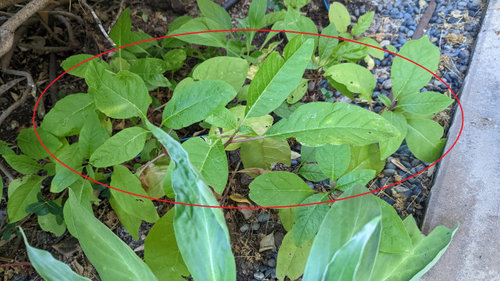
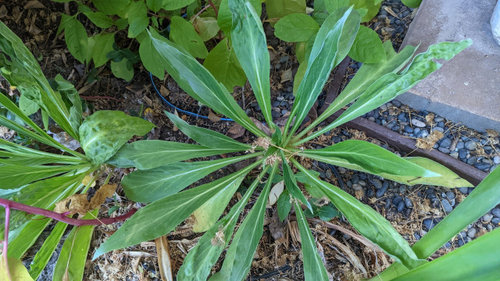
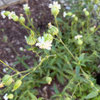
I have an Echium Webbii that we recently planted in the ground. As soon as we planted this, dozens of some different species suddenly appeared behind that plant. It looks like we brought some stragglers along and they are taking over. Does anyone recognize the plants I have circled in red in the photo? The second photo shows the Echium Webbii in front of those unidentified plants.


Comments (18)

  • 4 years ago

    I don't recognize the plant, but they look like tree seedlings, possibly a shrub. Is there something nearby that is the seed source? Got rodents?

    westes Zone 9b California SF Bay thanked Christopher CNC
  • 4 years ago
    last modified: 4 years ago

    Might it be sprouts from roots that were broken/cut when the Echium was planted...?

    What's in the vicinity?

    westes Zone 9b California SF Bay thanked carolb_w_fl_coastal_9/10
  • 4 years ago
    last modified: 4 years ago

    They look bizarrely similar to avocado seedlings which seems doubtful. What is the size of the leaves? Can you dig one up and see if there’s a nut or seed? Or are they all joined to one root stock?

    westes Zone 9b California SF Bay thanked floral_uk z.8/9 SW UK
  • 4 years ago

    No to the avocado. They remind me of something more along the lines of Stewartia. This is Nor Cal though and that is not my flora. The largest seedling in the center with the more elongated leaf and red stem even looks a bit different from the others.

    Whatever they are, they look like a dollop of seeds, not root sprouts that landed in the soil from some source.

    westes Zone 9b California SF Bay thanked Christopher CNC
  • 3 years ago

    Hoping OP returns to clarify...

    westes Zone 9b California SF Bay thanked carolb_w_fl_coastal_9/10
  • 3 years ago

    I always wonder about all the fuss made over these sorts of posts ;-) If you do not recognize it and it is not something you planted intentionally, then just get rid of it!! Its spontaneous appearance indicates it is likely not to be anything of value. Or if compelled to know precisely what it is, save one, pot it up and grow it on to a recognizable form or size.

    westes Zone 9b California SF Bay thanked gardengal48 (PNW Z8/9)
  • 3 years ago

    Haha - when in doubt, it's probably pokeweed 😃

    westes Zone 9b California SF Bay thanked carolb_w_fl_coastal_9/10
  • 3 years ago

    @carolb_w_fl_coastal_9/10 Nothing in the vicinity of the planting has this same style of leaf.

  • 3 years ago
    last modified: 3 years ago

    @Embothrium I have a Phytolacca americana in another part of my yard! I thought of it as a weed originally but those amazing berries converted me over to tolerating it. Maybe a squirrel grabbed an entire bunch of berries and placed it there. When we put in the drip irrigation, the seeds finally had water and went to work.

  • 3 years ago

    Remember animals who've eaten the berries will move around and deposit the digested remains elsewhere - whole seeds tend to move through the digestive tract intact...

    westes Zone 9b California SF Bay thanked carolb_w_fl_coastal_9/10
  • 3 years ago

    Pull one up. If it has a white carrot like root, it is Pokeweed. I considered that, but they look a bit different from my east coast Pokeweed. They don't have seed pods. They have dangling clusters of berries that change color over time.

    westes Zone 9b California SF Bay thanked Christopher CNC
  • 3 years ago

    @carolb_w_fl_coastal_9/10 What argues against it being an animal depositing it through stool is that 10+ plants appeared in exactly one location and no other plants of that species appeared anywhere else. What you say is still possible.

  • 3 years ago

    @Embothrium That gets my vote for identification of the year. To guess that based on such an early stage of the plant was impressive.

  • 3 years ago
    last modified: 3 years ago

    They look exactly like the eastern Phytolacca americana around here,(no varieties or subspecies throughout entire range), and the leaves, stems and petioles look exactly the same whether they're very young or old,(easy, no stretch). Were you referring to the cluster of berries as the 'seed pod'?

    westes Zone 9b California SF Bay thanked Jay 6a Chicago
  • 3 years ago
    last modified: 3 years ago

    P. americana is frequently asked about on social media so I have seen many pictures of it in various stages. With it also becoming something seen popping up on it own during later years in west coast locations. Typically where there has been alteration of site conditions by human activity. Such as at my previous habitation north of Seattle, where appeared in a bed with no others ever being seen by me elsewhere in the neighborhood. Even as conspicuous as this plant is, once fully developed (something that happens quickly). Such occurrences will of course be due to the species being bird-disseminated.

    CPNWH Search Results (pnwherbaria.org)

    Phytolacca americana var. americana (berkeley.edu)

    Phytolacca americana Profile – California Invasive Plant Council (cal-ipc.org)

    westes Zone 9b California SF Bay thanked Embothrium
  • 3 years ago
    last modified: 3 years ago

    Okay, so I just had a great laugh at myself and thought I'd share the giggles.

    I'm notoriously bad at identifying stuff and always love to read these ID posts - one, to test myself (and I usually fail!) and two, to learn. Not to mention to marvel at how many of you are so good at it! You all amaze me!

    I open this thread and see the photo and immediately think, oh! That's pokeweed! Then I read on and see there are various ideas and all this discussion, so I think, hmm, I was wrong again (not to mention someone's post about erronoeous pokeweed IDs being in the back of my mind lol!).

    So once again I marvel at the ID-making abilities on this forum, and in the interest of expanding my knowledge, click on Embothrium's links... and start laughing. Phytolacca americana, aka pokeweed!

    The funny thing is, 99.9% of the time I use the botanical/latin names for plants. For some reason I don't seem to do so for weeds - maybe because I'm not buying them and don't need to know if I have the right thing. But this is a good case for knowing them.

    Have a great day everyone!

    :)

    Dee

    westes Zone 9b California SF Bay thanked diggerdee zone 6 CT
  • 3 years ago

    Just remember the rule of thumb here on Name That Plant: when in doubt, it's probably pokeweed - a.k.a. Phytolacca americana 😄

    westes Zone 9b California SF Bay thanked carolb_w_fl_coastal_9/10
Sponsored
Peabody Landscape Group
Average rating: 3.5 out of 5 stars8 Reviews
Franklin County's Reliable Landscape Design & Contracting