Software
Houzz Logo Print
mcarroll16

Wrong light housings installed? What are my options?

3 years ago
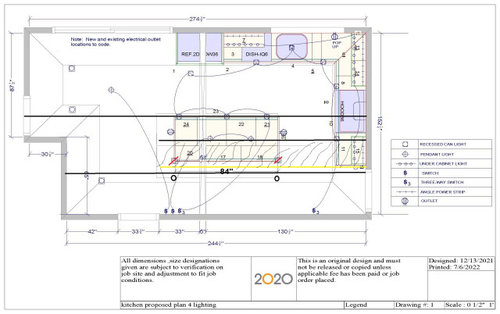
I need some emergency lighting advice. Electricians are coming tomorrow to install trims. Our kitchen designer retired last month and is not available to help us. Relevant facts, from the perspective of a stressed-out homeowner:

*Our kitchen designer designed a lighting plan for 5" recessed lights.

*We clearly asked our contractor for 5" lights with clear Alzak trim. We stated that verbally at the electrical walkthrough, and in writing with a follow-up email to our contractor.

*Electricians informed us late last week that the trims have to be integrated LED for code compliance. They did not mention this at the walkthrough, or I would have done research then on the LED options.

*Electricians installed Juno IC1W housings. Juno's specs say this housing takes 4" trims with conventional screw-in bulbs.

*The only LED retrofit trim I can find online for this housing is a contractor basic, white baffle trim.


I'm wondering what the reasonable position is here for us. Maybe 4" trims would work ok, even on lights spaced for 5" trims? (Ceiling height is 92", if that affects things.) I see the following options:

1. Let them install whatever trim is needed to pass inspection. If Alzak LED options aren't available, we install our own conventional Alzak trims with screw-in LED bulbs, and deduct that cost from the final payment. This option assumes that 4" trims are good enough.

2. If Alzak is not available for this housing, insist they change the housings, and negotiate with our contractor for how to split the costs (price difference of housings, labor, drywall repair).


What's a reasonable position here? Lighting really matters to me (nerve damage issues). I'm willing to accept a significant delay in finishing the project, and to bear some of the cost for a fix. But I want to make sure my expectations are realistic.


Attaching our lighting plan, for reference. Those weird squiggles mark a duct that is forcing slightly different placement of the lights from what the designer recommended.


Comments (15)

  • PRO
    3 years ago

    I have no clue as to why the lights need to be integrated at all. I think alot of electricians are still behind the times when using LED lights . Unless you have absolutely no space for even a retro fit electrical box there is no way I would ever do integrated lighting where all pot lights are needed . I like 4" cans all LED 4000K bulbs and have never needed to use integrated .Any buls can be replaced with LED no special anything needed .

    mcarroll16 thanked Patricia Colwell Consulting
  • 3 years ago

    You have a medical reason for having specific lighting. Does your primary doctor have that documented? Do you have a copy of that? Contact the ADA and possibly a lawyer. Also, I learned many years ago that: 1. If it's not in writing, it's hard to prove. 2. Anything that is said verbally needs to be proven. Document, document, document.

    mcarroll16 thanked Elaine Doremus Resumes Written
  • 3 years ago

    Thanks Patricia. The need for integrated is local energy efficiency building codes. We won't pass inspection without integrated LED trims. I'm not opposed to 4", but I'm worried that a lighting plan that was designed for 5" won't give adequate light coverage with 4". Our designer specifically said she thought the beam spread on 4" wasn't wide enough.


    Thanks Elaine. Fortunately I do have it all in writing. But I'm not going to take this to a lawyer. Not cost-efficient, not worth the relationship damage with a contractor who has mostly done really great work. I just need to know what a reasonable fix is, so I can be confident as I negotiate this.

  • 3 years ago

    First, clarify your local code requirement:

    - If you can specify a retrofit integral LED fixture into an Edison housing, then that does not prevent anyone from taking that out and putting an incandescent 'bulb' back in. That would defeat purpose of code.

    - From that ^^, if your code requires only LED lighting, then why didn't the contractor install a Juno QC 5" series which can only accept LED fixtures with it's wiring quick connect? This prevents from ever converting to Edison 'bulbs.' Or, a Juno IC20LED (5") which has a Juno LED light engine (more expensive) but you then can add a specular baffle.

    - Or alternatively to that ^^, they could have installed rough-in templates (instead of a housing) for any retrofit integral LED fixture.

    - If they have circuited the wattage for 60W incandescent fixtures, then there is no issue with going to LED retrofit. If they have circuited for 9W LED-only fixtures, then there could be a problem with overloading a circuit (though you could theoretically fit 24 60W fixtures on a 15a circuit).

    Then, clarify the design:

    - Why are you using specular baffles and a 5" trim? Typically, I don't see a specular trim in residential, beyond some 2" or 3" fixtures or very high ceilings. Here, you have a 7'-8" ceiling and a pretty standard kitchen layout. If for some reason you needed more lumens, I would think you would have went with a 6" can or more closely spaced 4" cans, rather than specular in trying to achieve 100% efficiency and a more direct beam spread. Also, in the old days I would see a 5" here and there, but not so much today in residential.

    - I do not see that layout as being a noticeable difference between a 5" can and a 4" can. Note that in the incandescent days, the trim size would dictate your 'bulb' style, which then dictates wattage and thus lumens. But now, you can get a 4" LED can that puts out as many lumens as a 6" LED can. So in your situation, there are a few ways to accomplish your goals. However, I am not certain of the original goals - was it more light, more directed light, less glare, aesthetics?

    mcarroll16 thanked 3onthetree
  • PRO
    3 years ago

    Not sure I am of much help. I don't think that the difference between 4" and 5" will be an issue either ( for reasons stated above ). Not sure where you live, but I don't believe that we have a code like that. Maybe call the local inspector and see if that is really true?

    mcarroll16 thanked Debbi Washburn
  • 3 years ago

    Thanks. I’ve read the local code now (a little late unfortunately). New lighting has to be “high efficacy.” For recessed ceiling lights that specifically excludes screw-in bulbs, even LED bulbs.

  • 3 years ago

    When I remodeled in California (Los Angeles) Code required that any lighting permanenty affixed - i.e. sconces, chandeliers and ceiling cans had to accept ONLY LED lighting.


    I needed to find interim sconces which accepted only LED lights and this was quite difficult as it had only been a few weeks since it went into effect and so there were almost none available for sale. I wound up "wasting" about $600 buying sconces to pass inspection which I took down when I found sconces I wanted. FWIW I am NOT a scofflaw and my sconces use LED bulbs as do my cans. The issue was that I couldn't find ones I liked that ONLY took LED lights within the time frame.


    OP - what do you want to happen. I am unclear as to whether this is solely a functional issue in terms of your eyes or partially functional and partially aesthetic. What is the cost differential for the various solutions.

    mcarroll16 thanked Helen
  • 3 years ago

    Then if the electrician is putting trims in, you're done with drywall and paint. So it was missed by the electrician, inspector during rough, and maybe your designer if they spec'd an Edison specific 5" Alzak reflector/housing.

    If the electrical inspection didn't catch it during rough, then they won't know the difference at final seeing a LED retrofit trim connected to the Edison socket hidden up in the housing.


  • 3 years ago

    Our electrical inspection was a joke. The electrician didn’t show up on time, the inspector glanced around, asked me a couple of questions about how things would be finished, and left.

    My issue is that I’m worried there just aren’t retrofit trims with an acceptable finish. White baffle trims glare badly. It’s ugly and it’s physically painful. I guess I’m ok just replacing the trims completely after final inspection, since fixing this to code seems likely to involve drywall work. It’s frustrating though that a solution might involve violating code.

  • 3 years ago

    The glare's a problem with all integral LED retrofits available to homeowners. The baffle isn't deep, and don't get me started on wafers. You'd have to go expensive to the light engine housings to get the deep LED baffles equivalent to incandescent trims.

    Well, the only solace is like Helen said and most of us, you will be using LED 'bulbs' no matter what. And it doesn't sound like you did anything wrong, your electrician messed up. Once you get that final sign-off for permit though, you lose some leverage to get him to come back and change the fixtures.

    mcarroll16 thanked 3onthetree
  • 3 years ago

    Thanks. Exactly my concern on leverage. He’s coming tomorrow to install. That’s when I find out what kind of trims he has. And that’s when I have a chance to negotiate ok cost. I can change trims myself. I just don’t want to pay for two sets of trims when this isn’t my mistake.

    Really bummed out now, and wishing I had done more research earlier. I would have happily paid for the expensive housings. Wish we were getting the hyperbolic lights. Missed the chance.

  • 3 years ago

    Thanks. That's probably about what we will do. Except Alzak. White trims are too much glare. Appreciate the feedback on light placement, as a top concern is just whether the plan is going to work for 4" trims.

  • 3 years ago
    last modified: 3 years ago

    @3onthetree sorry, somehow missed one of your earlier replies. You also gave helpful reassurance there about can size. I'm surprised though that you say specular is rare for residential. I already replaced our 6" living room trims with specular haze trims, because it made a big reduction in glare. That's my primary goal with lighting (beyond adequate lumens and coverage). As little glare as possible.

    Appreciate your info above about wiring for 60W incandescent vs. 9W LED. I think the former, as the wires between all the cans are 14/3 (or 12/3, can't remember). But that's something I will definitely ask about tomorrow. As to why they used this housing, instead of one of the Juno LED housings, that's what's frustrating me. They knew in advance that integrated LED was a code requirement. That alone should have made themoffer me the option of paying more for a housing with a good LED driver. But they also knew in advance that I wanted specular trim. Really really frustrating.

    I'd really like to ask that housings are replaced at electricians' or contractor's expense, and we pay ourselves for the cost difference of the better housings, and the extra drywall work (painting hasn't happened yet). Still trying to figure out whether that's a reasonable ask, or whether it makes me "that client."

  • 3 years ago

    Thanks everyone for helpful advice! Our contractor was slow to respond, but has come back with an offer to open the ceiling and replace the housings. I wouldn't do this for just a switch to 5". But based on 3onthetree's comments, I think we will do this in order to get better LED trim options. We will offer and expect to pay for the upgrade to LED driver housings.