Software
Houzz Logo Print
webuser_31980380324

Decision on which furnace - is it worth for 2 stage variable speed?

3 years ago
last modified: 3 years ago

Any thoughts on making this decision - which would you go for in this situation? Feel free to make comments if you think it would help my pro/con list!

premium furnace $5575

trane s8x2 2 stage variable speed 100K BTU

https://www.trane.com/residential/en/products/furnaces/s8b1/

deluxe furnace $4944

trane s8x1 single stage gas furnace 100K BTU

https://www.trane.com/residential/en/products/furnaces/s8x1/

standard furnace $4624

trane s8b1 single stage gas furnace 100K btu

Gas Furnace - S8B1 Gas Furnace - Trane®

same warranty on all 3, 10 year parts 20 year on heat exchanger

House scenario:

3 story townhouse 2000 sqft townhouse, 3 br 2.5 bath with finished basement

1 external wall, 1 attached wall

basement level has electric baseboard heat

1st and 2nd floor have duct heating

single zone system, thermostat on 1st floor

using ecobee smart thermostat

philadelphia area -

frigid winters dec - feb/mar

variable falls- with some days that dip

just purchased home 1 year ago - slightly at a premium, so keeping track of how much i put into the house. i also have had to invest other costly 1st year repairs like new gas fireplace and new driveway. the house was built in the 90s so many things are past their prime.

not sure how long i'll stay in the house - could be 5+ years - but if something in life randomly comes up with a reason i'd move, not stuck to this house as a forever home - could be a long term home bc it suits my needs just dont know what else life could bring.

haven't noticed pockets of hot or cold in any place particularly in the home, but only had 1 cold season it it so far.

premium furnace $5575 trane s8x2 2 stage variable speed 100K BTU
deluxe furnace $4944 trane s8x1 single stage gas furnace 100K BTU
standard furnace $4624 trane s8b1 single stage gas furnace 100K btu

Comments (29)

  • 3 years ago

    A 2-stage furnace for an additional $634 is a good investment in my opinion. The Trane S8X2 is not a variable speed furnace, What is the size and efficiency of a current furnace? I question if a 80% 100K BTU furnace is the correct size. Is the 2000 sq. feet all three levels or the two heated by the furnace?

  • PRO
    3 years ago

    I am not familiar with 2 stage gas furnaces we have hot water heat from a gas boiler I love that heat is does not blow dust everyhwere it heats the mass and so once all the mass its heate it stays very much the smae all the time. I does require rads but because they are hot water you can place furniture or even drapes in front .OUr boiler cost 10K the extra rads and install were about 20K so we have a 3300 sq ft house a main level and a full walk out basement I love the all the spaces stay at the same temp not vents to clean either .

  • 3 years ago
    last modified: 3 years ago

    In much of the US, including for this person location in Philadelphia, cooling season can be as long or longer than heating season. In these areas, hot water heat is not commonly found in newer construction. Using forced air for heat (whether from a heat pump or furnace) takes advantage of the same ducts as for air conditioning and is much cheaper equipment wise because it avoids having to install two different HVAC systems.

    This will continue to be the case and increasingly so as gas appliances get phased out in the US and heat pumps, mostly of the air source variety, will be the only systems allowed in new construction and ultimately for equipment change-outs.

    PS - I agree with the load calculation inquiry, 100K seems very much too large for 2000 sq feet.

  • 3 years ago

    I upgraded to a two-stage system (heat pump) and think the two-stage capability is worth the additional expense. The primary benefit is that the blower operates at a slower speed, reducing the noise of the air whooshing through the ducts; it's almost silent most of the time. Some ecobee thermostats support two-stage furnaces.

  • PRO
    3 years ago

    We have a home built to not get sun in the interior in th e summer so our cooling is minimal even when it is 95+ F for days on end . Many people here have gone to heat pumps I actully do not like AC so we have 2 portables we use when the temp gets above 100F for a short time before bed maybe.

  • 3 years ago

    Be sure to check the furnace warranty. When we did all new HVAC, installing a NEST would have voided the warranty.

  • 3 years ago

    " I actully do not like AC so we have 2 portables we use "


    Perhaps a few hundred million American live in areas where AC is an essential item, not a luxury, and those who can afford it, have it and use it.


    I think you're in Canada and from your description, you don't live in a climate with hot weather from spring to fall.

  • 3 years ago

    Thanks everyone!

    The house was built in 1995
    I have no idea the current furnace specs but I think it’s original bc it’s 20+ years old

    The furnace only heats the top 2 floors
    The basement has electric baseboard heat

    I have a central AC system that uses same ducts as the heater
    The AC system is 6 years old and does not need to be replaced . It is essential in the Philadelphia peak summer with high humidity and 100+ degree days.

    I have a gas hot water heater

    I had 3 companies give estimates
    All 3 gave two choices for standard or variable speed and all 3 listed the units at 100k btu

    It’s $1000 difference between the basic unit and the variable speed

    I’ve read and understood if I’ll be in the house for more than 7sh years I’ll earn back the efficiency savings that trade off the extra initial investment

    Apart from that savings I’m not clear on what other benefits variable speed would make a difference in my living experience

    I don’t notice any cold pockets anywhere
    My old standard hvac seemed to heat the place fine

    I also have a gas fireplace and a ceiling fan in winter mode that adds some warmth on the most open room with vaulted ceilings and Cathedral windows

  • 3 years ago

    Apart from that savings I’m not clear on what other benefits variable speed would make a difference in my living experience

    I think by variable speed you are referring to your quote for a 2-stage furnace. The Trane S8x2 2-stage furnace will operate at high and low stage or two speeds. Those two speeds are set at the time of installation and never change during normal operation There are 2-stage furnaces where the blower speed will change. as it operates. Those types of furnaces are much more expensive. the Trane S8X2 is not one of them.

    A 2-stage furnace is more about comfort and less about energy savings. The furnace will operate in the low stage most of the time. It will be quieter and have longer run times. Longer run times small increase in operating efficiency and potentially a longer life.

    Here are some questions:

    How did the three contractors determine the size of the furnace?

    Did they take any measurements or do calculations?

    Did the look at the current furnace and quote the same size?

    Did the size the furnace so it is compatible with your existing AC condenser and coil?

    Did they include a 2-stage thermostat as part of the quote?

    What size and type of filter is included in these quotes?

    What is the labor and parts warranty?

  • 3 years ago
    last modified: 3 years ago

    "The AC system is 6 years old and does not need to be replaced . It is essential in the Philadelphia peak summer with high humidity and 100+ degree days."

    You won't "recover" the extra $1000 with a multi stage/variable speed system - they are all about comfort, especially in your location with high summer humidity. Spend the extra money, get a variable speed furnace and a thermostat that can control humidity - you won't regret it.

    Unless your mid-90s house was very poorly insulated (unlikely), 100kBTU is probably too high and a 60k to 80k is more like. Tell them they can install a 100kBTU furnace only after they've done a thorough manual J heat load calculation, otherwise don't go over 80k.

  • 3 years ago

    100KBtu seems rather large with no supporting documentation.

    What’s the capacity of your electrical entrance?

    Will you require a new chimney liner; at what cost?

    What are your unit energy costs for gas and electricity?

    IMPO

    SR

  • 3 years ago

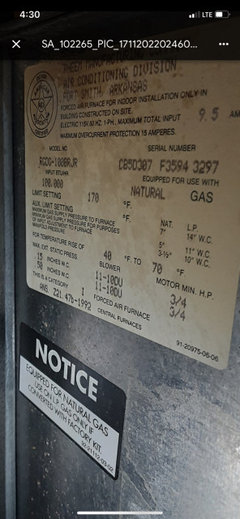
    Looks like my current heater was 100k btu
    So maybe that’s why they all priced that

    Don’t believe I need a new chimney just a partial piece of pipe

  • 3 years ago

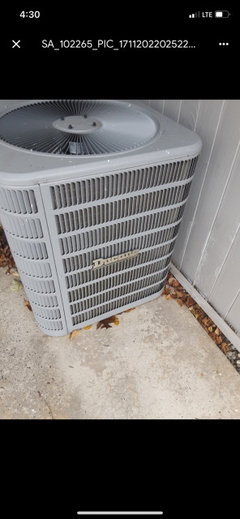
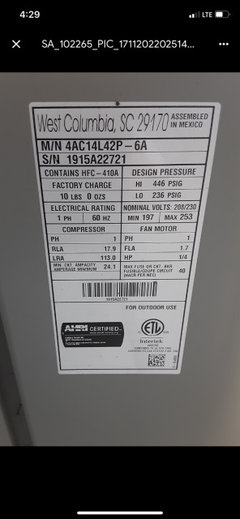
    I still doubt you need a 100kBtu furnace as the one you have is 30-yrs old. It would depend on the efficiency of your existing furnace v the efficiency of the new one. The new one would have to have a blower to support what looks like the 3-1/2ton AC condenser that you now have.

    A heat loss calc should still be done.

    IMPO

    SR

  • 3 years ago

    If I'm reading the label correctly, the 100K number is the gross input. I didn't look exhaustively but I didn't see what the efficiency is or what the output is.


    I'd like to point out to RM that if this furnace is an 80% efficient type (you'll know if it has a sheet metal exhaust coming out and going outside), it's producing 80K net BTU. If you were to replace it with a 90K furnace that's 90% efficient, that would be the same size and still too big - 90% of 90K BTU = 81K BTU, the same amount.


    A load calculation will determine the furnace's heat output needed, not the gross input size for a furnace. It's the net output number that matters, however large the gross needs to be based on the equipment's efficiency to get there, that's a different matter, of course.

  • 3 years ago

    Thanks all I don’t know about any of these things as I just purchased this home and have never needed to purchase a furnace or any hvac system before

  • PRO
    3 years ago

    R M,


    Most furnaces these days either use the variable speed blower or ECM which is more or less the same thing, except the ECM is cheaper than the variable speed.


    Because the ECM is cheaper, the life span may not be as long as a variable speed. With that said, they both fail much more frequently than the PSC motors they are replacing and they both cost more than PSC motor. They are both only minorly more efficient than the PSC, but the PSC wasn't programmable to do more functions. (I could go further, but rather stay outside the rabbit hole for now.)


    You have the top choice listed as a variable furnace and it's not. It's an ECM. Technically you could say ECM is variable, but these manufacturers try to do mystical things to be able to charge higher prices for stuff.


    In terms of sizing? 100K vs 80K --- it's all argumentive. I can only assume the duct work to this furnace was done properly when it was installed what appears to be nearly 30 years ago?


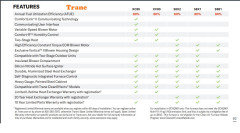
    click to enlarge.

    The above is a list of features: You'll notice the hyper bole right away. High efficiency constant torque ECM blower motor?


    What variable speed is not high efficiency and it costs more? oops.


    Sizing: You had a 100K btu furnace before internet people tell you put in smaller without telling you then need to replace all your duct work because the smaller furnace attached to an over sized duct system won't perform worth a lick. (*I am assuming here your duct work was properly sized for a 100K btu furnace or? Why would you get 3 quotes for 100K btu furnace. People who frequent boards like this being oh so helpful don't get into the finer details of the job. Keep that in mind.)


    The other is: Trane parts are quite pricey, the parts they use are no better than any other brand out there. Some areas of the country are better suited to certain brands because of distributorships in place and the need to get parts quickly. So the brand issue can be a complicated one for sure.


    The reason I say that is you could get some additional quotes of another brand just for fun. It may confuse you even more... but this is how you can gain some experience. Your best bet is to pick a company that is going to service it too.


    I service the Katy, Texas area.

  • 3 years ago

    Did any of the contractors measure the duct work? If not then measure the width and height of the main duct. Also post the size of the current filter. If these contractors insist on installing a 100K BTU furnace then at the very least you want them to install the proper filter size.

    Your AC condenser is 3.5 tons. That requires about 1400 CFM of air flow. That also seems oversized.

  • PRO
    3 years ago

    "They are both only minorly more efficient than the PSC, but the PSC wasn't programmable to do more functions."

    All motors have the capability to be variable-speed motors including PSC motors. I installed a number of variable-frequency controllers in the 1980s which allowed the speed of "fixed-speed" AC motors to be varied. What controls the speed of a motor are the motor controls. A PSC or any other type of motor isn't programmable; its motor controls may or may not be. Some ECMs have controls integrated with the motor as an assembly, but the controllers are still responsible for the control function.

  • 3 years ago
    last modified: 3 years ago

    " In terms of sizing? 100K vs 80K --- it's all argumentive. "

    No, for those properly trained and skilled in HVAC work, it's all measurable and objective. Load calculations.

  • PRO
    3 years ago

    Heck, what's 20K BTU/hr between friends? Well, quite possibly the difference between being comfortable and not. That's why you need to hire real professionals--not some guy with a truck and a dog. And it's the reason to rely on someone other than an installer who's fried his brain too often and for too long in hot attics.

  • PRO
    3 years ago

    Hi, Ray,

    Yes, I'm a licensed contractor. I'm also an engineer with a professional engineer's license (mechanical discipline.) I have 18 years of experience designing, specifying, sizing and selecting industrial/commercial HVACR components and systems and 23 years experience collaborating on the design of residential HVAC systems for each home we build and remodel. I suspect both the depth and breadth of my HVAC experience and expertise exceeds yours by a good margin.

    I don't use rules of thumb for sizing HVAC equipment.

  • PRO
    3 years ago

    Ray,

    You continue to apply a "builder" label to me and others to suggest some sort of limits on our ability to do other things--like HVAC design. You'll find lots of talented builders and architects here on houzz that have a broad range of skills. And, if you can get past the label, you can learn a thing or two like what dewpoint is, relative humidity,....

  • PRO
    3 years ago

    Ray,

    The context of the original post--which you have conveniently omitted--was to address your continued and unwarranted builder bashing with regard to shoddy HVAC systems.

    You blame builders for poorly designed and/or poorly installed HVAC systems. To be sure, many builders and architects don't pay much attention to HVAC systems. They rely on mechanical contractors to do what's necessary. They often choose the lowest-bid alternative that meets codes or the approved specifications because they're competing with others to sell homes based on price. If you need to assign blame for lousy HVAC systems, you can allocate it among the following:

    1. inadequate and/or poorly written mechanical codes; 2.) little or no specifications from a design professional; 3.) little or no review of equipment sizing and system design by code officials; 4.) inadequate or zero inspection in the field 5.) poor training of HVAC technicians 6.) HVAC companies that are willing to install lousy equipment and inadequate systems; 7.) uneducated home buyers or home buyers more focused on granite and stainless steel appliances than on systems like HVAC; 7.) home buyers programmed to purchase based on price, etc.

    As for my company, our ongoing, 16 +/- year collaboration with a single HVAC trade partner is outside the norm. The ability of our team to design and deliver better performing systems is a differentiating competency.

  • 3 years ago
    last modified: 3 years ago

    Unfortunately, many (not most, not all) builders do not understand HVAC, and sub the work out to the lowest bidder. This is a recipe for failure. This is what many posters on this forum are having to deal with. The other problem is that many HVAC businesses are not much better. That's what many more posters on this forum are dealing with.

    Pissing contests between contributors does nothing but confuse the original posters as to what options may be available to them and are counter-productive. If we can stay on topic, this would be a much better forum.

  • 3 years ago

    I agree with Austin insofar as the unprofessional past practice of many contractors building new homes doing so oversized HVAC equipment, but the irony and hypocrisy of his comment is that by his own admission, while scoffing at load calcs, it's clear his outdated practices tend to simply replace like with like sizewise when putting in new equipment and thus perpetuating the mistakes made by the less sophisticated builders that are common in his area. Can't have it both ways, Austin.


    I agree with sktn's comment as well. Both as to the ineptness and lackadaisical attitudes of many contractors (though clearly not CR Homes) AND as to the futility of the pissing contests. Another irony is that the most active purveyor of misinformation in this forum doesn't realize how his often patently ridiculous comments (and cartoon videos) accomplish the opposite of what he thinks they do. He'd be better off spending the time printing and distributing flyers.


  • PRO
    3 years ago

    You blame builders for poorly designed and/or poorly installed HVAC systems.


    Don't you do the same thing in not so many words Charles? Who is to blame, if not the builder?

    • The house is a recent newly built house.
    • The house is an older home.
    • The previous owner took the recommendation of repair of the house from houzz or some other DIY site / home warranty / etc.
    • Blame can only be put where it's deserved. New home meaning newly constructed is different than a rehabbed home or "flipped".
    • The contractor(s) chosen did it because they were "directed to". Who directed them? A builder perhaps? Let's not think about that.
    • The contractor(s) chosen did it because they were "directed to". Who directed them? A home owner that got illustrious info from a DIY / flipper website?
    • Context is important.

    3 out of 4 people are not happy with their recent home buying experience. These are the facts.


    Ray you can't have it both ways from a home owner?


    Elmer this is a mile in my shoes sort of thing from what I deal with from the list above.

    It's more often the equipment is undersized if anything in a flipped home build because?


    So "new home" has more than one meaning. From a forum board we can pretend all day long what the actual problem is.


    If I can't have it both ways I think you need to elaborate more... there's more ways to disaster than you can imagine from my viewpoint. When I go in to a new potential job I am 99% of the time repairing the system.


    From there I make recommendations, that are greatly influenced by the budget of the home owner which in my market is 95% people here working a job as opposed to some one who bought a house to live the rest of their life. Not many can stay in my market for a lifetime. So this is an additional equation to contend with.


    I pick my battles very carefully ---- so to say I can't have it both ways doesn't really tell the "whole story". I've been in homes in which the home owner was told the equipment wasn't sized properly. That is argumentative as the day is long. The home owner gets told they need to replace everything because of it.


    I make a repair, some times that may include replacing a "part" of the system. I have been successful in that for 29 years. 15 years running my own company. If problems strike again I go back again.


    While I could replace a whole system that is an extremely rare event for me to do so. Service is a much larger market than to run around giving bids to tire kickers. I don't have the man power for that side of the market. There's companies here that will run anywhere for free to give you an estimate, they advertise on TV, they go out and will tell you that you need to replace everything for 15K, 20K maybe even 30k. They have to do that to advertise on TV. The are professional sales people they know what buttons to push.


    I'll have an illustrated story soon about this exact thing on my YouTube Channel. I was the one who got the job to fix it. It was a repair, but everyone else was telling them to replace everything. Did it go smoothly?


    Not entirely, I recently had to go back because the furnace was having random fits blowing cold air. Like I said... I will go back... only to go back again and again if necessary.


    My most favorite HVAC brand? any brand that is broken. They all break.

  • 3 years ago

    " It's more often the equipment is undersized if anything "


    This comment is surprising coming from someone who's said repeatedly that load calculations aren't SOP for your equipment replacement projects. If, as above, equipment installs are a small percentage of your work, why do you comment on such user questions at all? If you do, start off by saying "I do very little of this kind of work and don't have a lot of experience with it, but......."

  • PRO
    3 years ago


    " It's more often the equipment is undersized if anything "

    We do a fair amount of remodel work where additional living space is either added or an unconditioned space such as a walk-in attic is converted to conditioned living area. In my experience, HVAC systems tend to be oversized more often than not. The problem with oversizing is that the run times are short and don't allow for adequate dehumidification. So the temperature may be at setpoint, but the indoor environment is clammy. It's futile to complain to an HVAC contractor if the system is controlling to the desired temperature. And even more so when that contractor doesn't have a clue what relative humidity is.