Software
Houzz Logo Print
todd_gregory30

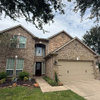
Raised garden bed up against attached brick garage?

3 years ago

I know this has been asked before but my situation is a little different than others since this is the garage which is on a slab.


I'm looking to install two rows of raised garden beds along the side of my garage which faces south. To save space and materials, I would like to build one of them against the garage and use that as a wall (also as a deer fence so that I only need to fence in 3 sides). My garage is brick. Are there any concerns about doing this? Garden beds will be 24" tall, so I can't imagine much water getting all the way down to the ground unless I grossly over-water. I would also be putting in some sort of drip irrigation to reduce that possibility.

Comments (20)

  • 3 years ago

    " Garden beds will be 24" tall, so I can't imagine much water getting all the way down to the ground unless I grossly over-water. I would also be putting in some sort of drip irrigation to reduce that possibility. "


    What about rain? And the moisture in the dirt? Brick is a giant sponge so that is in my opinion a bad idea.

  • 3 years ago
    last modified: 3 years ago

    Brick in contact with soil will deteriorate. That's because bricks are porous and will absorb water. The deterioration will happen especially fast if it goes through a freeze-thaw cycle, which might happen near the surface. Acid soil will do a job on mortar as well. Standard construction keeps all brickwork above grade level. In principle, you can mitigate some of that degradation with brick or concrete sealer. I'm not sure about the toxicity of that stuff though. Certainly water-based sealers are preferable. Be aware that if the brick was repaired with caulk, most caulks have a lot of PCBs, which are toxic.

    https://flourishingplants.com/protect-a-brick-wall-from-soil-and-moisture/

  • 3 years ago

    Well, glad I asked. What about putting a plastic sheet on that side against the wall to prevent contact with the soil? I have 6 mil sheeting on hand. There is also good roof overhang at that side of the house. The soil is bone dry up to a foot away from the house typically.


  • 3 years ago
    last modified: 3 years ago

    You talked about raised beds and that would bring-up the soil level onto the brick, and this is a valid concern. The plastic sheeting will create it's own problems by trapping moisture behind the sheeting. I wouldn't do it.

    Is there some reason you need to make raised beds? It seems, if you didn't raise the soil level, there wouldn't be a problem.

    Whatever you do, you need to keep that brick dry and able to have air circulatiuon help with that. And, plants need that air circulation too - to keep from getting fungus and such.

    Good luck!

  • 3 years ago

    Put a plastic dimpleboard against the brick for the 24" height. All the way to grade, so there is airflow and moisture and water through weep holes can still exit the brick veneer.

  • 3 years ago
    last modified: 3 years ago

    As noted, plastic against the brick will just trap water and prevent the brick from drying out when water gets in, as it certainly will. Weep holes will allow water to go both directions, not good. Again, a painted-on sealer may be your only viable option if you want to do this, but you have to think about possible toxicity, and that sealer is probably only good for a decade or less.

    What you might do is build a separate wall, maybe with stacked cinder blocks, a half foot or so away from the brickwork, and mound soil up against that. In fact, just ring the bed with stacked cinder blocks, and you're good to go.

    Note also that "bone dry soil" is never really bone dry.

  • 3 years ago

    @daninthedirt (USDA 9a, HZ9, CentTX, Sunset z30, Cfa) Dimple board is used against foundation walls below grade. Google. It will allow water accumulated to fall without penetrating the wall, and air for moisture mitigation will circulate. Weep holes are what are designed within brick veneer walls (well, supposed to be but most houses are wrongly built without them) to allow the moisture that collects between the brick and wood framing to accumulate at the bottom and exit.

    There are many examples of houses with built-in planters as part-n-parcel of the house (Frank Lloyd Wright, anyone?). Typically, they are lined with a waterproof membrane, but here, since it is being added later and the wall wasn't designed for it, I would go with dimple board so as not to overthink it.

  • 3 years ago
    last modified: 3 years ago

    I know that dimple board is used for protection against water intrusion up against concrete foundation, but we're talking about brick. The idea is that moisture condenses on the dimpleboard and drops to the base, and exits through weeps so you don't have liquid water actually contacting the concrete. But the air in there is still very moist. Brick and continually moist air don't go well together. In fact, while dimpleboard will keep liquid water out, it'll lock in moist air. The brick won't ever dry out, and it absolutely needs to dry out.. The idea of keeping brick in a suspiciously moist environment, where you can't see it and see what's happening, isn't particularly attractive. I guess you can pile up moist soil against dimpleboard over brick and cross your fingers.

    I should add that bricks may have been mortared with toxic adhesives, so even with dimpleboard, those toxins are going to come out of the weep holes into the bed. Of course, you can make a planter with bricks, but you have to assume that it will gradually degrade, and you'd be smart to use non-toxic binder, if you're even mortaring it at al. But if you aren't growing edibles, no sweat.

  • 3 years ago

    I would put the raised beds further out away from the garage. You will be watering the plants in there, and that water doesnt need to be up against the garage. Its never a good idea to have a raised bed against any structure.

  • 3 years ago
    last modified: 3 years ago

    Penny wise, pound foolish.

    And aside from that, planting things against a brick wall in full sun will bake the plants in the heat retained by the bricks.

  • 3 years ago

    I've built several retaining walls with wall block. Wall blocks are basically big bricks. So how come it's OK to have dirt against wall blocks, but not bricks?

  • 3 years ago

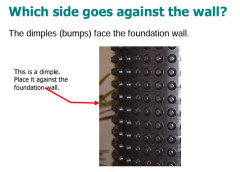
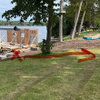
    I think there is some misunderstanding and overthinking here. Here is a dimple board, it is HDPE and in this case is used as an air gap membrane:


    Remember, there are probably also insets with the mortar of the brick, so even more air space allowing movement of air. Soil placed against the "flat" side will not make it through the HDPE. You can overspray the planter, rain can blow against the brick, condensation if for some reason there is a huge difference in temperature/dew point within the air space, a hurricane, whatever happens, and most of the water will fall to the earth within this airspace. Any moisture the brick absorbs is just like the exposed walls on the rest of the house.

    This air space is not a biodome trapping humidity, and the OP did not say they are planting an Amazon jungle in the planter. It is 24" high=about 9 or 10 brick courses, and with humidity, you are dealing with air movement between low/high pressure. Pressure movement is a powerful natural phenomenom, so air will move regardless of the size of a gap.

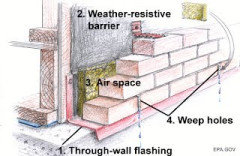
    As far as the weep holes, these have nothing to do with water falling within this dimpled air space or humidity in it. It is a standard detail at the bottom of the house brick walls that allow moisture that goes through the brick (it will happen whether a planter is here or not) to collect within the wall air space and exit the wall. The dimple board will simply allow that to continue to exit the wall.


    Todd thanked 3onthetree
  • 3 years ago

    If by "wall blocks" you mean concrete cinder blocks, those are decidedly not brick, and don't absorb water. That's why they make below-grade slabs out of concrete, and not brick.

  • 3 years ago

    My garage is brick.

    Solid brick or brick veneer over framed walls?

    Do you live in termite country?

    Orkin Subterranean Termite Infestation Probability Map


  • 3 years ago

    Besides all of the above, if you have 4x8 beds, are you going to be tromping through your beds in order to pick stuff in the back? I have a small yard and made sure there was at least 18" from the wall (which actually gives some heat), so that I can squeak by in the back to pick whatever is growing on vines or just is in the back row!

  • 3 years ago

    I appreciate the suggestion of dimple board and recognition that I am not growing an Amazon jungle. I don't understand what it is about these forums that encourages prideful comments that suggest that I actually know the answer, and am just being stupid.


    "Exactly how much space and materials will you be saving by cheaping out on building the back wall of your 24" tall raised bed? Is it worth the risk of damaging the wall of your garage?" Is this a question or a statement? Well, the reason I came on here was because I DIDN'T KNOW there was any risk of damaging the wall. By your answer I will assume you believe there is.


    "Penny wise, pound foolish.

    And aside from that, planting things against a brick wall in full sun will bake the plants in the heat retained by the bricks." Again; doesn't even answer my question. Plus, really....bake my plants??? C'mon man. You don't even know what color the brick is. I've had stuff planted here since I moved in and it does just fine. Tomatoes love heat.


    All that said. after more deliberation and layouts, I ended up pushing the whole thing away from the house 24" to give me another walkway even though it creates the need for another door now. Now that it seems like soil in contact with brickwork is going to make the brick crumble apart; I should probably do something about the soil that has been pushed up on 2 courses of brickwork for the last 55 years. Miraculously, the house is still standing.


  • PRO
    3 years ago
    last modified: 3 years ago

    It is a wise idea to have walking space all around your beds if you can, especially if they are going to be over three feet deep. Regardless of the height of the bed, once you get over three feet deep, it starts to become more difficult to reach in from one side for most of the work.

    What materials are you planning on building your beds with?

  • 3 years ago

    "Exactly how much space and materials will you be saving by cheaping out on building the back wall of your 24" tall raised bed? Is it worth the risk of damaging the wall of your garage?"

    That is two questions with two question marks. It is not a statement. I am sorry you took it the wrong way. It was intended to help you think through the consequences of what you were asking. At least I did not mention that a three sided box unless it was firmly attached to the garage wall was going to have trouble holding in the soil and not bending and warping from the weight of the soil and water.

  • 3 years ago

    Todd, one of the primary reasons for not piling dirt up against a wall is because it is an open invitation for termites to infest the framing. You haven't clarified if this is solid brick or brick veneer and we don't have any indication of where you live. Subterranean termites are a problem in a large part of the US.