Software
Houzz Logo Print
worthyfromgardenweb

Condensing dryers anyone?

3 years ago
last modified: 3 years ago
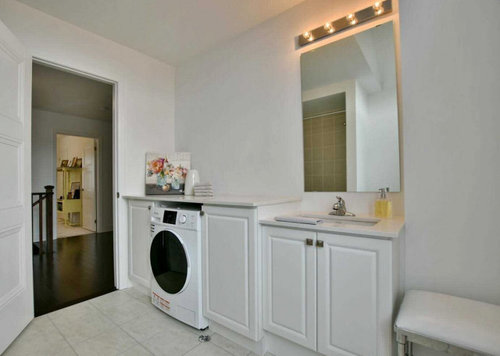
Just noticed this Danby combo washer/condensing dryer on the second floor of a new home in Collingwood, Ontario where there's clearly room for standard units.

Note floor drain, required by local building code.

We were considering a condensing dryer for a new build strictly to avoid an exterior wall vent on the front of the home. Plus it would be on the second floor 16' above grade, so hard to access for cleaning. Anyone with experience using a combo washer/dryer or stand-alone condensing dryer?

Comments (28)

  • 3 years ago

    I have a miele condensing dryer and I love it. It drains directly into the outgoing water so no need to manually empty like in the old days. The newer units dry much better than the older units did and condensation dryers always seem to be easier on clothing.

    worthy thanked Linda Choi
  • 3 years ago
    last modified: 3 years ago

    There is ONE full-size condensing electric dryer in the US: WhirlpoolWHD862CHC / Whirlpool WHD560CHW. In CR's tests, its performance was mediocre.

    worthy thanked wdccruise
  • 3 years ago

    I would suggest skipping condensor dryers and only look at heat pumps. Some may consider them condensors, but they are significantly more efficient.


    Think of condensors as previous technology and heat pumps modern technology.

    worthy thanked luna123456
  • 3 years ago

    I also suggest getting a heat pump dryer. I have a Miele T1 heat pump dryer. It's small but works well and is efficient.

    worthy thanked littlegreeny
  • 3 years ago

    I see Bosch, Samsung, Miele, Danby, GE, Midea and Insignia offer condensing and/ or heat pump dryers where we are. So there seems to be a growing interest in them.


    The house we're now in was rebuilt extensively after a housefire originating in the dryer vent. I've also had enough of chasing and /or blocking birds and mice from dryer vents!

  • 3 years ago

    CR has ratings of condenser and heat pump dryers ($10/month digital). All are compact. Click 'More Filters' to exclude vented models.

    worthy thanked wdccruise
  • 3 years ago

    Heat pump dryers are a better option. Ours is Samsung and MUCH cheaper to run. It’s also condensing in style so the water either collects in a tank or you plumb it so that the water discharges straight out (ours is plumbed into the sink piping)

    worthy thanked shelleyuk
  • 3 years ago

    I had a Splendide combo washer/dryer but I got the vented version instead of condensing due to extended dry times. Its capacity was pretty small to do anything without wrinkles but it was nice to put in a load and come hours later to clean dry clothes. It was important to sort clothes for being able to wash AND dry together eg could not do combined cyles if needing to remove lingerie. But, this was in the motorhome that we wintered in so I was very happy to have anything. For a house that presumably has more room I would heartily recommend separate units.


    In my house I now have Miele W1 / T1 heat pump dryer and am very happy with it. The laundry room is in an addition and while there was a vent into the wall when we bought it, we found out that it just dumps the lint and moisture in a soffit/ chase rather than venting properly. :o Fixing that was going to be several thousand dollars due to the house addition and construction (exterior wall, flat roof, etc), so I chose to spend that money on the heat pump non-venting dryer instead.


    I had the set installed in August and there was no noticeable difference in heat in the room and this is in Phoenix AZ! I would think in Ontario you would be A-ok. :)


    worthy thanked mtnfever (9b AZ/HZ 11)
  • worthy thanked bpath
  • 3 years ago

    @mtnfever (9b AZ/HZ 11): "I had the set installed in August and there was no noticeable difference in heat in the room..."

    A heat pump dryer will cool the room. A condenser dryer will heat the room.

    worthy thanked wdccruise
  • 3 years ago

    Go with heat pump. Like others here, I have the Miele model and love it, it's very quiet and gives off practically no heat into the room - Plus, it has reverse tumbling!

    worthy thanked Cal
  • 3 years ago
    last modified: 3 years ago

    A heat pump dryer rejects excess heat into the room but not enough to make a noticeable difference.

    worthy thanked littlegreeny
  • 3 years ago

    @littlegreeny: "A heat pump dryer rejects excess heat into the room..."

    "Rejects"? "Excess heat"? You don't seem to understand how a heat pump works.

    worthy thanked wdccruise
  • 3 years ago

    Electric motors generate some heat when they run. Heat pump dryers involve a compressor and the motor that turns the drum, and possibly also a fan/motor to circulate air through the drum and condensor and evaporator.

    Refrigerators and freezers, in the same way, increase the temperature of the space in which they're located, beyond the amount of transfer-heat that is moved out of the food-storage compartments.

    worthy thanked dadoes
  • 3 years ago
    last modified: 3 years ago

    @wdccruise I have a Miele T1 dryer and know exactly how it works. Can you say the same?

    On the front bottom right side there is an air intake. Behind the grill is a condenser coil and variable speed fan. The fan operates periodically during the cycle and cool down period. Warm air is blown from below and behind the dryer.

    The refrigeration cycle of a heat pump dryer is exactly the same as a common dehumidifier. A dehumidifier blows out warm air.

    I'd appreciate it if you DO NOT comment on anything I say on these forums.

  • 3 years ago

    @littlegreeny: "A dehumidifier blows out warm air."

    No, a dehumidifer blows out cool air. Cool air holds less moisture than warm air. A dehumidifer's heat pump cools air passing through the unit. Water in the now-cooler air condenses inside the unit and is drained into a container. Cooler, drier air is emitted by the dehumidifer.

  • 3 years ago

    Not that I care what temperature of air a dehumidifier blows, a quick google check says a dehumidifier blows out warm air. If the air coming out of a dehumidifier is cool, it is apparently not functioning properly. Maybe when that gal corrects you, she can at least check her own facts littlegreeny.

  • 3 years ago

    @armjim: "a dehumidifier blows out warm air"

    Please explain how a dehumidifer removes moisture from the air without reducing the temperature of the air passing through the system. Does warmer air hold more moisture than cooler air or the opposite? Does condensation form on a window when the window is warmer than the ambient air or when it is cooler? When you remove a can of soda from your refrigerator does condensation form on the outside of the can when the room temperature is warmer than the can or when it is cooler?

  • 3 years ago

    wdcruise, I was very precise in relating what I read on a quick google check. Perhaps in your zeal to try and post something to make someone squirm you did not carefully read what I posted.

  • 3 years ago

    Cruise must not own a dehumidifier. Because if they did, they'd know the exhaust air is warm. We all know cruise only relies on the internet for their information and "expertise." Consumer Reports and other cruise resources don't go into detail on how a dehumidifier works. Too bad for cruise...


    A key part a dehumidifier has that an air conditioner doesn't is the cold dry air then passes over the hot condenser coil and is reheated. This air is warmer than the ambient room air.

  • 3 years ago
    last modified: 3 years ago

    @littlegreeny: "A key part a dehumidifier has that an air conditioner doesn't is the cold dry air then passes over the hot condenser coil and is reheated."

    Wait? What? You're finally understanding that a dehumidifier is only able to remove moisture from the air by cooling it? Hallelujah!

    "Because if they did, they'd know..."

    I've been cloned!

  • 3 years ago
    last modified: 3 years ago

    Mr. Cruise,

    A freestanding dehumidifier pulls room air through a refrigeration evaporator (cold coil) to condense moisture out of it into a collection bucket (which may or may not have a drain hose attached). That airflow then passes through the condensor (hot coil) of the refrigeration system and gets thus gets rewarmed before it blows back into the room. The output air is warmer than the air that went in due to the additional heat of the refrigerant gas compression and operating heat generated by the compressor and fan motors. They're basically a window air conditioner sitting fully inside the room.

    How Dehumidifiers Work by Bob Vila (among other available explanations)

  • 3 years ago

    Once again cruise is being a bully and acting like a 13 year old.


    Sadly cruise has single-handedly destroyed the houzz forums with his massive ego, constant belittling and bullying of anyone who questions him.

  • 3 years ago
    last modified: 3 years ago

    A dehumidifer is not technically a heat pump since the heat generated by the compressor and in the refrigerant is not used for anything, like it is in a dryer. The energy used for cooling in a dehumidifer os also not moved from one medium/place to another either (hence where the ”pump” comes from in the name)

    it is literally just an dx coil and a waste heat rejection coil. It is doing work, but since it is not extracting sensible energy from the air or depositing in a different area/medium then it is not a heat pump. It would properly be called a DX coil with waste heat rejection. DX is an abbreviation for Direction Expansion which is what happens when the high pressure refrigerant is forced through a small nozzle into the larger coil. The refrigerant expands and cools.

    Air then passes over the cool coils, which have to be below the dew point to condense out moisture. The air cools and dew forms on the coils and drops onto the collection bucket.

    The cool coil picks up heat from the air.. Sensible heat and latent heat. Latent heat is the humidity. Sensible heat is the air without the moisture.

    There is usually a single fan that is placed on the exhaust side of the ”cool coil.” This fan blows the cooled air over the ”radiator” where the waste latent/sensible heat that was absorbed from the cool coil is rejected through a separate ”radiator” coil.

    This waste heatbis then sent back into the room. Usually the compressor and electronics are somewhere in this air path as well to keep them cool.

    In order for this to be considered a ”heat pump” there would need to be dual coils in the inside and the outside of the space. There would be piping thatbwould transport the refrigerant OR water, in the case of geothermal or traditional water source heat pumps. Heat would be absorbed in one space and rejected in another space with that other space providing a source of heat.

    Probably more than was needed, but hopefully that gives a better idea of what is happening.

    In a Miele dryer the ”waste” heat is just sent back to the inside drum to pickup more latent heat from the clothes (moisture). The process is mostly a closed loop. This is what separates a heat pump from a condensor. A condensor takes room air in and passes it over a ”radiator" matrix to cool it. A separate source of heat, usually an electric heating element provides the heating source. There is no reuse of the rejected sesible heat and it is vented back into the room.

    This is why condensor dryers don't work very efficiently in hot and humid locations or if they are closed up in a closet. Heat pumps have the compressor as the source of the energy for the "cool" side so they work in a much wider range of temperatures. The also dont vent the waste sensible heat into the room. It is deposited in the refrigerant and this heat is then "pumped" to the other coil where it used to rewarm the process air. This saves an large amount of energy and puts the waste heat to work.

    And that my friends is why a heat pump dryer works well on a 120V circuit. It doesnt need to constantly heat a large volume of air. Much of the generated heat is re-used. The electricty consumed is mostly embodied in the moisture that was removed.

    I bet Miele could have a small pump where the condensed water feom the T1 could be used as a source of water for the washer. This would at least put the embodied energy in the water to some use. For people who live in arid climates it could offset 1/4 to 1/3 of the water used in a wash cycle. I bet it will come eventually.

  • 3 years ago
    last modified: 3 years ago

    I got my Miele washer and dryer in October. I had used a GE washer and condenser dryer in a vacation rental. It took a really long time to dry and the room got really hot. I really like the Miele heat pump dryer. The washing machine will spin normal loads at 1600rpms while other dryers only go up to 1000rpms. The towels come out feeling like they are almost dry. That helps cut down the time of the dryer. It takes a bit longer to dry but I definitely feel it is less harsh on the clothes. My soft robe came out so much softer than in a regular dryer. Cotton items take longer to dry than the polyester so I wash them and dry them separately where as before I would throw them out together. The room does not get warm. I no longer have to clean the exhaust vent. Also most people don't realize that a traditional vented dryer also need to be cleaned on the inside. I had opened ours up and found a lot of lint especially where the hot air is blown up into the dryer and it was black. I don't think I have to worry about that anymore. The air goes through two lint screens and the plinth filter. All in front and easy to clean.

    You shouldn't use dryer sheets in the Miele because of the plinth filter. I had stopped using them a long time ago. They have a lot of chemicals and can leave a coating on clothing. Miele has scented flacons that you put in dispenser in the lint drawer. You can adjust how much scent is released. I didn't think I would like it but now I love it. Dryer sheets never seemed to leave much fragrance and some fragrances are overpowering. Their scents come from a French company that is family owned. They use essential oils instead of artificial fragrances. From what i have read, vented dryers creat the static cling. I have not had any of that with the Miele heat pump dryer.

    Heat pump is more energy efficient, even more than a gas vented dryer which surprised me. No more need to vent outside. The Miele works on 120v unlike all the others which require 220.

    I wouldn't want to go back to a regular vented dryer again. I don't think I want a different brand of washer and dryer either.

  • 3 years ago

    Very interesting post Tina. I don't recall ever hearing about the fragrance flacons and I found a lot of what you discussed intriguing. I would love to not have to have our vent cleaned annually. Luckily the guy we use is thorough-he also meticulously cleans the dryer itself. Our dryer will probably last another 10 years and it will be hard for me to justify replacing it if we remain in this house for a reason beyond it wearing out, but I certainly see the plusses of using a different type of dryer.

  • 3 years ago

    I would not have gotten them either but dryer was broken and then washer went. Miele was the only one that fit the space and didn't require changing to 220v outlet. I am so glad it was the only one like that because I really love it. I usually never replace anything unless its broken and not worth fixing anymore. My truck is 18 years old but runs great. In your case I can understand not replacing it. I wouldn't either. I was the one cleaning the vent so at least you have someone to do it.