Software
Houzz Logo Print
melanieforster635

Do you have HVAC in your laundry room?

2 years ago

My contractor was surprise by my request to route my HVAC to my new laundry room. Is it unusual to have HVAC in the laundry room? Thanks

Comments (42)

  • 2 years ago

    Title question answer: yes.

    Post question answer: not when the space is part of the environmental envelope of the house.

    Melanie Forster thanked dadoes
  • 2 years ago

    I would say it's very common to have your laundry room connected. I would certainly want my laundry room to be climate controlled, considering the moisture element, tbh.

    Melanie Forster thanked User Post
  • 2 years ago

    Is your new laundry room on a porch, or what was built as non-climatized space? If the area isn't properly weatherized and insulated, heating and air conditioning it could get tricky and expensive.

    Melanie Forster thanked latifolia
  • PRO
    2 years ago

    Yes generally speaking but it also needs a cold air return so you can close the door to keep tidy and noise down.

    Melanie Forster thanked Flo Mangan
  • 2 years ago

    My previous house laundry had hvac but my current does not. In my current house the laundry is in my walk out basement. The room is small and the temperature in the room stays the same as the surrounding rooms with hvac.

    Melanie Forster thanked vinmarks
  • 2 years ago
    last modified: 2 years ago

    Our laundry room is connected to the HVAC of the house; it is part of the living space in house.. Otherwise, it would be too hot in summer and too cold in winter. i cannot imagine a laundry room not having HVAC unless it is in an unfinished basement (my sister's house), a garage (next door neighbor at previous house and their washer froze whenever we had subfreezing temps), or a lean to shed addition (1890s house we used to own, built before indoor plumbing.)

    Melanie Forster thanked Cavimum
  • PRO
    2 years ago

    We always call for laundry rooms in our designs to be conditioned.

    Melanie Forster thanked Norwood Architects
  • 2 years ago

    Every house I've ever owned has had all of the HVAC equipment in the laundry room!

    Melanie Forster thanked rwiegand
  • 2 years ago

    I'm curious why the contractor was surprised. Is there something unusual about your laundry location?

    Melanie Forster thanked Andee
  • 2 years ago
    last modified: 2 years ago

    Thank you everyone Our laundry is upstsirs we converted a closet. It is 11 x 5.5 - not huge but i would imagine it would get hot. My contractor questioned why i would want this so then i started to question it. i appreciate all your responses and i will connect my HVAC in there as planned

  • 2 years ago

    Installing a supply vent in a confined laundry room is common and not an issue, but you really don't want to install a return vent. A return vent opens up a remote possibility of creating negative pressure in the room that could effect the dryer exhaust, so you will seldom see a return vent in a confined laundry room.

    Melanie Forster thanked kevin9408
  • 2 years ago

    Our laundry room sits atop the crawlspace and is surrounded on 3 sides by the unheated garage, outside wall, and unheated enclosed porch. I’m very glad it has HVAC, especially heat! It’s still chilly because the duct travels through the entire basement crawl before it gets to the laundry.

    For your new laundry, if it is unwieldy or expensive to include hvac, consider a louvered door to allow some air movement.

    Melanie Forster thanked bpath
  • 2 years ago

    Hmm. An 11 x 5.5 room isn’t very big, and assumably it didn’t have HVAC when it was a closet, so I can see why the contractor might have been surprised.

    Melanie Forster thanked littlebug Zone 5 Missouri
  • 2 years ago

    Yes, I have heat /air in my large laundry /pantry ... I'd consider it odd not to have it.

    Melanie Forster thanked Mrs Pete
  • 2 years ago

    Why in the world would you not want heat and air conditioning in your laundry room.


    I grew up in the Northeast where the homes were older and built without central air so rooms have units in the wall and not all rooms were air conditioned. And it was an ordeal to dash into the unair conditioned kitchen and bathroom in the summer. Thankfully both the bathroom and kitchen had radiators so there was heat.


    I can't imagine a modern home not having this basic amenity in which tasks are being done. Beyond controlling humidity level, why would one want to have an environment in which it is hot as Hades when doing the laundry - folding it etc.

    Melanie Forster thanked Helen
  • 2 years ago

    It would be hard to imagine not having it in our laundry room.

    Melanie Forster thanked chloebud
  • 2 years ago

    When you say HVAC, do you mean that you want the space to be climate controlled? Or do you mean that you want the furnace/air-conditioner/air-exchanger/et al to live in your laundry room?

    Melanie Forster thanked Jennifer K
  • 2 years ago

    @Jennifer K climate controlled :)

  • 2 years ago

    HVAC would typically be installed in every room of livable space.

    Melanie Forster thanked millworkman
  • 2 years ago

    Our LR has both an HVAV vent and an exhaust fan. I never use the fan, but am thankful for the HVAC vent. The sink is on an outside wall, and now that we are routinely having weather come through with temperatures down to the teens and lower, I like knowing some heat is flowing into the room.

    Melanie Forster thanked armjim
  • 2 years ago

    The home hvac was calculated to already heat/cool the closet you didn't add square footage this is why he question why add a vent now. I've had laundry rooms with vents and some without just depends on the room size.

    Melanie Forster thanked User
  • 2 years ago

    Reading between the lines, I think your contractor did not include the laundry room cost with his agreement with the HVAC subcontractor. This may be the reason he is having this conversation with you.

    A laundry room of your size should have a supply vent. Make sure the vent is positioned so it is not blocked by the washing machine, dryer, and any cabinets.

  • 5 months ago

    Hi, I have a 12 x 7 foot laundry room off of the main hallway on the first floor of the house. It has a moderate sized operable window and HVAC. The gas clothes dryer is vented directly to the outside. Would there be any reason to install a return vent in that room, if so, why? Thank You.

  • 5 months ago

    G-r-o-a-nnnn.

  • PRO
    5 months ago

    Hi, I have a 12 x 7 foot laundry room off of the main hallway on the first floor of the house. It has a moderate sized operable window and HVAC. The gas clothes dryer is vented directly to the outside. Would there be any reason to install a return vent in that room, if so, why?


    suede57,

    Without knowing the rest of the structure, the condition of the HVAC system among a host of other criteria can't exaclty understand why you're asking this question.


    1. Is this room often producing a load? (heat load due to excessive laundry use?)

    2. Is this room contributing to a dust problem (dryer in the house?)

    3. The current return is too small?

    4. Where does the HVAC sit -- you say first floor but tell us NOTHING as to what the structure entails?

    5. Typical best practice is centrally located HVAC unit / returns can be centrally located or strategically placed for known heat producing areas as your AC system does not produce cool, it removes heat... by having a return near a probable heat producing area the idea here would be to pull this heat load directly into the AC to prevent "hot spots" from occurring.


    Some may put a return there and then put a 5 inch media filter just before the equipment. In time that return will get caked full of dust. Depending on dust creation via how much laundry is done. Typically if possible (some homes can be more difficult than others) --- have multiple returns / multiple filters directly in those returns. Those filters collect the dust and you greatly reduce giving the duct cleaners those horiffic pictures of dirty duct work.


    Each house is different, the whole HVAC system really needs to be understood not to mention the goals of the household. What kind of problems are you having, how did this discussion come up? Why, what, how, when and where?


    If you just cold called an HVAC company? PE has entered the fray (you know the freebie guys that come to your home for no obligation that becomes a bigger obligation than you realized), they may be pulling your chain or it may be a credible option they are giving you.


    You put forth a minute amount of work explaining it with no serious details. Recipe for ??


    We only know what you tell us... and what you provided is no where near the needed info... I've take a first step guess as to a few possibilities. These are NOT all encompassing things related to your HVAC system.

  • 5 months ago
    last modified: 5 months ago

    What is meant by converted closet? A large hall way closet with by fold door where the entire space contains a washer/dryer does not need HVAC. A walk in closet deep in another room maybe wouldn't either. As stated not enough specifics given to question the expertise of your contractor. Traditionally, laundry rooms are located in basement/less finished spaces and double as the mechanical room. How much are you willing to pay for this rerouting?

  • PRO
    5 months ago

    arcy_gw this post is a 2 year stagnant thread that someone "new" just posted in, so my post was in response to the new post only.

  • 5 months ago

    This comment is in reply to Austin Air Companie....not sure why I got a lecture, but I still appreciate you for taking the time to reply. I'll give it another go and see what happens.

    Existing situation.... Forty yr old ranch home, a brand new gas furnace, hot water heater, and whole house water filtration system installed in an immaculate basement along with a new a/c condenser outside. All recently cleaned galvanized steel ducting and venting, no flex ductwork. Full attic above with insulated floor covered with plywood.


    The 12 x 7 laundry room is ducted for heat and a/c on an interior wall near the washing machine. The window is opposite that wall and when the HVAC is off, I use a well fitted fan in that window exhausting out when doing laundry. The return vent is located near the floor on an interior wall at the opposite end of this room. FWIW.... There's a sweep inlet near the floor hooked up to the central vac system. The room also has a moderate sized ceiling fan that is always on when doing laundry and left on most of the time afterwards. In the ceiling there's a sealed drop down attic ladder. I do 10+ loads of laundry a week.... I don't pack the machine ;-).


    Because there are so many variables depending on the individual dwelling, I've heard different opinions as to whether return vents are needed or even wise to have in rooms that are prone to moisture. .... kitchens, bathrooms, laundry rooms.... if each of these rooms already have dedicated exhaust fans that are properly sized and exhaust outside. I've also read that...

    • Moisture and Mold: Return vents would draw the humid air from these rooms into the central ductwork, potentially distributing it throughout the house. This can lead to increased humidity levels in other parts of the home and create an environment where mold and mildew can thrive within the ductwork itself.

    I don't know if you'll reply to me again, but if you do, I hope this information is helpful. TY

  • PRO
    5 months ago
    • Moisture and Mold: Return vents would draw the humid air from these rooms into the central ductwork, potentially distributing it throughout the house. This can lead to increased humidity levels in other parts of the home and create an environment where mold and mildew can thrive within the ductwork itself.


    Well I live in an overly humid environment, humidity just on it's own doesn't create the problem of mold. It needs 4 things.

    • damp
    • dark
    • cool
    • nutrients (dust, lint etc)

    So you notice from that list: humidity is absent.


    It's when the humidity condenses to damp is when the trouble starts. Lack of proper care, ventilation etc. BUT if you live in a humid climate, ventilation can make things worse, not better.


    If you're running the AC, the humidity hits the Evaporator coil condenses to water and runs down the drain, it's only circulated back thru the home if the AC is not running / operating properly.


    Some areas have very low humidity outdoors, so in this event ventilation is probably all you need. I'd say a return in there isn't going to hurt much given how it appears you are taking care of things. Care and careless like if there are stacks of damp clothes sitting in there in the dark with elevated humidity and cool temps?


    Other than that, your AC season how long it is could come into play somewhat. Where I live our AC season is typically 10 months long. -- So the odds of this posing a real problem is ultimately up to the "care part".


    There were homes sitting vacant here for upwards of 3 years after Hurricane Harvey. The AC's were off, so you have to understand humidity itself is not the danger. You need it to be damp / dark + cool.


    Humid, Hot and dark. won't do it... unless you have flood waters in the house. But these homes that sat vacant all that time had all the sheetrock and what not ripped out of them.


  • 5 months ago

    The international residential building code does not forbid return vents in Laundry rooms but it states this; "Return air shall not be taken from a closet, bathroom, toilet room, kitchen (with exceptions), garage, mechanical room, boiler room, furnace room or unconditioned attic."

    Unless your laundry equipment is in any of the above areas you are good to go.

    But it also states; Openings shall not be located less than 10 feet (3048 mm) measured in any direction from an open combustion chamber or draft hood of another appliance located in the same room or space.

    Technically a clothes dryer would qualify as a draft appliance and if it runs on natural gas it would also be an open combustion chamber, unless the combustion air was pulled form the outside, so there are some limitations involved.

    And finally it states; "The amount of return air taken from any room or space shall be not greater than the flow rate of supply air delivered to such room or space."

    This would be very important in a laundry room to for a a couple of reasons so the return must never pull more air from the room than the supply air.

    These codes were written for safety reasons. Would I install one? If my laundry room was in a confined space all by it's lonesome I wouldn't. I wouldn't want the rest of the house smelling like a laundry room.

  • PRO
    5 months ago

    "Well I live in an overly humid environment, humidity just on it's own doesn't create the problem of mold. It needs 4 things.

    • damp
    • dark
    • cool
    • nutrients (dust, lint etc)

    So you notice from that list: humidity is absent.

    It's when the humidity condenses to damp is when the trouble starts."


    Ray, that's a lot of misinformation in one post--you've outdone yourself.

    To thrive, most household molds need the following: 1.) a food source; 2.) ambient temperatures in the range of 60F to 80F (but molds can grow at temps outside that range,) and 3.) relative humidity of 60%+/- or greater to get established. Once established, some molds will thrive with relative humidity as low as 50%.

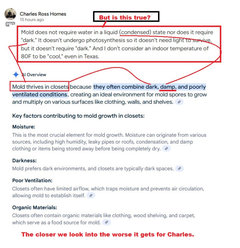
    Mold does not require water in a liquid (condensed) state nor does it require "dark." It doesn't undergo photosynthesis so it doesn't need light to survive, but it doesn't require "dark." And I don't consider an indoor temperature of 80F to be "cool," even in Texas.

  • PRO
    5 months ago

    Oh contraire Charles,


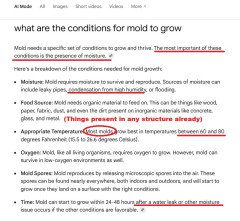
    Click to enlarge ( AI agrees with Ray, big surprise)


    Notice the most important of these is the presence of moisture. Humidity is moisture in the air.


    Moisture defined: from the picture. CONDENSATION from HIGH HUMIDITY. How high is high?


    MOST MOLDS grow between 60F and 80F. I did not say all no where in the previous post. I was going for the "highest possible occurance probability" Charles.


    Time: Mold can start to grow within 24-48 hours after a water leak or other moisture issue occurs.


    Moisture, what is your definition Charles? Gee another question that will go unanswered by a builder who thinks he knows more than AI. oopsie daisy.


    We're trying to contort ourselves into a box for something that doesn't fit in a box.


    I stand by what I said, choose carefully who builds your next house. I don't build houses I fix them.

  • PRO
    5 months ago

    Ah, doubling down on dumb, Ray. You'll be well served to remember the old adage "believe nothing that you hear and only half of what you see" whenever you substitute "artificial intelligence" for the real kind.

    You went to lengths to tell the OP that "So you notice from that list: humidity is absent." Relative humidity in the specified range is indeed one of the environmental conditions for household molds to become established and to reproduce. Why else would we want to control relative humidity to prevent mold growth? Water in liquid phase is not required, but can contribute to high relative humidity levels which favor mold growth.

  • PRO
    5 months ago

    The more I debate Charles on the subject of mold growth and the conditions needed thereof, the worse it becomes for Charles.


    We're just after the truth here folks. Is dark needed... well mold typically THRIVES in the dark when moisture conditions are met. Moisture? DAMP. You only get damp with a condensation of humidity. or an actual water source of some kind.


    (click to enlarge, AI agrees with Ray again! BIG SURPRISE!!!)


    I fix homes people, I don't build them. Charles indirectly is the source. Thanks Charles for all the work you do proving over and over why my services are needed. Choose carefully folks.


    I service the Katy, Texas area.


  • PRO
    5 months ago
    last modified: 5 months ago

    Why else would we want to control relative humidity to prevent mold growth?

    Oh Charles, Charles, Charles... what in the tarnation have you been smoking?


    Why would we want to control realative humidity?

    COMFORT.

    It's not just about mold growth Charles.

    Separating the tree from the forest. See you're trying to take a single thing, while ignoring everything else all the while calling me dumb. Great plan, Charles.


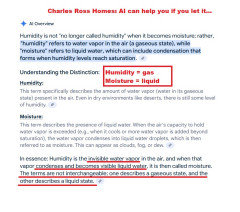
    Humdity is absent from the list because: it's in the form of moisture that has condensed. You do realize when Humidity changes from a gas to a liquid it's no longer humidity.


    Moisture vs humidity / Humidity vs Moisture (understanding the difference with help from AI)


    The terms above are not interchangeable, one refers to invisible moisture in the air in gas state the other refers to phase change of that gas into liquid form.


    click to enlarge


  • PRO
    5 months ago

    Ray,

    There is indeed a difference between humidity (water vapor in air) and water in the liquid phase. Mold doesn't require water to be in the liquid phase for it to grow. Maintaining relative humidity below 60% (ideally below 50%) is an important strategy for precluding mold growth. Houzzers who would like a good, readable source of information on mold growth will find it here:https://deye.com/at-what-humidity-does-mold-need-to-grow-understanding-ideal-conditions-for-mold-formation/


  • PRO
    5 months ago

    Charles the link you provide agrees with me as well.


    See what you are trying to do is suggest that mold can grow in ONLY a high humid environment... which would be true, but would also very much likely causing that humid environment to condense to liquid form, which would then cause the subject to become mold infested with actually mold you can see.


    Mold spores are in the air, but you can't see them? uh yeah Charles. If you can't see them how can you prove the mold exists... find the worst of the worst pictures than include high humid areas in which the humidity has condensed into liquid form.


    Now that we have you on record stating there is a difference of water vapor in air and water in liquid phase... you're back tracking Charles because you know you have nothing to stand on. You're a builder aren't you Charles?


    I suspect you'll beat a nail to death over this one >> your own link that you more than likely never read, or didn't comprehend the subject matter at hand.


    (Click to enlarge, take a look Charles your own source agrees with me)


    Requires considerable moisture -- most critical factor for mold growth.


  • PRO
    5 months ago

    Ray,

    I gained considerable expertise battling mold and mildew in my former home. I had it in two closets-- neither of which had any plumbing, any leaks or any condensation (i.e., no water in the liquid phase.) The airflow in each closet was poor; the relative humidity and temperature in each was conducive to mold growth, and there were lots of food sources. To prevent a repeat experience, in my current home I installed a dehumidifier integrated into the HVAC system on each level. They provide humidity control during shoulder seasons when there's not much demand for air conditioning. My personal experience is that controlling relative humidity in a home is an effective strategy for preventing mold growth and enhancing occupant comfort, too.

  • PRO
    5 months ago


  • 5 months ago

    I've always had heat in my laundry room, Former house had a heat pump with electric back up furnace, and AC This current house has radiant heat in the ceilings. No duct work at all meaning no AC. We've had about 2-3 nights in 12 years where I was concerned we might not sleep comfortably. With fans running, we were fine. We're too close to the northern pacific ocean to become too stressed about too-warm days or nights.

  • PRO
    5 months ago

    Different climate zones call for different HVAC designs for occupant comfort and for sustainability. What's appropriate in Maui, HI isn't the same as required in Anchorage, AK.