Software
Houzz Logo Print
jjoyful7

staking young Japanese maple trees

3 years ago

I purchased two young Japanese maple trees last fall. They are each about 5-6 ft tall and have delicate branches coming off a central trunk. They have been staked tightly to bamboo poles. I removed the binding strips holding one tree to the bamboo stake, in order to allow it to leaf out more naturally. The tree now has a little more flex than I expected, did I remove the binding too soon or will the tree become stronger now without the bamboo?

What is the general advice about when to remove the bamboo pole when it is tightly bound to the tree? Even in early leaf out, these look like they’ll be outstanding trees and I want to do right by them!

Ao

Comments (12)

  • 3 years ago

    most poles in pots.. are remnants of shipping stakes.. and should be removed..


    trees are supposed to blow in the wind ...


    we need pix.. if you want help specific to your plants ...


    ken

  • 3 years ago

    The tree will definitely become stronger if not staked because air movement that causes the trunk/branches to flex releases ethylene (a growth regulator/ hormone) which stimulates production lignin, the natural polymer that makes plants woody/strong. The downside is, flexing of trunk/branches beyond the limits the tree can tolerate will cause structural damage the tree might not be able to deal with over the long term, including fractured trunks/branches. In many ways, it sort of depends on a judgment call. If your tree is staked because the shipper recognized it has a weak trunk, especially if your tree has or is developing a lot of foliage which serves as a wind catcher, it might might be better to loosen the restraints gradually until you're sure the tree is capable of withstanding a stiff wind. Gradually loosening isn't always easy because the stiffening effect and stability of the stake is pretty much a sum of the combined stiffness of the stake + trunk. It's best to use 2 or 3 ties attached to the trunk at a point where just enough flex is allowed to strengthen the trunk, but not so much it can break.

    This tree ^^^ is secured because it was recently repotted, but the way the constraints are used is consistent with a tree that has weak trunk ..... except that the restraints would be secured to the trunk proportionately higher. If in the ground, stakes that allow some trunk flex but not over-flex would be the best temporary restraint until the tree is securely anchored by roots and danger from typical wind levels is no longer much of a consideration.


    Al

  • 3 years ago

    Just for an example.

    Here's a young maple that I staked with 4 lath and some stretchy nylon material.

    There's equal tension on all four sides keeping the tree upright, but letting the tree move & sway some with the winds, but not enough for damage to occur.

    Without some movement, the tree will never adapt to being free standing, at least not very soon.


  • 3 years ago
    last modified: 3 years ago

    Another thought is to make sure the tree has been planted properly.

    Sometimes a tree that been in a pot too long can have a twisted, knotted root ball and if this is not corrected at planting time, the tree will never establish a strong root system.

    Make sure the root flare of the tree is at or slightly above ground level. If the root flare is planted too deeply (below grade), the tree may never develop properly and will have other future problems.

    eta:


  • 3 years ago

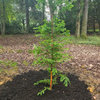
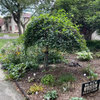
    Appreciate your comments! Here are photos of the two trees. The green leaved tree, “Aoyagi” is still staked. The other, which I cannot remember the name of, is the one I set free.

  • 3 years ago

    Japanese maples are one of the plants I focus on - I have a pretty extensive collection - and as a former nursery staff person, I can state with a lot of confidence that staking is almost always exclusively a shipping concern. JM's are rather delicate little trees and can be easily damaged by rough handling.....and they get plenty of that being transported in semis across country from the growers!! You should see how they pack them in, precariously stacked on top of each other's pots and each with their branches snuggly roped together!

    I remove the stakes as soon as I get them home and potted or planted. And since JM's are not best sited when exposed to strong winds anyway, there should be little risk of the root ball or the tree itself becoming unstable with normal airflow and movement.

  • 3 years ago

    It's not the windy locations I worry about.

    It's the occasional Thunderstorm winds that come through my area, once or twice a season. :-)

  • 3 years ago

    Bill, can you grow JM's in your location? Iwould have thought it too cold.......

  • 3 years ago
    last modified: 3 years ago

    Why? do you think Thunderstorms can only happen where I am?

    Good grief gal, there's lots of places people can grow JM's that have occasional high winds.

  • 3 years ago

    Yes, even here. But the occasional high wind is rarely a problem ......unless it is of gale or hurricane force. It is sustained winds that are more of a concern. And living so close to the beach, I can get a lot of those but they have never proven to be an issue.

  • 3 years ago

    Thank you all for the info. I now have 6 Japanese maples, one is just an 18” high Autumn Moon baby, these 2 juveniles, a couple 4 footers (one is a Lions Mane (Lion Head?)which are in large pots and a large, mature tree just leafing out in my front yard. I could easily see myself adding more as I cultivate my vision for my newish place. Like a newly discovered candy, all these luscious cultivars!
    I really appreciate your helpful responses.

  • 3 years ago

    Well, we can get TS winds of 60-80 MPH (hurricane strength). That's enough to topple newly planted trees and I've seen plenty.

    If JM's are different, more flexible or something, I have no idea and must go with the pro. ;-)