Software
Houzz Logo Print
birdie234

Help! New Red Oak Floor Problem

3 years ago
last modified: 3 years ago
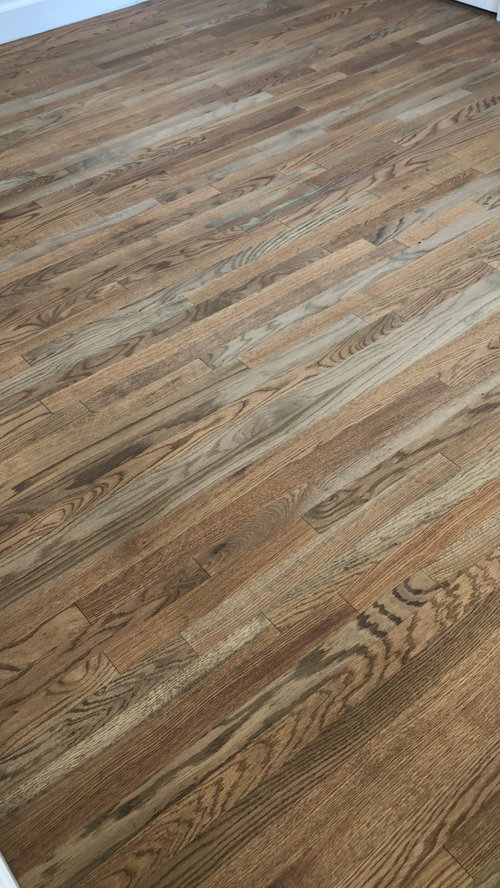
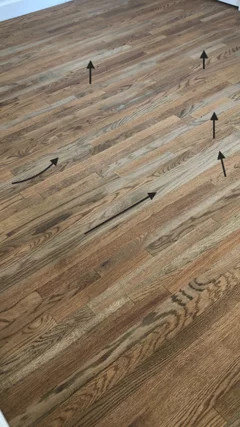
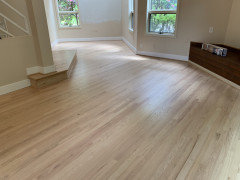
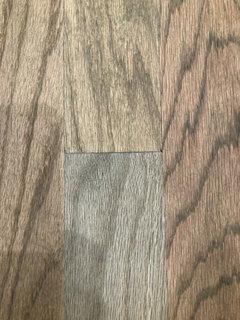
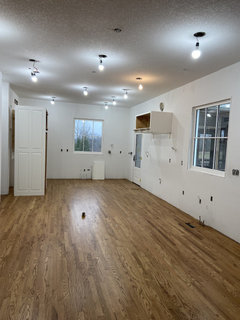
Just had new red oak floors stained Driftwood. They are very variegated. I do not like it at all. The polyurethane is not applied yet. My flooring guy says it will even out a little more….


1- what is the problem?

2-what can I do to fix it?

3- Do these floors look like select? That’s what I bought….

Comments (44)

  • 3 years ago

    Are these engineered or solid wood? If they are solid and you really don't like the stain, ask the floor person to restain and start again. we has a lot of variation on our red oak and we ended up going with Bona Nutmeg and I think they blended very well. I don't know if they are select, but I agree there is a lot of variation,

    birdie234 thanked Jacki Levine
  • 3 years ago

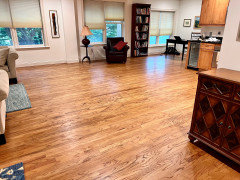
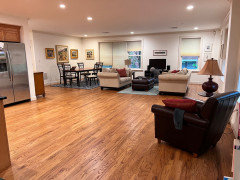
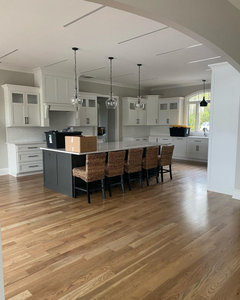
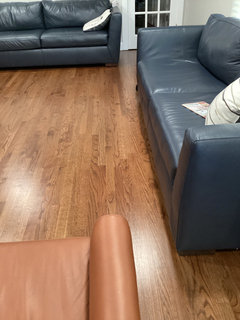
    Here are my red oak floors (definitely not select) with Bona Nutmeg to blend.

    birdie234 thanked Jacki Levine
  • 3 years ago

    @Jacki Levine

    They are brand new hardwood, not engineered. I am hoping for one of the resident flooring experts to weigh in here, as I am meeting with the flooring contractor tomorrow morning:)

  • 3 years ago

    I'm no expert, but having read enough posts by experts here, in order to restain you'll need to sand first. But I'm sure someone will weigh in -- the pros are really generous here. But if you don't hear by the morning, don't be rushed into making a decision you aren't comfortable with.

    birdie234 thanked Jacki Levine
  • PRO
    3 years ago

    Looks like the installer water popped and did not allow the water to completely dry off before applying the stain. It requires a full rework. Use a moisture meter for reference. Take reading before water popping for reference dry point.


    We are transitioning into the humid part of the year. Allow more drying time than usual.

    birdie234 thanked G & S Floor Service
  • 3 years ago

    Don’t know why it was water popped. Is that standard? I will have it resanded…

    Do these floors look like select grade to you?

  • PRO
    3 years ago

    Yes, its select grade. If, the floors was not water popped. Then this is a result of bad sanding. Those darker, blotchy spots are from heavier, coarser grits.

    birdie234 thanked G & S Floor Service
  • 3 years ago

    Inexperienced flooring person doing the work is the issue. What was the job price point?

  • 3 years ago

    The installation looks good, but you're right, the stain looks terrible. Before you have the same contractor redo it, ask them how they're going to get a better end result than the first time. Unless they employ a more skilled person who wasn't on your job initially I would wonder how they'll be able to fix it. Remember the definition of insanity is to do the same thing and expect different results.

    birdie234 thanked kandrewspa
  • 3 years ago
    last modified: 3 years ago

    Thank you all! I will try to address the points raised in no particular order:)

    This is a mid level flooring company with a solid reputation. They are doing the install and the finishing.

    They were not water popped.

    The sanding was done right. According to the stain guy...

    It was confirmed as Select.

    The stain guy says there are too many white oak boards thrown in and no matter what color I choose, other than quite dark, it will not look uniform.

    The owner is offering to resand and try another darker color.

    I may ask him to remove the white oak boards and replace with red oak.

    My old red oak floors look fine, so it is only the new floors.

  • 3 years ago

    Birdie, this is why I sent a photo of my Bona Nutmeg floors -- that stain, which isn't too dak, did a good job leveiing out the boards -- some of which were quite dark.. Might be worth a sample. Good luck.

    birdie234 thanked Jacki Levine
  • 3 years ago

    @jacki

    I am not using Bona at this point. But thanks for the photos and info!

  • PRO
    3 years ago

    Why driftwood? Any brown stain will work better to even out the wood tones than the grey that was chosen which pulls grey on very white boards but is obscured in the more orange boards. Did they do a stain sample for you first on the floor?

    birdie234 thanked HALLETT & Co.
  • 3 years ago

    @Hallett &Co

    I did see a sample… I liked that it was very light, almost natural looking. It didn’t look grey at all.

    What color do you recommend if I want to go the least dark necessary, if that make any sense:)?

  • 3 years ago

    @Hallet & Co

    Is it reasonable to expect new floors to take any color? What level of variation would be ok in a select red wood floor?

  • PRO
    3 years ago

    All wood has inherent characteristics that makes it react to stain in specific ways. No any new floor can’t accept any stain. You choose a grey stain that shows a lot on light boards and not on others. If you saw a sample how does it differ from the final product? If you wanted light why use stain at all? Provincial is a brown stain that has been popular for decades.

    birdie234 thanked HALLETT & Co.
  • 3 years ago

    You have a few things going on - the sanding issue that G&S shows and the different color boards that Hallett & Co noted. I am not aware of a single stain that will blend the white oak with the red oak. I don’t understand why there is a mix if this is a brand new floor. You could try bleaching, but not sure I would trust your current crew to do that. I would definitely stop the process and examine the floor closely and have the sanding issue addressed. Then have them test some stains with both species.

    birdie234 thanked Susie .
  • 3 years ago

    Why is white oak mixed with red oak? Or are you just inferring that the lighter boards are white oak because they didn't take the stain like the darker boards did?

    birdie234 thanked User
  • 3 years ago

    @DeWayne

    The only one who thinks it’s white oak is the stain guy, and yes, because of how it took the stain.

    My builder had someone in for a second opinion who sees nothing wrong other than the color chosen and some sanding as per G&S below.

    I will keep you guys updated! Thank you for all your input!


  • 3 years ago
    last modified: 3 years ago

    I agree w/G and S flooring on his sanding comment. It was NOT sanded correctly, hence the darker stain uptake.

    Why are they installing white oak boards w/red oak boards? doesn't even make sense. Pick one or the other. White oak is going to stain differently than red oak, plain and simple.


    Of course your builder is going to pick someone who sides with him. Do you think he wants to lose money? Call in an independant flooring service to give you an unbiased opinion.

    Tell the builder you're not happy with it, (I wouldn't be either) and applying a poly is just going to make more work for the next person who has to come along and fix the mistake. it's NOT going to even out the blotchiness. I can't believe they even said that to you. That's a brush off if ever I've heard one.


    this is a seriously a poor job. I'd never allow this. your builder is hoping you be quiet. arrows look like the white oak mixed in w/red.


    both of these are well done red oak floors


    birdie234 thanked Beth H. :
  • 3 years ago
    last modified: 3 years ago

    I should clarify that we are on a cost plus and I chose the flooring company. My builder brought in the guy he normally uses as a favor to me. He is not losing or making money on this part.


    It looks like white oak mixed in. The only way to really know is to pull out a board and test it.

  • 3 years ago
    last modified: 3 years ago

    Anyone claiming that there is White Oak mixed in with Red Oak on the basis of board colors is strictly speculating and using improper criteria to identify wood type. To determine whether the lighter boards are actually White Oak would require closer examination at a minimum. Pictures that are close/detailed enough to show the medullary ray length on the board surfaces could settle that issue. If the wood was all bought together in bundles it's completely unlikely that you have any White Oak mixed in. In 38 years of wood flooring work I can't remember seeing boards mixed together in bundles unless they were sold that way.

    Driftwood stain does have some gray. Perhaps a different stain is needed, incorporated with water popping the floor before the stain application. Water popping usually makes the wood soak in more stain, but on your floor it doesn't seem to have had the desired effect. Some people water pop with a mixture of water and alcohol to make it dry faster. We use straight water. If there's any question about water quality, buy filtered or distilled water from a grocery. Between the water popping and staining the floor should dry completely and not be walked on. Then the stain is applied directly to the popped wood and the finisher needs to take care not to affect the surface that has been raised by the water to keep it uniform.

    birdie234 thanked Timothy Winzell
  • 3 years ago
    last modified: 3 years ago

    My builder brought in the guy he normally uses as a favor to me. He is not losing or making money on this part.

    You don't think your builder gets a piece of the pie for bringing in his guy? I bet he does. A lot of the guys in the business get 'referral fees'.

    If he doesnt, then it shouldn't matter to him if it gets redone.

    I'll also add that a cost plus deal can be a disadvantage to you since the builder/contractor gets paid either way, in spite of a poor job. There is less incentive to do quality work. (not saying this is what your builder is doing, i'm just stating in general)

    The flooring company you're using did a poor job. You aren't happy with it. They're trying to tell you those blotches will even out w/a coat of poly. That's ridiculous. Ask him if he will sign a guarantee

    The only one who thinks it’s white oak is the stain guy, and yes, because of how it took the stain.

    you can tell a red oak and white oak board just by looking at them. Have you asked him if he substitued a few boards or had some mixed up? are the stain guy and the install guy on the same team? call in the install guy and ask him.

    Who is the contractor on the job? The builder or someone else? if someone else, they're the onethat should be rectifying this.

    You can still call in a diff flooring company, don't give them any background on who did it, and just ask them what they think happened.

    birdie234 thanked Beth H. :
  • 3 years ago

    @Beth H.

    Can you share what the color and finish are in the pictures you posted?

  • 3 years ago

    "The only way to really know is to pull out a board and test it."

    Wood type CAN be identified by removing a board and examining it but it's NOT necessary.

    The easiest way to identify the type from the surface is by examining the medullary ray length. White Oak rays are longer, often 1" to 1-1/2" or longer, while Red Oak rays are shorter, like 1/4". In addition, there are chemicals that can be applied to determine wood type. Another common way to identify White Oak is to see the prevalence of boards that are part light and part dark. The heartwood on White Oak is markedly darker than the sapwood and where the two meet it yields boards with stripes. For an example, looking at Beth H's second picture, one sees a high prevalence of boards with stripes, part light and part dark. She claims it's Red oak, but from the picture it looks like it could be white. This is why it's smart to see close pictures of the surface to verify the type, rather then jump to a conclusion based on pictures from a distance.

    birdie234 thanked Timothy Winzell
  • 3 years ago


    Timothy-can you tell if the lighter ones are white oak?

  • 3 years ago

    "Do these floors look like select?"

    Yes. Grading is judged by board length, milling quality and prevalence of defects. Your boards don't look all short, which is a hallmark of lower grades. Presumably it all had full tongues and grooves. The number of defects like small knots, bright sapwood and mineral streaks appear to meet the definition of Select and Better grade flooring.

    https://nwfa.org/wp-content/uploads/2020/03/NWFA-NOFMA-Unfinished-Standard-Final-April-2018.pdf

    birdie234 thanked Timothy Winzell
  • 3 years ago

    Timothy, those pics were pulled from links where people shared what stains they used. they're the ones that said it was red oak.


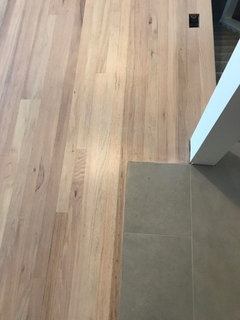
    Birdie, 2nd pic, is 3 1/4" red oak, Rustic Beige (dura seal I think) satin finish, oil based poly.

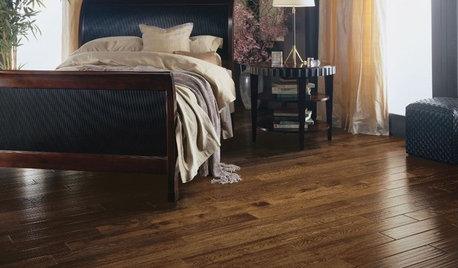
    The 3rd pic I don't have the recipe, but it looks like a natural finish like you'd get w/the Bona products.

    This one is bona nordic seal on red oak


    another example, 4" White Oak, duraseal weathered oak, oil poly.


    birdie234 thanked Beth H. :
  • 3 years ago

    Birdie, those boards are definitely all Red Oak. This means your staining solution should take account for the variation. It's why I recommended water popping. It will make the all the boards soak in more stain, but it should bring the light boards closer to the darker ones.

    birdie234 thanked Timothy Winzell
  • PRO
    3 years ago

    A warmer light stain, with no gray, would be the better design direction.

    birdie234 thanked Yonder Way Design
  • 3 years ago

    @Yonder Way Designs

    any recommendations? I may end up trying a darker stain like special walnut, but I would much prefer a lighter option.

  • PRO
    3 years ago

    Duraseal 75% neutral and 25% Ebony can tone down the red a bit, without taking on that ashy look. It's more of a toner than a stain.

    birdie234 thanked Strawberry Patch Designs
  • 3 years ago

    I'm quite fond of Duraseal Chestnut over water pop, or even Golden Oak, but you should see a sample. Make sure the sample has at least coat of finish over top before evaluating.

    birdie234 thanked Timothy Winzell
  • PRO
    3 years ago

    Heritage Brown is pretty nice, if you are wanting to tone down reds.

    birdie234 thanked DeWayne
  • 3 years ago

    Here's discussion of successes and failures using Bona Red Out. Bona Red Out anyone? (houzz.com)

    birdie234 thanked dan1888
  • 3 years ago
    last modified: 3 years ago

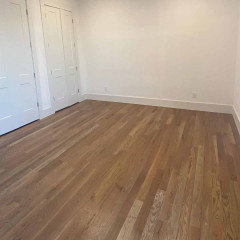
    We just used Duraseal Golden Oak over water-popped red oak and are happy w/result. It’s hard to distinguish the new boards in one room from the refinished boards in adjacent areas. Golden Oak gave a light finish without too much variation. Neutralizing the red/orange wasn't a priority. (ETA photo)


    birdie234 thanked petula67
  • 3 years ago
    last modified: 3 years ago

    Its been a long while... heres an update. The floors were sanded and we settled on special walnut. As soon as it was put down on a sample we saw the same issue. We are still in middle of negotiating with the flooring company.

    According to an NWFA inspector it is within industry standards for select red oak but there is an unacceptable variation in the color. Unfortunately, as he says, there is no industry standard for that so we are basically stuck with trying to work with what we have.

    Currently discussing water popping- won't the darker boards still take stain darker than the light ones? Or double staining? Would just a poly without a stain look less varied?

    Inspector recommended replacing the most egregious boards in dominant places and replacing with ones that match better or hand staining the floors with different shades so they match better. Not sure the flooring company is up for any of that.

  • 3 years ago
    last modified: 3 years ago

    We ran into the same problem when we had our engineered red oak floors resanded after a leak. It was different in that they were 20-year-old floors with a heavy coating of deep stain and a very shiny gloss finish. But when the floors were sanded down, what was revealed were a lot of "blackish" boards. Our very talented floor person replaced the most egregious ones with the new oak we bought (that, by the way, was all beautiful). We then stained them in Bona Nutmeg to try to bring it all together. I mentioned this in an earlier comment and posted photos. You said then you weren't interested in Bona, but I will say the Nutmeg is a rich and lovely color. But I'm re-commenting to say that your flooring company SHOULD replace those darkest of boards. It can be done and in the long run you will be glad you did it. Good luck. I know it's incredibly frustrating.

    birdie234 thanked Jacki Levine
  • 3 years ago
    last modified: 3 years ago

    "Currently discussing water popping- won't the darker boards still take stain darker than the light ones?"

    With water popping, the dark boards get a little darker and the lighter boards get much darker, narrowing the spread between the light and dark. That's why I mentioned it above and expressly recommended it as a way to solve your problem.

    "Or double staining?"

    Horrible idea, which is not recommended because it can easily cause a finish adhesion failure. I'm going to guess that you don't want to re-do this again in a year or two.

    "Would just a poly without a stain look less varied?"

    Probably not. Dampening an area of flooring with water or mineral spirits would give you an idea how it would look. Your issue isn't that the boards take stain unpredictably, it's that there a lot of variation between boards.

    "Inspector recommended replacing the most egregious boards in dominant places and replacing with ones that match better or hand staining the floors with different shades so they match better".

    I'm not wild about replacing boards, where you lose tongues and grooves, when water popping and staining should solve the variation issue.

    Suggesting that different boards be stained separately brings into question the credibility of the inspector. Hopefully you're inaccurately recounting what they said, or they were speculating out loud.

    There is a method that would help. After water popping, staining and applying one coat of finish over the entire floor and abrading the floor in preparation for another finish coat, if there are unacceptably light boards, they could be masked around and a tinted coat of finish could be applied to darken them. Then the tape would be removed, the boards with an extra coat would be abraded by hand and two more coat of finish applied. There are distinct advantages of this strategy, which I've used many times. You can positively identify which boards need attention, more easily experiment with color in the tint coat since it can be wiped off right away if it looks bad, and the tint coat won't bleed over on to adjacent pieces.

    birdie234 thanked Timothy Winzell
  • 2 years ago
    last modified: 2 years ago

    @Timothy Winzell

    Been a long time, just wanted to update all the helpers. Water popping with Special Walnut worked out nicely. Not the look I was hoping for, but it did come out nice. Thanks again all for your input!


  • 2 years ago

    Can you add a photo? Would be nice to see.

    birdie234 thanked Jacki Levine
  • 2 years ago

    Maybe it doesn't match what you desired, but the pic looks fantastic! It's hard to believe it's the same floor.

    birdie234 thanked Timothy Winzell
  • 2 years ago

    So pretty

    birdie234 thanked Jacki Levine