Software
Houzz Logo Print
archer6356

dryer indicates 80% blockage. Professional duct cleaning didn't help

3 years ago

there are no kinks in the hose either. What could be the problem?

Comments (19)

  • 3 years ago

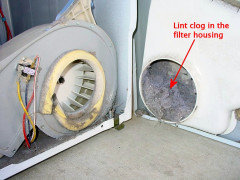
    Disassemble the dryer and check for lint accumulation in the blower and filter housings, which can obstruct airflow.

  • PRO
    3 years ago

    Did you clear the error code? If not, try disconnecting power to the dryer for 5 minutes and then reconnect.

  • 3 years ago

    We always use a professional who specializes in dryer vents and the dryer itself. Thoroughly cleaning the dryer itself is in his marketing. He works inside it and behind it to get out all of the lint he can find.

  • 3 years ago

    This is one I serviced for a relative.


  • 3 years ago

    The dryer is fairly new. Also I disconnected the hose and ran the dryer (I know- not a good idea) and there was no error so I don't think it's the dryer itself. Could there be some kind of damage in the internal ductwork?

  • 3 years ago

    I'm not aware of any dryers that have sensors to directly monitor airflow rate, although that is not to say some may exist. An obstruction probably is inferred by triggering of the heating element's or gas burner's overheat thermostat (insufficient airflow causes it to run hotter than design parameters).

    Your dryer (you didn't cite the brand/model) presumably has run for a period of time without throwing the airflow fault warning? There's no harm in a test run with the duct disconnected, just don't keep running it that way to avoid the exhaust problem. What are the characteristics of your exhaust design? Length, number of bends. What method was used by the cleaning service? Did they inspect the full length of it? How long is the duct connecting the dryer to the wall port, and what kind of material? Is it getting kinked or crushed behind the dryer when it's pushed into operating position?

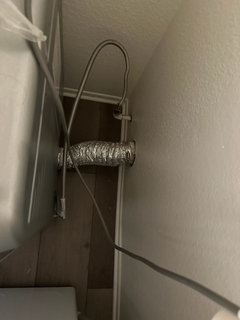
    I must set my dryer at an angle to the wall. The exhaust is straight through an exterior wall and very short (I can reach through the outdoor hood into the dryer) but the exhaust port is too close to a corner (can't shove the dryer partway into a sidewall) which causes a kink/obstruction in the connection ducting.


  • 3 years ago

    It could be the length of the vent piping and/or any elbows. As well as the exterior flapper door. How long is the run? If it's long you may need to size up to a larger diameter pipe size.

  • PRO
    3 years ago

    What kind of dryer is it? And if the duct work was damaged/blocked, that's something the duct cleaning pro would have noticed and likely commented on.

  • 3 years ago

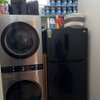
    It's an LG 7.3cu ft dryer. The hose length is about 2 ft. I suspected it was being kinked behind the dryer so I pulled it away from the wall to avoid any bends. Did not make any difference. It runs for a few minutes and then flow sense light starts flashing. Sometimes it shuts down shortly after with a d95 error (95% blockage)

    The cleaning guy used a vacuum as well as a spinning brush on a long stick attached to a drill. Seemed very thorough.

  • 3 years ago

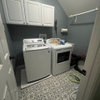
    Your photo looks to show the dryer pulled away from the wall. You need to confirm how much the ducting may be kinked or crushed when it's pushed fully into normal position.

  • 3 years ago

    Have you confirmed that the pipe is clear where it exits the building? If it has a screen on thte exit they often get clogged with lint, without a screen you get birds nesting n the pipes.


    In a prior house they builder used about 20 ft of flex pipe to get to the outside, the internal resistance of the corrugated piping and multiple turns was too much for the dryer blower to overcome. Re-piping with larger smooth-walled pipe and eliminating 90 degree beds was needed to fix it.

  • 3 years ago

    Sorry, I overlooked the stated detail that you've operated the dryer pulled away from the wall so as to straighten the ducting and the fault still occurs.

    What is the arrangement, material, length, and number of turns of the exhaust path from the wall to the outdoors? Presumably that is not an exterior wall for a straight-through path. Each 90° turn in the path is equivalent to 5 feet of length. The installation instructions for the dryer should state what is the longest workable length of the exhaust path.

    You say the dryer is new. How long did it operate after installation without exhibiting the airflow fault? Did it dry faster, slower, or equivalent to your previous dryer?

  • 3 years ago

    Is it remotely possible the problem is with the sensor itself?

  • PRO
    3 years ago

    I was able to find a wiring diagram on line for an LG dryer with Flow Sense (my limited IT skills won't enable me to paste it here.)


    As dadoes suspected, the dryer doesn't sense air flow directly; it infers an exhaust problem utilizing rate-of-temperature rise switches (I believe there is a separate one for 80% blockage and one for 90%.) Either switch can be triggered if the dryer is operated with a too-small load or no load. It's important to test the dryer from a room temperature start--not after it's heated up.

  • 3 years ago
    last modified: 3 years ago

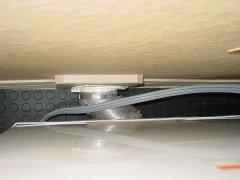
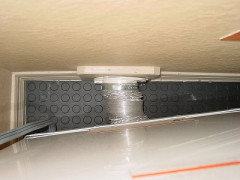
    The vent goes from top floor to the roof, so I'd say about 10ft. Not sure about material or number of bends. I just bought this home and the new dryer exhibited this issue (at varying levels) from day 1. I assume the previous owner operated a different dryer here before. There are many other units in the community with the same arrangement.

  • PRO
    3 years ago

    Did the person who cleaned the dryer exhaust duct go up on the roof to inspect the roof cap and verify the backdraft damper is operating correctly and that there is no screen installed?

  • 3 years ago

    he went up to the roof but maybe I should go check for myself

  • 3 years ago

    Did he clean inside the dryer itself? Is it possible there is a blockage before it even exits the machine? From what I see on youtube, if you can't find a blockage, it's likely the sensor misfiring. Seems to be fairly common.