

Turning our trees into cabinets
Hi!
I have a post in another thread about the remodel my husband, Dana, and I are doing for our kitchen/dining/living room.
We have white oak trees we're considering for our kitchen cabinets. An Amish gentleman, Emmanuel, will custom-build them. He provided a quote that we were happy with.
My husband's friend (and previous boss) is an experienced and reputable sawmill owner. He'll turn the trees into quarter-sawn boards for us (500 sq. ft.).
And the last piece of the puzzle - we've got a couple of places (also reputable) that will kiln-dry it for us in the timeframe we're looking for at the right price.
What pitfalls could we run into?
Emmanuel quoted us for building the kitchen with and without our wood. He said we'd only save about $3,000 if we provided our own.
We were so excited because we were expecting an astronomical cost. Both quotes are doable. Our hearts are for using the wood because it's on the property my husband's family first purchased when they came from Sweden. Their heritage is meaningful to both of us.
Since his quote without the wood was within our means, we're wondering if we'd be opening a can of worms by providing the wood - and only for sentimental reasons.
Any thoughts about this or anything from the other post linked above would be greatly appreciated!
Dana and Heidi
Comments (29)
 2 years ago
I love the idea of cabinets made from trees on your property! Sorry to comment when I don't really have any advice... except that maybe the cabinet maker could advise on what to look for, and perhaps an arborist could provide advice on which trees to use that 1) would make the best candidates to harvest for wood, and 2) could best be removed without negative impact on what is around them.
Related Professionals
Bismarck Cabinets & Cabinetry · Florence Furniture & Accessories · Rochester Furniture & Accessories · Omaha Furniture & Accessories · Houma Carpenters · Orangeburg Carpenters · Virginia Beach Carpenters · Monroe Carpenters · Brunswick Custom Closet Designers · Auburn Custom Closet Designers · Brooklyn Custom Closet Designers · Rapid City Custom Closet Designers · Pittsfield Kitchen Remodelers · Wheeling Kitchen Remodelers · Madison Custom Countertops- 2 years ago
Our home, new to us, was built out of pine on the property, including the floors. One room is in laminate, so my assumption is they didn't mill and dry enough. If you were to have a shortage are you willing to wait until you harvest and mill more trees? Do you want to just do the island or another focal point with your wood so you're not so dependent on the mill not burning down and other catastrophes?
- 2 years ago
Given the current prices for QSWO ($15-20/bf and up for the good stuff) if you've got a sawyer willing to do it and big enough trees to make it practical I'd jump on it at a price that isn't astronomical. Make sure your sawyer will really give you quartersawn, it's much more common to get a mix of rift and quarter from the mill, and then only of that's what you're paying for. There's a lot more waste in the process. Flat sawn would be the norm, with quartersawn boards occurring only by chance. You're going to get narrower width boards if you quartersaw than with other cutting methods-- but much prettier!.
I also get a little nervoius when I hear "kiln dried" and "time frame" in the same sentence. It takes as long as it takes to do a good job drying wood, and it's not necessarily quick. You can end up with hundreds of board feet of expensive firewood if the process is rushed and it's all case hardened. Make sure the person doing the work is routinely producing furniture grade hardwood and not just supplying a pallet mill. It takes skill and experience to do it right. Air drying is much safer if you have the time and an appropriate place ot store the wood, but then you are talking a couple of years. - 2 years ago
It's a no brainer. Use the wood form your farm. I gave my Grandson-in-law lumber last year form some my brother and I cut over 40 years ago.
- 2 years ago
It'll be beautiful. Remember to plan for all wide drawers for your lowers with full extension undermount slides with self-close. You can go further by harvesting enough for doors and trim around the house. Consider Ciranova Ecofix or Woodlook as a finish for a matte raw wood appearance. ECOFIX PLUS (ciranovastore.com)
- 2 years ago
I think I would either not use the trees since they have always been on the property, and you can get comparable wood for a reasonable price.
If I were to use the trees, I would want them for something that would stay in the family. so I like the furniture idea. Someone (a later generation of the family or a non-family member who later purchases the property) is going to rip your new kitchen out. - 2 years agolast modified: 2 years ago
A good rule of thumb when milling lumber is that the tree tells you what it wants to be. Until you mill the boards you can’t know how they will look. The boards could be gorgeous or they could be crappy. So… I wouldn’t select a few trees to cut down in order to make stained cabinets.
However, if you have to have the trees removed anyway then milling them is a great opportunity to see if it will look good in your kitchen. If you are painting the cabinets, then go for it.
Kiln drying will still take a while. Most suppliers don’t exclusively kiln dry because it takes too long. It is much more efficient to air dry for six months then kiln dry to finish the process. This cuts the time in the kiln (and therefore the number of kilns operating) down by about 85%.
I think having it milled is a great idea, but don’t let the tail wag the dog. So once they are opened up then decide whether to send them to a kiln or just cover them and let them air dry for future use.
 2 years ago
I have a friend whose kitchen is all from trees from his property. Very beautiful and a good feeling of something that wasn't just cookie cutter purchased. Have more than enough cut, and you may have to live with more defects in the wood.
- 2 years ago
The step you haven't mentioned is finding someone to dimension the kiln-dried but rough sawn lumber. I'd choose a shop with a wide belt sander to avoid the tear out from a planer.
Pipe clamps, a home-built clamping table and a biscuit or tenon cutter would let you use your lumber to make panels. You'd need a jointer.
 PRO2 years ago
I agree with the comment of furniture instead of cabinets. You can take the memory with you that way. Perhaps the kitchen table set.
- 2 years ago
500 board feet will not be enough raw material if you are going for rift and quartered. Either accept that plain sawn materials are what you are going to use, or down grade to just doing a (portable) island with it. Or a bed and chest.
- 2 years ago
I think there are some misconceptions here... As someone who regularly mills their own lumber, dries it in a solar kiln, and then turns that lumber into stuff, I disagree with a lot of what is being said here.
Quality furniture usually requires better wood than cabinets. Unless you are building rustic furniture, you are not going to want to use the best pieces for cabinets and save lesser pieces for furniture. It just isn't that hard to find good clear boards for cabinets. Base cabinets only need 26.5" of good boards and tall wall cabinets will need 38". I prefer 6/4 boards for panels which become bookmatched 9/16" door panels after resawing and surfacing. Any cabinetmaker who regularly makes solid wood doors will have all the equipment needed to resaw, dimension, and join boards for cabinet doors. You certainly don't need a wide belt sander (I have a 51' wide belt sander and I would still use my planer) and tear out is usually a problem unless you are getting too aggressive with the planer.
A good rule of thumb is that you need 10-12 board feet of material per linear foot of cabinets to a 9' ceiling. So if the mill is saying that you will get 500 board feet of quarter sawn oak then it is likely that will make 40 to 50 linear feet of cabinets. If you are looking for rift sawn then that is going to go down to 25 to 30 linear feet.
Heidi Ekey
Original Author2 years agoThere's so much good information here I don't even know where to begin. THANK YOU!
But let me say first that the property is 80 acres, and it's all woods. We don't live there on the property, and we aren't able to (though we would if we could).
So, we aren't limited to 500 board feet (yep, AB Normal - that's what I meant!). They've already added a good percentage of wasted wood (for errors/problems). And we can adjust that if there's a feeling that we still haven't started with enough raw material.
I have a couple of follow-up questions.- What is the ideal size for our trees (knowing the end result is quarter-sawn boards for our kitchen)?
- Besides being straight, what could we look for that might give us the best chance of harvesting "quality" wood? I know every tree is different, and there's no way to know for sure, but are there some things that are telltale signs of possible problems?
- Are quarter-sawn veneers for the door panels and exposed cabinet sides and backs a bad idea?
- Do quarter-sawn veneers look kind of like riff-sawn solid wood?
- Do you think it would look good if we mixed the veneers with the quarter-sawn portions of the cabinets?
I love the look of riff-sawn White Oak, but it's too much waste, and we don't want to do that (we love QSWO and RSWO almost equally).
It SEEMS to me like quarter-sawn veneers look almost like riff-sawn wood. We think that maybe the price from our Amish cabinetmaker would be impossible to resist if we told him we wanted high-grade veneers for the door panels and exposed sides and backs. That (and some of what you've said here) would give us enough reasons to let him supply the wood.
We LOVE your idea - and it's clear everyone else does, too! Making furniture with the trees on the property speaks to my heart. Thank you! The ideas are already piling up on what heirloom-like piece(s) we might make. HU-7538532650, I like the idea of a bed and armoire. You are all thoughtful in your suggestions, and I appreciate that! There should be something we can take with us or hand down. We didn't think of that. We could start the process now to take all the steps we'd need for the wood to be as perfect as it can be (air drying, etc.)
One of the places we talked to about kiln drying said it'd be a couple of months. Another one is a vacuum kiln, and that would be two weeks. Does anyone know anything about vacuum kilns?
@dan1888- I'm in a situation now with golden oak on everything, etc., so I won't do that with white oak. And I won't paint it. I want to limit the amount of color change to the wood over the years - so we'll look into that Ciranova. Thanks! Also, Dana said what you described in your post today about dimensioning - that would happen after it's in Emmanuel's hands (our cabinetmaker).
@bry911 - very interesting! I will show this to Dana. We'll probably have more questions. Our cabinets will be 36" with a 4" crown. Our ceiling height is 8'
We have not finalized the design, but we're very close. I've gotten some great feedback on the other thread. We're still happy to hear ideas and concerns anyone has. Thanks again to everyone for the thoughtful answers and suggestions.
Dana and Heidi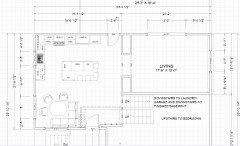
- 2 years ago
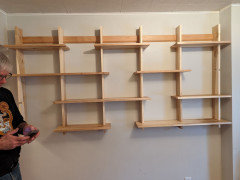
DH just finished some shelving for #1DD. Got the white oak from a tree cutter. They barter for wood/product/labor often. It was rough cut into boards. Took DH FOREVER to get it all run through the planer and sanded out so I would allow for this taking longer than anticipated.
Heidi Ekey
Original Author2 years agoHe's 100% sure that they are white oak. He went to the property and looked with his own eyes. The bark and the leaves are both different. That's not a concern.
Heidi Ekey
Original Author2 years agoarcy_gw
That's very pretty. That's for the info! Emmanuel said it would take a couple of months. That's good, though. We have a lot to do in the meantime.
Heidi Ekey
Original Author2 years agoWe live a few steps from the Allegheny National Forest, so we do have a lot of info and resources. haha and my husband was a boy scout!
My BFF is a research ecologist. He knows a lot about wood, but says he's not the expert, then provided this presentation on wood quality which was provided by Scott Weikert, Extension Educator, Forest Resources.
Since there are so many people in the Houzz forums who work with this stuff day in and day out, I thought I might glean some insight from your experience of turning trees into "stuff".
I'm sharing the presentation because it's just so fascinating and maybe others would enjoy it, too. 😊
- 2 years ago
It SEEMS to me like quarter-sawn veneers look almost like riff-sawn wood. We think that maybe the price from our Amish cabinetmaker would be impossible to resist if we told him we wanted high-grade veneers for the door panels and exposed sides and backs.
I am not a big fan of mixing store bought veneers with home milled logs. There are around 150 species of White Oak in the Americas and soil conditions, weather, etc. can create variation within the species. It is often difficult to get a good match between veneers and boards. You can saw off a small board and dry it fast at home and then check it against veneers to see if you can find a good match, but that often requires actually going to see the veneers in person.I often just make my own veneers, it really isn't that difficult to resaw a board into veneers and get veneered panels and frames from the same tree. However, cabinetmaking isn't typically woodworking, it is production and your cabinetmaker may not be willing to cut veneers. I wouldn't take that as any indication of their ability to produce fine cabinets, it just isn't something that most cabinetmakers have found a reason to master.
I am making some assumptions about your project that may turn out to be problematic if they are incorrect. First, I have been assuming that only the doors, moldings, cover panels, and face frames (if you are doing framed faces) are going to be made from your trees and the actual boxes will be constructed out of plywood. Next, I have been assuming that you are going to do some sort of cope and stick door rather than a slab door. If you are doing slab doors then veneers are usually the better choice. There is just too much wood movement for a solid white oak door to perform optimally.
I will try to answer your other questions in another post.
- 2 years ago
What is the ideal size for our trees (knowing the end result is quarter-sawn boards for our kitchen)?
20" diameter at the smallest point that you are planning to get quality quarter sawn boards from.
Besides being straight, what could we look for that might give us the best chance of harvesting "quality" wood? I know every tree is different, and there's no way to know for sure, but are there some things that are telltale signs of possible problems?This is a question best asked someone in your area with a mill. The best logs depend a lot on regional soil conditions, water table and weather. So what I look for in trees may not work at all for you.
Are quarter-sawn veneers for the door panels and exposed cabinet sides and backs a bad idea?I am not really following your question, but I may have answered it above. Feel free to include a picture to help me understand what you are asking.
Do quarter-sawn veneers look kind of like riff-sawn solid wood?Yes, and no. A big percentage of quarter sawn wood will be indistinguishable from rift sawn wood. In fact, most of the rift sawn lumber you buy isn't actually rift sawn (especially sheet goods), they are just the center cuts of other milling processes (quarter sawn and flat sawn).
Do you think it would look good if we mixed the veneers with the quarter-sawn portions of the cabinets?Answered above I think.
On a note. It is pretty important that when the tree is cut down that you slap some anchor seal on the cut ends of the logs. If they are milled before you seal the ends then seal them right after milling. It helps with checking and drastically increases the amount of useable boards for your kitchen. - 2 years agolast modified: 2 years ago
I'm not any kind of expert on kiln drying, I trust the folks who are to do their job. I know vacuum kilns are used successfully and are faster, I've never knowingly had wood that has been processed in a vacuum kiln, but I might have. I have a good friend who keeps me in as much beautiful old air dried walnut and cherry as I know what to do with, so I've mostly stopped worrying about commercial lumber.
In answer to a question I thought I saw, quarter sawing will maximize the medulary rays ("flake") of white oak. It's a look prized for use in Arts and Crafts furniture. Rift sawn wood will have some of the structural stability of quartersawn but will display much less figure. Neither should have a lot of the pronounced "cathedral grain" of flat sawn boards. Any lot of wood will have a mixture of grain patters, and it's up to the cabinet maker to pay attention to color, figure,and grain direction in picking and orienting boards for any given project.
If you befriend your sawyer perhaps he will help you choose ideal trees to use. It's very good to have a friend with a sawmill!
Heidi Ekey
Original Author2 years ago
Our original question probably wasn't very clear. I meant to ask how it would look if we used quarter-sawn white oak plywood for the door panels and the exposed sides and backs while using milled boards for the rails, stiles, and cabinet frames. (Cabinet boxes will be regular plywood.)
What do you think in this case?
I'll respond everything else tomorrow, but I really appreciate all this help from everyone. We are big fans!- 2 years ago
Our cabinet maker used quarter sawn plywood for end panels and it was a good match to the quartersawn frames and fronts. They used solid wood for the panels. I did look at Kraftmaid Vantage (I think) cabinets in quarter sawn that used a veneered panel for the panels, and I couldn't tell the difference from the solid wood.
- 2 years ago
The match between veneered rift ply and your own lumber can depend on wheter you stain the wood.. If you're trying for a raw light tone without stain and using a clear water poly the match is the least likely at the time of fabrication and going forward over time. Most here have seen this color change process for maple ply door panels yellowing over time while the frames don't yellow. Bad product.
When I ordered rough-sawn ash for my build, 2000bft. was an economical threshold for delivery. That did all the doors, casings, kitchen cabs and island. Rift and quarter are less prone to tearout than flat. A sanding planer likely won't be necessary for you. If you have the kiln-dried lumber dimensioned, you can diy as much of the woodwork yourself. Keep that in mind when figuring costs. A friend had the planer I could use and a Williams and Hussey molder. I bought knives to my design for that.
 PRO2 years agolast modified: 2 years ago
The exposed sides should be integrated decorative ends. They look like doors, and are made the same way as doors, but the stiles from the side and front are mitered.
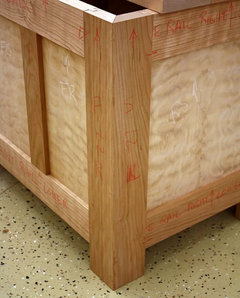
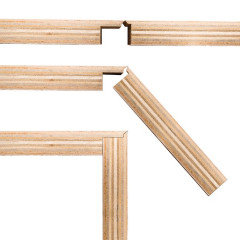
And this is why you need a kitchen designer in addition to a cabiner maker. It's all the little details that make a kitchen work, and be special, that need to be considered.- 2 years ago
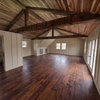
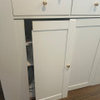
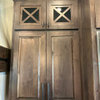
I just had a dining room table made from a white oak that was on our property. Here's what I learned:
1. White oak has to be kin dried with white oak only which means you need a full kiln load of white oak. If you have less than a full kiln, it gets expensive.
2. White oak is difficult to kiln dry. It takes significantly longer than many other woods.
3. Even after it is kiln dried, white oak is extremely sensitive to humidity which can result in cracking and cupping.
I had a full kiln load of beautiful straight white oak. Of that load, only 4 slabs were stable enough to make a table. We had a very humid summer. Even those slabs cupped and cracked a bit.
I understand your desire to use the wood for your kitchen cabinets. I am thrilled I was able to get a dining room table out of our majestic fallen oak.






chispa