Software
Houzz Logo Print
artinnaturez8b

Question about Eucryphia

last year
last modified: last year

Finally made it to Cistus Design Nursery yesterday and picked up Eucryphia 'Nymansay'. My question is: how early does it begin to grow in spring? I've had problems here in the Willamette Valley with plants that grow too early and are then damaged by freezes. I'll choose a cooler spot if it tends to begin growing very early.

Comments (22)

  • last year

    Klark, it is evergreen :-) Or should be.

  • last year

    Pam, I didn't word that post properly did I? Now edited. I have a lot of evergreens that grow early and are then damaged by freezes: Crinodendron, certain rhodies(!), Osmanthus, Cephalotaxus, and Ilex.

  • last year

    Never had any issues with BLE's and late frosts. But then, they are not very common in my area, as you know. Problems can arise with Arctic blasts but that's more a January/February concern and also not all that common.

    There are several eucryphias planted in the gardens at the local library and they always look lush and full. Also a massively large specimen (30+ feet) at Olympic College in Bremerton that's been growing there for going on 50 years. Not seen cold damage on any of them.

    How helpful this is for your situation may be questionable. 🤔

  • last year

    Art I don't know which part of the Willamette Valley you are in - but my understanding is that it is one of the leading areas for hazelnut production in the US, so I cannot imagine late freezes are altogether very common as that is the issue that keeps them from being a commercial crop in much of the US. (my issue with them right now is squirrels, but I digress!) Perhaps you are in a microclimate more prone to them? Are you on a south facing slope? Now that I think about it, I actually don't remember seeing what looked like orchards as I drove south on I-5. And it was _board flat_. Is it possible that the orchards are actually in the foothills surrounding the valley, to give them more cold air drainage?


  • last year
    last modified: last year

    @The Logician LLC - I was hoping you would chime in with your Eucryphia experiences. I'm happy to hear that your plants begin growth in May. The recent hot summers have been hard on almost everything I grow, even things you wouldn't expect, like Arctostaphylos. But those spring freezes following weeks of warm weather have been particularly troublesome here. We actually received .1" of rain this morning, and today has been delightfully cool & overcast!...so far.

  • last year

    Logician, thanks for relating your experiences. I gave up on Eucryphias on the east coast years ago, but E. glutinosa seemed to be the only one that could survive our winters, alas, it really struggled with our summers. I wish there was a E. glutinosa X E. moorei hybrid, as the latter from mainland AU should be the most heat resistant of the species. This article is interesting - I'm surprised anywhere in Devon got as cold as -16C!

    https://www.treesandshrubsonline.org/articles/eucryphia/eucryphia-moorei/


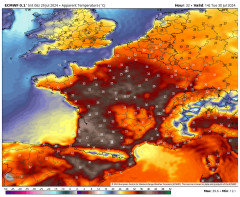
    Sadly, places with warmer versions of maritime climates seem to be having more and more hot weather. Average summer high in Paris should only be 26C/78F.


  • PRO
    last year

    The smaller-leaved varieties do better in the cold. My 'hybrida' (lucida x milliganii, if I recall correctly, got it from Cistus nursery) has not had cold damage, but then the flowers are very small and do not attract many bees. The larger-leaved and flowered varieties, even if they last only a decade, are worthwhile for their summer bloom, aroma, and as a bee plant.


    My lucida 'Pink Cloud' lasted about 15 years. It would develop vertical fissures in branches that would die off; eventually a fissure in the main trunk did it in. May have been a quirk of that one particular plant. Got that one from Gossler.

  • last year
    last modified: last year

    Note that -16 was in a very cold winter and 'dipped', ie it wasn't like that for long. Also Devon includes Dartmoor which can be very cold in winter. Well, cold by our standards.

    My dad had Nymansay. The only problem it had was damage from salt laden winds off the sea.

  • last year

    Floral - thanks, I appreciate getting your "Devonian" perspective on the matter!

    Winter 2010, in fact, might have been one of the coldest ever in Devon in terms of absolute low. Even Exeter got to -16C!

    https://en.wikipedia.org/wiki/Exeter

    OTOH, I think the 1963 winter had a longer period of extreme cold. I was just reading about that in an old UK book about Magnolias, which noted it killed some rare ones at Caerhays.


  • last year
    last modified: last year

    Disclaimer .. I'm not a Devonian.

    I remember 1963. Birds dying in the garden. The sea freezing along beaches. And of course, not many if us had central heating then. Far, far worse than 2010 which was a shorter spell and which I don't even remember clearly.


    Ps sorry about the repetition above which I've now removed. It seems to be a quirk of this site when editing posts.

  • last year

    "Disclaimer .. I'm not a Devonian."


    Well, just for our generally edification, when one says "SW" UK, in the UK, which counties/regions are included?


    Oops - it is officially defined after all. https://en.wikipedia.org/wiki/South_West_England


    Of course these semi-arbitrary classifications can be vague in terms of how actual residents interpret them. My state, Maryland, is by far the 'least southern' of the southern US states...contrasting southern strictly in terms of how the term was historically defined (south of the Mason-Dixon) vs what residents actually believe. It's considered 'northern' by a majority of residents! https://www.cbsnews.com/baltimore/news/maryland-considered-northern-state-goucher-college-poll

    So does someone in Wiltshire really think of themselves as "Southwestern" in the same way someone in Cornwall does? Seems doubtful...but do correct me if I'm wrong.

  • last year

    Didn't think to take any photos as I was just in and out but the eucryphias at my niece's garden (a large, heavily landscaped property) were in very full and heavy bloom yesterday. The scent was quite lovely.

  • last year
    last modified: last year

    They are truly amazing looking trees. FWIW, a reminder that the 'Nymansay' (probably) in 'my' Edinburgh garden had obvious damage from single digit temperatures in winter 1995-1996, but seemed to have outgrown it and was blooming well by the time I was leaving Scotland in mid August. Do they bloom on new wood?

    I had hoped that × Gordlinia might prove to be a 'replacement' for US east coast garden. Alas, it blooms around the same time of year but is proving to be a difficult plant to keep happy for me at least. A cross between two 'shallow gene pool' plants from the same part of the world seems to have produced a still weak growing tree; although I have at least seen pictures of a fine large one on Long Island proving it is possible, mine, so far, is weak and floppy. And yes, I have the supposedly improved tetraploid form they introduced a couple years later. They no doubt had to release it because the original diploid plant was such a weakling! Mind you it wouldn't completely reproduce the look as the flowers are bigger. Maybe if you crossed Polyspora with Franklinia (Schima has been crossed with Gordonia, after all) you could get a plant that would be a fairly hardy, humid subtropical climate 'fake Eucryphia'. Alas, the sort of people with that kind of vision are disappearing from American horticulture. At this point, might be slightly more likely that someone figures out how to add genes for root rot resistance (and hardiness!) to these various Cfb climate plants - thus we could expect a 'real' east coast Eucryphia. Until then I'm just happy I got a lot of rain yesterday!

  • last year
    last modified: last year

    There was a tree in bloom at Cistus, arching over the pathway just after exiting the Bigtop. It was beautiful but nobody knew which variety it was. I should probably look for trees in bloom at Sebright again, they seem to have everything there.

    I grew Polyspora in my Seattle area garden and loved it, as much for the foliage as the flowers. It was indeed delicate, but when the autumn/early winter weather was just right, it was spectacular.

  • last year

    I did a bit more research, turns out Schima is the only Asian Theaceae that might cross with the American Franklinia or Gordonia.


    https://en.wikipedia.org/wiki/Franklinia


    Franklinia is now thought to be closer in relation to the Asian genus Schima. Recent DNA studies and examinations of floral ontogeny in the Theaceae place Franklinia together with Gordonia and Schima in a subtribe.[4]

  • last year

    Well we went to Sebright today. Found Eucryphia Rostrevor - had a paltry bloom, not very impressive or fragrant. This is the only one I've grown, and I killed it, in Seattle. Then I found a little E. milliganii...not blooming. Finally a small 5' Nymansay, growing rapidly, looking healthy, but also not blooming. If there were any large specimens I did not see them. Very possible I missed some, the place is vast.

  • last year

    I just realized you're probably talking about a mail order nursery I've ordered from - *that* Sebright. All I've bought from them were ferns but they were some of the best grown mail order ferns I've ever bought and all are at least least surviving the drought the summer (knock on wood, but hopefully over) and the ones in pots are thriving.

    FWIW the wikipedia entry for Polystichum munitum says it doesn't grow well on the US east coast, but it doesn't seem to have gotten the memo! In fact, ferns generally, don't seem to be affected by the inability to grow outside maritime climates that affects typical angiosperms or even conifers...Woodwardia fimbriata grew very well for a couple years but alas, the polar vortex winter killed it off. I wish I'd had it in a more sheltered, albeit still shaded spot. I'd try again but they are incredibly rare in the trade. Sorry - I do love my digressions!

  • last year

    davidrt28 - Yes, that Sebright. Not many people know that there is a lot going on at Sebright besides the mail order shade plants. They have a world class botanical garden. It appears that they add a least an acre of new gardens every year. I think Thomas is in charge of that, while Kurt is in charge of the mail order/retail shade plants (I hope I have their names right!) They also have a bearded iris division, and I wouldn't doubt, several other divisions, judging by the beautiful new buildings that have been built to the SW of their substantial compound. The oldest display gardens to the south are a mix of mature woody plants with perennials beneath. Then they expanded to the north with primarily woodies, super rare woodies - Melliodendron xylocarpum, anyone? (I can share pics if interested), how about Wollemia nobilis, absolutely thriving after some very rough winters. This year they went nuts with annuals near the parking area, and it looks incredible!


    Digress away, that's what we're here for! I'm not surprised that you're having success with Polystichum munitum, it is a very common garden weed in the Seattle area, even in full sun, not as much down here in the Willamette Valley. I have no shade and heavy clay soil, and my ferns are all really struggling. I will not plant any more in ground until my soil has improved and the shade has increased. I've actually been thinking about P. munitum since everything else I plant is fading away. My only fern that is thriving is Asplenium trichomanes planted on a mound of organic matter in the middle of a group of large rocks.

  • last year
    last modified: last year

    Thanks, I'll have to check that place out the next time I'm in the PNW.

    It's frustrating how, with the exception of Cistus, most of the west coast nurseries I visited on my big x-country trip in 2011 have "completed their lifecycle", so to speak. American horticulture, amongst my various other critiques of it, just seems to be lacking a certain kind of 'permanence of commercial establishments'. For example just on the rhododendron front, can we actually compare Whitney Gardens, now the oldest US rhododendron nursery under original management, to the Cox's Glendoick in Scotland and Baumschule Hachmann in Germany? I don't really think we can. On the east coast, Rarefind, once so incredibly promising and well capitalized, is a hollowed out shell of what it once was. (And don't get me started on Van Veen. NOT what it was under Kathy, and clearly never will be again!) At any rate, I hope whatever Sebright Gardens is doing, which sounds very interesting, can endure. But, again, I digress! Thanks for filling in the background on them!

  • last year

    davidrt28 - I somehow missed your July 28 post. I do feel that my garden is in a cold microclimate but I haven't figured out why. I'm at 400' which I think is about 100-150' higher than much of the big valley growing areas. My neighborhood slopes slightly to the south, I would consider it to be just into the Coast Range foothills. I don't seem to be enjoying any freeze protection resulting from cold air drainage.


    Hazelnuts and wine grapes are about even around us. The only crop rivaling them is grass seed. Corylus bloom super early, probably late February. They must have some sort of mechanism that protects both male and female flowers, and developing fruit, from freezes, as they certainly do endure a lot of freezing weather from February through April.

  • last year
    last modified: last year

    There are pix of a nice couple growing in Cornwall in this post from the Name that Plant Forum https://www.houzz.com/discussions/6459325/what-trees-and-are-they-the-same#n=3m.

Sponsored
Pristine Acres
Average rating: 5 out of 5 stars55 Reviews
Leading Northern Virginia Deck/Patio Specialist- 10X Best of Houzz!