Software
Houzz Logo Print
jessica_cardenas44

Matte Black Flushed Stove Vent

Hi! im looking for a stove vent that is matte balck and flushed with the cabinet. home depot has two priced at about $350 Hisoho and iKTCH. Never heard of these brands and not sure how great of a brand is needed for a vent. Any feedback?

Comments (17)

  • last year

    Wow, you briught up so many good points. i do cook alot (7-days a week) and my daighter is Celiac so we don’t eat out at all. Additionally, my husband does want a quiet vent. So, with that being said, I’d like a rec for a good performing vent…it just needs to be black.

  • last year

    Just add a can of black spray paint to your order!


    Black is an uncommon color for a range hood, greatly restricting your choices, and may tend to be used in very style-forward products that aren’t designed for maximum function.


    Wipe a stainless hood down with degreaser, then spray (outside) with black paint - gloss or satin best, or hammered if you like, not matte. Two light coats.

  • last year

    For background, start here. This is what you are trying to approximate with a residential hood. The first dozen or so pages should be sufficient.

    https://www.tagengineering.ca/wp-content/uploads/2015/02/KVSApplDesign_catalog.pdf

    Then review these FAQs for further information. Note that the real collection of performance messages is among many hood "discussions" here which deserve to be searched out.

    https://www.houzz.com/discussions/2328297/range-hood-faq-personal-notes-updated-10-31-2007#n=20

    https://www.houzz.com/discussions/5161173/hood-faq#n=101

    https://www.houzz.com/discussions/6099827/exhaust-hood-faq-ii#n=113

    https://www.houzz.com/discussions/6040827/range-hood-noise-project

    And some MUA related:

    https://www.houzz.com/discussions/5888450/seeking-muas-advice#28657635

    https://www.houzz.com/discussions/6078111/cost-to-add-a-make-up-air-system-for-kitchen#n=65

    When you have read enough to capture the essence of the problem space, we can help define specific parameters.

    Last, a hint: Quiet requires -- at a minimum -- a remote blower and an intermediate silencer (muffler).


  • PRO
    last year

    Sounds like you are looking for a "hood insert" not a chimney hood? Or an under cabinet hood?


    The actual physical working parts of the hood will never be black. They will always be stainless. Because the black finishes all scratch scratch and peel. Just look at the joke that is "black stainless" and how the actual stainless shows through underneath it when scratched with a scrubbie trying to clean it.

  • last year

    You didn't specify the dimensions of the range hood, but build.com has 179 black range hoods. Seventy-four have baffle filters which I understand are better.

  • last year
    last modified: last year

    Wow! lots to research here. I’m not doing any stainless steel in my kitchen which puts me at a bit of an issue.

  • last year

    "im not doing any stainless steel"

    Confused. You wrote that you wanted a black range hood. Those are all black. What does "flush with the cabinet" mean? What are the required dimensions? Did you search the hoods at build.com?

  • last year

    I did search at build.com, but I was looking for black. I didn't realize that would mean stainless steel painted. I now need to rethink what I want to do. Ideally, I didn't want any stainless steel in the kitchen. We have a 36" black electric inductor/cook top. I want an under cabinet hood.

  • PRO
    last year

    How did you think it got to be black (or white, or purple) if not painted?

    Jessica Cardenas thanked Minardi
  • last year

    build.com has 17 black, 36" under-cabinet hoods. Yes, they're metal, painted black. The Zephyr AK2136CB Typhoon looks like it might be the best choice. Also at Home Depot. Just make sure the distance between the cooktop and the bottom of the hood is correct: 24" to 32".

    Cheaper: Zephyr AK6536CB Cyclone also at Home Depot.

  • PRO
    last year
    last modified: last year

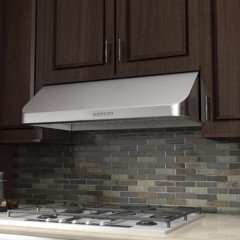
    You want an UNDERcabinet hood, like this? Just in matte black? Matte black finishes show ALL the grease and dust. It would drive you crazy. Also, underneath on any hood will always be stainless.


  • last year

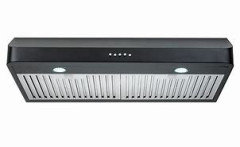
    Thank you for the suggestions! I'm looking for something more like this. I believe it's referred to as an "under cabinet" hood vent.


  • last year

    Wolf calls it an under cabinet hood insert. See the Wolf Design Guide for examples. These are distinguished from regular inserts by using standard cabinet depths rather than a protruding hood structure that can accommodate greater depth entry apertures.

    Under cabinet hood inserts are too narrow (front-to-back) for good capture of rising and expanding plumes, and in many cases will also be insufficiently wide. In the image just above, some capture help is provided by the side walls and built-out mounting surface, but performance will be limited, and higher velocity plume components that initially miss the assembly will likely reflect outward (spill) into the room.

  • PRO
    last year

    That is a hood insert, and you will have functional issues with that. It's pretty dysfunctional being shallow, and then has to be mounted higher than a standard hood, so you see everything underneath, and it works much worse because of the reduced capture area. You might want to do something more functional if you cook. If you don't cook, you still might want to do something more attractive.

  • last year

    Thank you so much for this feedback. This is my first time remodeling a kitchen and I want to do it right. I do cook A LOT. With that being said, I'd rather purchase something functional (although it isn't the most minimalistic). I am thinking now I need redesign my original idea and go for a commercial grade (which I understand will be stainless steel) hood and do a custom cover, which I can worry about designing later. Any recommendations (perferably on build.com) for a hood vent? My cooktop is 36" induction/electric cooktop. Thank you all so much in advance!

  • last year
    last modified: last year

    As you (the OP) might discover from the hints contained in the references I listed above, the proper approach is to determine hood system requirements before hunting down hood candidates. Ideally, for a 36-inch cooktop, you need a 42-inch wide hood, as deep (front-to-back) as the market can supply (most likely 22-ish inches). Such as hood would have an entry aperture of 6.4 sq. ft.

    Searing or stir-frying can generate 4 ft/s plume velocities (on gas; maybe 3 ft/s on induction). To ensure capture using residential hoods with low volume reservoirs below the baffles, hood inflow velocities of ca. 90 ft/min are needed. This is equivalent to 90 CFM per square foot of hood entry aperture. For the example 6.4 sq. ft., this requires 550 to 600 CFM.**

    But wait; there's more. Hood flow rate is not equal to blower rating; blower flow rate hanging naked in the air equals blower rating. Use a further factor of 1.5 to select blower rating from required CFM. This roughly selects a region of the fan curve where pressure losses in the system are accounted for. Adequate make-up air is assumed.* So the blower rating needs to be 850 to 900 CFM.**

    Ducts are sized so that grease collection is minimized. This requires a balance between impact condensation (high velocities) and thermal condensation (low velocities). Flow rates between 1000 ft/min and 2000 ft/min are recommended. With a mostly warm duct, the lower end of this range will be better.

    An 8-inch round duct with an actual flow rate of 575 CFM will have a velocity in the duct of 1650 ft/min. One wouldn't want to use a smaller duct. 10-inches diameter would be OK if it could fit.

    For best noise performance, the blower should be outside and a silencer installed into the duct path. For 8-inch duct a Fantech LD-8 silencer would be 12 inches in diameter. What is the height of the beam above the range?

    Consider how you can access the duct if you bury it in a soffit. You may wish to make the soffit face or bottom at least partially removable.

    *For make-up air (MUA), a system that provides low pressure loss replacement air is needed to avoid back-drafting of combustion appliances connected to kitchen air. The required type of MUA system depends on numerous factors not yet revealed.

    ** For induction multiply by 3/4 if you are willing to limit future range choices. Essentially, cooking plumes are wet, greasy effluent with added gas combustion products if cooking on gas. The gas products will be hotter, initially, and add velocity to the plume. Higher velocities increase the ability of the plume to reflect from hood structures and potentially spill out of the hood. Higher baffle flow rates (and hence hood intake aperture flow rates) resist this.