Software
Houzz Logo Print
elizabeth4912

kitchen drain pipe behind cabinet?

last month

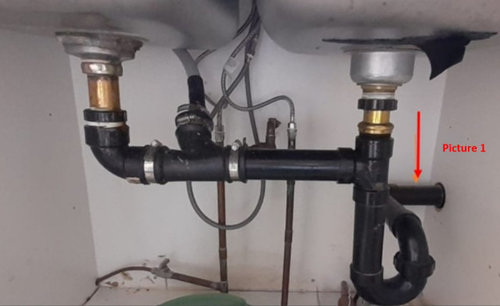
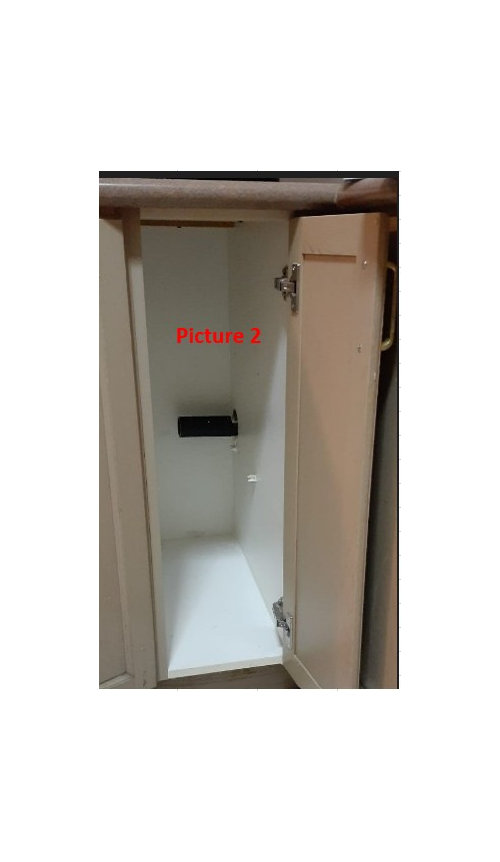
We are renovating our kitchen. Picture 1 shows the configuration of the pipes for our sink before demolition. Part of the horizontal drain pipe (red arrow) ran through the adjacent small cabinet (picture 2), continued behind the back panel of the next adjacent corner cabinet and connected to a vertical pipe that goes down to the basement and also goes up to the roof.

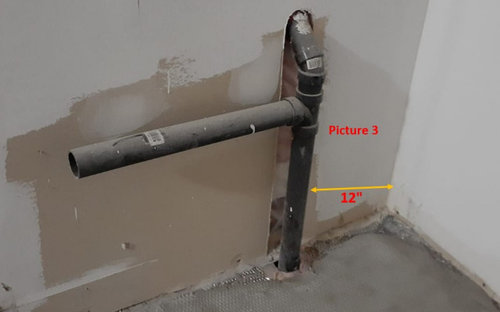
Picture 3 shows the drain pipe after demolition.

The new corner cabinet will be a 90° angled cabinet (34 3/4" x 34 3/4") with bifold doors and we are supposed to have a Lazy Susan sitting on 2 full shelves.

1. Is there another way of running the drain pipe instead of behind the cabinet? If there is a leak, would the back panel of the cabinet need to be cut to fix it?

2. If the pipes are behind the cabinet, its depth will be reduced by 4", the 28" Lazy Susan may not fit in the new corner unit.

Your suggestions would be appreciated. Thanks


Comments (12)

  • PRO
    last month
    last modified: last month

    Those pipes are normally inside the wall.

    Is there a reason they are exposed (not inside the wall)?

    Once the pipe and fittings are glued together, they don't leak.

    Elizabeth L. thanked PPF.
  • last month

    @PPF. Thanks for your response.

    Pictures 1 and 2 show the pipes prior to demolition.

    If you are referring to the pipes that are exposed in picture 3, I didn't know they were behind the cabinet until the demolition few days ago.

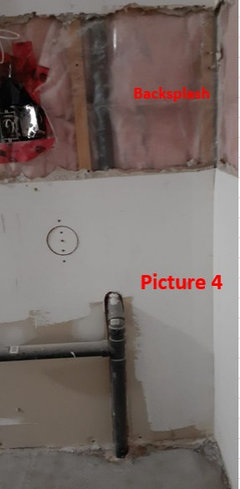
    Picture 4 below shows the continuation of the vertical pipe going up that is inside the wall. The walls got damaged when they removed the backsplash. That same pipe in the basement is also exposed.


  • last month

    If you remove the drywall and install the horizontal pipe right up against the studs putting a 45 elbow at the floor level and top on the vertical pipe to do the same would that work? We did that in my son‘s kitchen and then sheetrocked right up to pipe and he was able to gain enough room for a pullout to work properly.

    Elizabeth L. thanked mojavemaria
  • PRO
    last month

    Hire an actual plumber to redo all of that. You have some major issues. Long horizontal runs like that are too far from the trap weir. You have a high chance of clogs, and incorrect venting, with a good chance of sewer gas into the home.

    Elizabeth L. thanked Monique
  • PRO
    last month
    last modified: last month

    Someone is going to need to cut out some concrete and do the plumbing that should have happened originally. That right there is a recipe for big issues.

    Elizabeth L. thanked Rainbow Colors
  • PRO
    last month

    " Is there another way of running the drain pipe instead of behind the cabinet?"


    Yes, run the pipes inside the cabinet. Pipes don't leak if they're properly installed.

    Elizabeth L. thanked Joseph Corlett, LLC
  • last month
    last modified: last month

    " Is there a reason they are exposed (not inside the wall)? "

    Yes, I suspect that this is an exterior load bearing 2x4 wall with a window and a sink centered on the window. Drilling the studs for a horizontal run of 1.5" drain pipe would weaken them considerably. I'm also guessing the floor joists run parallel to the wall here and they were trying to avoid a joist or they didn't want to drill the bottom plate.

    Your trap arm can be 42" long or 72" (depends on the code, but 42" would be safe) for 1.5 pipe at a 1/4" slope per foot. That's measured from the tee in the wall to the outlet of the trap. If it's longer than that, you will have an issue. It looks like you are within the 42".

    You may be able to relocate this to the basement and solve the problem. I would look at drilling the plate though unless there's a joist in the way.

    Get a plumber in there to do it right.

    Elizabeth L. thanked Jake The Wonderdog
  • last month

    @Joseph Corlett, LLC

    The issue, as I understand it, is that plumbing bump-out to go around the bottom plate in the corner is going to interfere with a lazy Susan.

    Elizabeth L. thanked Jake The Wonderdog
  • last month

    To give a correct alternative to what you have now the BIG picture needs to be seen. Based on the size of the vent pipe going up in the wall is a indication the vent pipe is also being used as a vent and drain between floors, also called a wet vent and not permitted between floors.

    Based on the lack of thought put into the original plumbing route I'm wondering if they also used a wet vent between floors. The configuration has a tendency to create a vacuum and sucks the water out of traps on lower floor fixtures allowing sewer gas to pass throught he traps.

    What needs to be known is if there a a plumbing fixture above on a second floor that drains into pipe in the wall going up? If there is the original plumbing is wrong and a new vent pipe 1-1/4" dia. must be run up above all second story plumbing fixtures and connected into a dry vent. When opening up walls you will never know what you will find, and in your case it may be an improper plumbing job or outdated by code.

    What also needs to be known is why they didn't run the drain pipe through the floor into the basement, so what is below the sink in the basement? Nothing looks right to me so I'm reserving corrective measures until I get the big picture.


    Elizabeth L. thanked kevin9408
  • last month

    @kevin9408

    I think you are imagining a lot of things without much basis.


    OP, please hire a competent plumber to look at situation to see how to run that horizontal pipe and still have it vented properly. I think you have options besides cutting the new cabinets.

  • last month
    last modified: last month

    Jake, it's not my imagination running wild, it's the little things I see many others don't because they lack knowledge and experience. The fact the vent pipe wasn't reduced to 1-1/4" by the plumber tells me just he decided to use 1-1/2" pipe for the vent, or he ran it the way in the picture to pick up another plumbing fixture from above. If he did this he ran a wet vent between floors and prohibited.

    The OP said; "vertical pipe that goes down to the basement and also goes up to the roof." If there is no second story without a plumbing fixture then everything is fine, if there is something above there is a problem. The OP mentioned a basement, so why wasn't the drain pipe located in the floor under the sink? This is why knowing what's under the sink in the basement that would of prevented the original installer from doing the job right before assessing the problem.

    With out the big picture with the details it is irresponsible to give advise. You said "I suspect that this is an exterior load bearing 2x4 wall with a window and a sink centered on the window. Drilling the studs for a horizontal run of 1.5" drain pipe would weaken them considerably." This is incorrect speculation, the code allows up to 60% of the stud width for a horizontal plumbing run through a load bearing wall. If it's a 2x4 wall (3.5" nominal) a 2.10" hole can be drilled through the studs. But the plumber did not need to use 1.5" pipe and could of used 1.25" pipe, so why did he not use it? Flags may man.

    You're also even throwing out guesses; "I'm also guessing the floor joists run parallel to the wall here and they were trying to avoid a joist or they didn't want to drill the bottom plate." You're not giving any valid information what's so ever, so who's doing the imagining?

    Until the OP comes back with the information I'm done here. Good day sir. Nice fluke you have by the way, all I have is a 87 with a 80TK.

    Elizabeth L. thanked kevin9408
Sponsored
SK Interiors
Average rating: 5 out of 5 stars55 Reviews
Loudoun County's Top Kitchen & Bath Designer I Best of Houzz 2014-2025