Software
Houzz Logo Print
webuser_831626

DIY custom range hood with large containment volume

last month

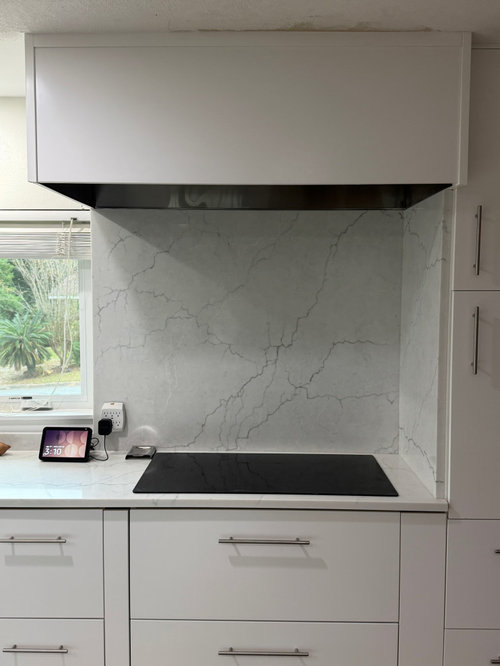
We’ve just completed a kitchen renovation that included a 36” GE Profile induction cooktop. I was very dissatisfied with the island range hood performance in our last house. It had zero containment volume and would spill significant quantities of effluent whenever we did anything like sear a steak. I was determined not to have the same problem with the new kitchen, but struggled mightily to find a satisfactory solution. In the end I came up with something I’m quite satisfied with and I wanted to share it here in case it inspires others, since despite the simplicity of my solution, I haven’t seen many if any other examples. Even though I’m sure they’re out there, they haven’t materialized in my research.


For a long time I looked for a residential hood that had more than a tiny containment volume. Most have none or only the nominal amount provided by a slight slope of the baffles. The most suitable residential hood I’ve seen is the Prestige High Capacity, but I still wasn’t especially happy with its volume. I considered a commercial hood but didn’t have any luck getting vendors to contact me, plus my wife wasn’t wild for their size and appearance.


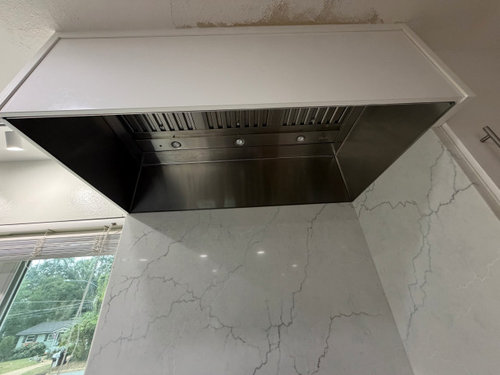
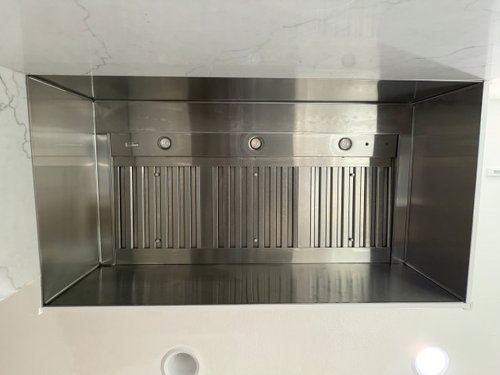
My solution is basically a low profile (4” tall) hood insert in a decorative box, but instead of mounting the insert flush with the bottom of the box, it’s instead mounted flush with the ceiling at the top of the box, providing a large containment volume (volume is about 25x insert baffle area). The capture area of the box is 51” wide, which is far more than enough for the 36” cooktop, but more importantly it’s 27” front to back to ensure that we get good capture of effluent from the front burner even though the box is 41” above the cooktop.


The blower is a 12” Fantech ducted centrifugal fan, which is quite oversized but was chosen mainly because I got a great deal on a dented item. A side effect is that the blower can run at quite low speeds and very low noise and still handle all the cooking we’ve done to date. The low blower speed may mean that the baffles aren’t working at full efficiency, but so far I’m pleased with how the whole system has worked.


The price was just under $1200 for the insert and blower plus about another $500 for the ducting and exterior panels and interior stainless, with most of that being the stainless.


The only downside we've encountered so far is that a step stool is required to remove and reinstall the baffles.


I'd like to particularly thank @kaseki and @opaone for their contributions here over the years. I learned a lot from their contributions about how hoods should work and why they too often don't. Anything in my design that works well owes a great deal to them; anything that's a bad idea is entirely my fault.


Comments (14)

  • last month

    Thank you for providing another approach to residential hood system configuration that should achieve adequate capture and containment. While commercial hoods in this size might have interior shapes modestly better at directing reflected plume 'rays' into the baffles, I doubt this is materially significant for the likely plume characteristics from cooking on this induction cooktop.

    Whether these particular baffles (area and form) can extract grease particles under the full flow rate of the selected blower is a question in my mind, but generally residential cooking is not going to result in significant impingement grease building up in the duct. And the blower can always be operated at a lower, quieter, setting.

    Horizontal baffles will "puddle" the collected grease, so cleaning more often than might be needed with sloped baffles should be considered.

    The phrase "volume is about 25x insert baffle area" is unclear, because relating a volume to an area makes the result dependent on the measurement units.


  • PRO
    last month

    "my wife wasn’t wild for their . . . appearance."

    Does she like the appearance of this one?

  • last month

    @kaseki The baffles aren't horizontal -- they're angled about 5 degrees. Unfortunately there's no grease cup at the low side, but we've decided to wash the baffles every two weeks, which seems to be often enough to prevent the buildup from transitioning from film to liquid.


    I agree that the volume/area thing is nonsensical in dimensional terms and it made no sense to me when I first encountered 18x as a fairly frequent recommendation. I eventually assumed that it was meant to signify that the numerical value of volume should be 18x the numerical value of the baffle area. I may have misunderstood what was intended, but a value on that order looks reasonable to me as a containment volume for a residential kitchen.

  • last month

    @Mark Bischak, Architect Surprisingly to me, she does. As we progress through the installation stages, she was happy to have it simpler and simpler, to the point where this is just two sections of our kitchen cabinet doors cut to size with stainless lining them. Our kitchen design is pretty minimalist, so it fits in well. If she had her choice it would be somewhat smaller, but she agrees that performance is a very important feature of a range hood and so is okay with it.

  • last month

    Nice and clean, and I can believe it is very effective. Capture volume seems to be the thing that residential hood makers "don't get". They used to - the old VAH shaped like pyramids had capture volume - but the trend seems to be toward low profile hoods. Nice to see an example of using a residential insert with a custom housing that really works.

  • last month

    @Noah Tye I'm glad you like it. Despite searching for many weeks for a solution, I never saw anything like this here or elsewhere, so I hope somebody someday benefits from seeing it.

  • last month

    @John Liu I get that lots of low- to mid-priced hoods are designed for looks first and function last, but it just seems so wrong that it's almost impossible (for me, at least, and I have good search skills) to find a residential hood in that price range that has any meaningful containment volume; you'd figure there'd be a possibly small but at least detectable selection. And there's an added challenge that almost no marketing photos show an angle that lets you decide how much, if any, volume a hood has. I have to figure it's at least partly because most consumers believe that CFM is the only important factor, and that enough suction will pull any amount diverging effluent plume into the baffles.

  • last month

    Two factors may be relevant to restricted containment volume. (a) Easily reachable removable baffles. (b) Fits under 8-ft ceiling (7-ft in some residences). Making the hood entrance (capture) area large to add containment volume tends to make the hood obtrusive, and possibly more easily head intersecting.

    In any case, due to the nature of air flow outside the hood volume, the first requirement is capture, and this sets the hood size vs. height to overlap rising and expanding cooking plumes. The second requirement is containment, which actually happens at the baffles. The effluent is not truly contained until it gets past the baffles. This forces the hood flow rate to be sufficient to entrain plume effluent into the baffle gaps, and also take control of the plume 'rays' that reflect off of the hood interior and head toward escape.

    So CFM is still important.

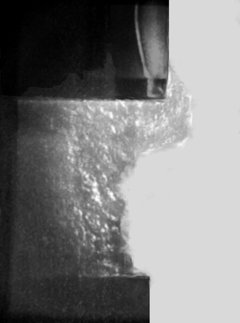
    Insufficient CFM in a commercial hood with plenty of containment volume.


  • 25 days ago

    @kaseki I posted this to another thread but seeing as how that one is like 10years old I'll repost it here in the hope you find it. I've not seen discussion of if and if so how the design of the leading edge of the available high end hoods affects, or doesn't, capture and wondering what your thoughts are.

    Most pro style hoods, such as the Wolf have light and/or controls along the leading edge that significantly reduce the deep capture area of the hood. In comparison the VAT designs have a much narrower band. Not as narrow as commercial hood, but still the difference between Wolf/Thermador and VAT is several inches. However what I don't understand is how significanty, if at all this affects capture. Does performance fall off dramatically if the first few inches of depth are modest or is the effect minimal?

    This is not an idle quesiton since both aethetically and with regards to build quality we prefer the Wolf hood but we plan to use the grill that came with our 48" Wolf range and if smoke is going to spill then we'd go with the VAT.

    Just so we're comparing like to like and only discussing the single variable of the effect of the design of the leading edge on just capture (and not containment volume), I'm assuming a VAT with baffles and an external blower an option they offer but prefer not to talk about.

  • 25 days ago
    last modified: 25 days ago

    Not kas but just asking for a clarification -- what is a VAT hood? Or did you maybe type "VAH" for "Vent-a-Hood" but were "helped" by auto-correct software that decided to help you by correcting it to "VAT"?

  • 25 days ago

    Sorry. Vent a Hood. Not a victim, the perpetrator. Apologies.

  • 25 days ago

    I don't see my post anymore. No idea why so I'll repost with the correction made.

    I'm hoping that @kaseki is still monitoring this thread as I have a question. Most pro style hoods, such as the Wolf have light and/or controls along the leading edge that significantly reduce the deep capture area of the hood. In comparison the Vent-a-Hood designs have a much narrower band. Not as narrow as commercial hood, but still the difference between Wolf/Thermador and Vent-a-Hood is several inches. However what I don't understand is how significanty, if at all this affects capture. Does performance fall off dramatically if the first few inches of depth are modest or is the effect minimal?

    This is not an idle quesiton since both aethetically and with regards to build quality we prefer the Wolf hood but we plan to use the grill that came with our 48" Wolf range and if smoke is going to spill then we'd go with the Vent-a-Hood.

    Just so we're comparing like to like and only discussing the single variable of the effect of the design of the leading edge on just capture (and not containment volume), I'm assuming a Vent-a-Hood with baffles and an external blower an option they offer but prefer not to talk about.

  • 25 days ago

    I did respond to the Hood FAQ II questions.