Software
Houzz Logo Print
lisa_wellington1

Speed Queen TR5 overflowing a 2" standpipe. SOLVED!

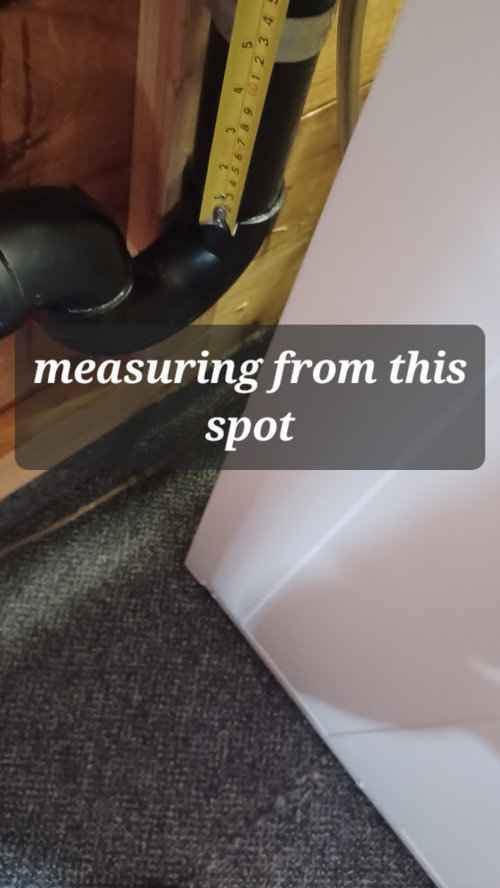
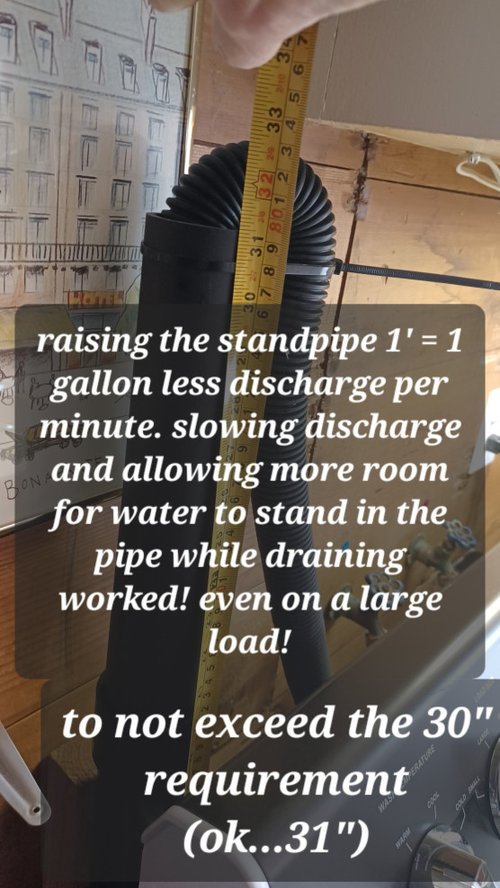
After spending $600 on a plumber (snaking the line) , the standpipe still overflowed. I did more research and learned that for every 12" of standpipe height, the machine will drain 1 gallon per min. slower. That's all it needed. It is called a stand pipe because that's where the water stands as it drains out.
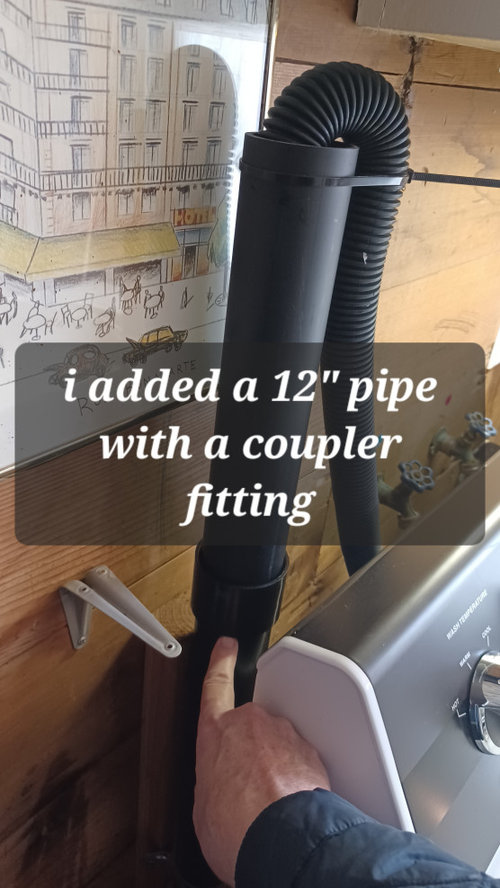
I went to my local hardware store and asked them to cut a 2" ABS pipe to 12", and get me a connecter and some plumbers cement. I connected the pipe with connector to my existing standpipe to test before cementing. Voila! Even on huge loads, no problem with overflow. Cost: $11.54.
I called the plumber later to report this finding and asked why this solution was not offered. He said, "To be honest, I never would have thought of this."
Hmm.

Comments (26)

  • last month
    last modified: last month

    The plumber didn't offer this solution because it's Micky Mouse.

    A 2" drain that's properly installed and not clogged should be able to handle the output of the washing machine. Cleaning the drain is exactly what any competent plumber should have done since laundry lines often often become restricted with a combination of lint and soap.

    A fix that's slightly less visible is to put a slight restriction in the end of the discharge. If that's a 1" discharge hose then clamping a 1" x 3/4" reducer would do the trick, for example.

  • last month

    Jake- I disagree. It's not mickey mouse. It is allowed to 30". Although a 2" pipe should handle it, some old homes (mine is solid slab 1951) is what it is. The pipes were cleaned and the problem continued. Speed queen tr5003 is known for having a powerful pump/spin combo that often overflows 2" or smaller pipes.

    In my opinion the restrictor would put just as much pressure on the output and thus the pump as does the extension. I'm quite proud of this solution and that I did it myself and followed others who did the same.

    Speed queen is aware of the complaints.

  • last month

    It's fine that you are proud of it, and I'm glad it works for you, but I answered why the plumber wouldn't suggest it.


    If it were my issue to resolve, I'd do the restricter so I didn't have to look at the standpipe sticking way up.

  • last month

    Jake, I think the plumber didn't suggest the extension OR the hose restrictor because it wouldn't have made him as much money.

    Along with the solution I chose I also read of the restrictor solution. I chose the one I thought would put the least pressure on the pump. I can hide the extension with other creative solutions. Or leave it. I mean who cares?

    Thank you for your contribution.

  • last month

    Thanks for posting the standpipe-extension solution.

  • last month
    last modified: last month

    @lisa_wellington1

    It's unfortunate that you would say the reason a plumber wouldn't suggest a makeshift solution to your problem is because he wouldn't make money at it. He didn't suggest that solution because it's makeshift, unprofessional, and doesn't meet "the standard of care" for that problem - to borrow a term. He did the correct, proper and professional thing.

    Code calls for a 2" drainline (vs 1-1/2") for washing machines to avoid the very problem you have. A properly functioning 2" drainline should be more than adiquate to do the job. If it's overflowing, the most common cause is lint buildup - as I mentioned - and cleaning the drain is the correct initial response. Not first assuring that the drain was clean would "plumbing malpractice". The second most common reason for these to backup is a 2" standpipe was reduced to 1-1/2" someplace before the main stack. If the rest of the drainline is visible, then it's good to trace it to see if the drain line can easily be brought up to code.

    In some homes, esp older ones, the drain is not up to code, and it's not going to ever be. In that case, the most common accepted solution is to drain the washer into a laundry sink that can handle the surge of water.

    The very least common reason for a washing machine to overflow a 2" drainline is because the manufacturer messed up and is discharging water faster than a 2" line can handle it. It's the least common reason because appliance manufacturers know the code and should be designing their appliances accordingly. Plumbers would not, and should not, assume that's the issue unless a home owner draws their attention to the fact that they purchased a machine with this known design defect. Even then, they would have to snake the drain and inspect for improper drain plumbing if it was visible.

    Again, becuase they don't typically want to take responsibility for your washing machine, the accepted solution is to drain into a laundry tub.

    Of course there's the other solution of buying a washing machine that doesn't have this design defect. Front loading washers use considerably less water than tub washers and don't have this issue. A different washer can be a reasonable alternative to paying for a plumber to run your drain and install a washtub - or have a makeshift solution that may cause problems with your washer later.

  • last month

    OP, did the plumber offer any solution to resolve this issue? Reading this thread it seems like he did not offer a solution so you resolved it yourself without any suggestions from him-is that right?

  • last month

    Jake, I understand. And snaking the drain was a smart first step. (I do believe $600 for that is excessive.)

    1. The drains were snaked not once but twice. First by an inexperienced tech. And 2nd by a real plumber from the same business. (Who did additional camera work on lines, to be generous and because the tech didnt solve the issue and wasnt helpful)
    2. The line from the washer to the main stack was replaced and upgraded by the same company 3 years ago. All 2" and connecting to 2" cast iron.
    3. There are several pipe angles as one would assume.
    4. I spoke with the washing machine appliance tech SME and he recommended a different washer with front load and less powerful pump. (If plumbing fix was too costly) Basically down grading from my superior speed queen. I initially ordered one for replacement and got a credit for my existing machine. All cancelled due to my inexpensive fix.
    5. The drains are clear.
    6. The problem continued.
    7. The extension of the pipe was an excellent fix.
    8. Because this is basic plumbing math, and 30" is within regulation (!!) and the pipe was accessible not buried behind a wall) and pipes were clear, this solution should have come to mind.
    9. Period.
    10. Thanks for playing.
    11. Again: $11.53.
  • last month

    Armjim, he snaked it twice within 2 days. He offer to snake it a 3rd time with a stronger machine, but was a bit reluctant. He offered to cut into my wall and enter the pipe from the main stack to get at it that way although he didn't think there was any blockage really left.

    He offered some bio/enzyme drain cleaner for maintenance. He was stumped it appears. (I will amend my post. Thanks for the feedback)

  • last month

    JAKE, Sometimes the simplest solution that SOLVES THE CUSTOMER'S PROBLEM is best. Solve the damn problem. They did not. I did.

  • last month

    Well good. I'm glad you got relief from the problem. It's not the most esthetic set up but if problem is solved, then there you go.

    I'm a Speed Queen top load owner and have had the same drain pipe problem from day 1. It's been 9, nearly 10 years so I have a different model than you but they likely drain water in a similar manner. I too had plumbers out to snake the pipe in the early days of SQ ownership. It didn't help and they said the pipe was clear with nothing in it. SQ does claim to know nothing about this problem but it's pretty well discussed in online forums--we aren't the only one with this problem.

    How I handle our issue is I drape and clip a washcloth over the opening where the exit tube goes into the pipe in the wall. Nothing high tech, but it helps. My theory is that the washer has a very strong pump which blows air into the pipe when the wash water has already left the building. The blowing air stirs up suds from residue in the pipe and they blow up the suds and out of the pipe, and sometimes down the interior wall in my case. My previous washing machines drained water a lot slower and with much less force while not blowing heavily into the pipe.

    For note, I've had many washing machines hooked up to this same drain pipe since the late 1990s and the SQ is the only one with such a strong pump that it blows bubbles out of the drain pipe. Not a ding on SQ, but a point to help understand *why* it happens in some set ups. I too am on slab, hooked up to dilapidated city sewer, so maybe that has something to do with it.

    Thanks for sharing your solution. Somewhere on this site, there are photos of a rubber part that can be attached at the drain pipe to help keep the suds in the pipe. I was never able to get my hands on the thing but mentioning it should someone have the time to dig through archives here to learn more about that.

  • last month

    SEA SEA, thanks for your comment. True, it's not esthetically pleasing that's easily solved as you mentioned. I'll simply hang a lovely art banner over that spot.

    I never saw suds come up, just water overflow. I'm so glad I didn't return the washer and go for a lower graded pump/washer! (Which I was about to do)

    The problem occurred when on small loads so I knew I had to research better solutions.

    Maybe, like you said, suds occur and perhaps they confuse the venting which makes it all work less optimally.

    Cheers to dry floors and clean clothes!

  • last month

    I have always wondered if the issue is with a washer that spins the water out during the drain portion of the cycle versus a machine that drains without spinning (old Kenmore TLs for example). I am having a brain fog as I knew the term just before I typed this. SEA SEA did any of your earlier washers spin the drain water out?

  • last month

    Discharge rate is a factor of the pump design. Whether the machine spins during drain or has neutral drain shouldn't reasonably be a factor.

    Spin-drain is mechanically simpler. Neutral drain has the load settle down in the basket and helps prevent off-balance spin related to items floating and gathering together in a wad as basket rotation gets going (particularly smaller loads on a too-high fill level). It's common belief that spin-drain prevents lint/scum from settling on the clothes by throwing the water up/over the rim of the basket, not "straining" it through the clothes via the falling water level during neutral drain. That really is only a thing for non-perforated spin baskets. Spin-drain with perforated baskets still ends up straining the water through the clothes as the level drops. Early WP/KM direct-drive machines were a spin-drain design. WP redesigned them for neutral drain after 4-ish years, they must have had a reason to do that.

    Norge had a partial neutral-drain beginning at some point in the 1960s, which kept the spin brake engaged until the water level dropped low-enough to allow reset of the pressure switch.

    I recall when working for a local WP dealer during the introduction of direct-drive, which drains faster than the classic WP/KM belt-drive design, there were instances of the drain standpipe overflowing when test-running a machine at delivery/installation.

  • last month

    Kudos to you Lisa. I not only salute those that figure out solutions for themselves, I encourage it as a way of life. If more folks applied common sense and thought for themselves the world would all the better. However,,,, when bringing fresh ideas here to share, please consider the emotional impact it has on those that look to nanny for their every need.

  • last month

    Klem, my point was that a plumber should have noticed and suggested this solution after making sure drains were clear. He did not and only suggested his future options would have been more invasive and expensive. It was meant to help people know more when they work with issues like this with a professional. Their emotional reactions are really not my business.

    But, thanks for the encouragement.

  • last month

    Hi armjim,

    To your question above, my old washing machines, the top loaders I used to have (3 top loaders and 2 front loaders, not at the same time of course, in the this particular drain pipe), the top load washing machines did not spin drain like the Speed Queen does. They were older washers of Whirlpool, Kenmore and Maytag vintage. They would drain out and when the water was almost gone from the washing machine, then they would start to spin.

    I should have mentioned above just to tap all the minutia buttons of reasons why this problems happens with some households, that in my case, the bubbles being forced up and out of the drain pipe only happens on final spin. It doesn't happen on the spin between wash/drain/spin/rinse. It doesn't happen when the water is being ejected out of the machine at high force either (of which my drain pipe is able to handle, thank goodness), it's on the final spin, when the water has left the building. The washer still spins and the pump is busily pumping, which at this stage of action is basically blowing air into the pipe-water left to pump out; thus the bubbles are coming out of the drain pipe.

    For note, if I open the lid and look inside the washer during the rinse cycle, the rinse water can be clear without visable suds or cloudiness indicating left over detergent is in the laundry. This leads me to think the pipe has residue inside it and the blowing air from the strong pump is kicking up the bubbles that run down the wall and sometimes onto the floor. This is the only washer I've had that has done this, and it's also the only washer I've had that has a pump as strong as this one. All that said, we've been very pleased with this SQ washer, but it does have a quirk that none of my past washers have had. It's a trade off we've been alright with.

    I've learned to handle the situation as I had to. I look at as there is no perfect washing machine anymore; they all have at least one thing we wish was different/better.

    In my situation, having a laundry sink for the washer to drain into would be best case scenerio. Space being what it is, I won't be having a laundry sink, thus, I deal with it with my rudemetary wash cloth method lol. Or like the OP does, with the addition to her drain pipe. We figure it out as go.

    lisa_wellington1 thanked SEA SEA
  • last month

    Sea Sea, Maytag toploaders were always spin-drain until after Whirlpool bought Maytag in 2006 and segued them over to WP's direct-drive platform. Kenmore and Whirlpool toploaders of the early direct-drive design (1981 to ~1985) were spin-drain.

    lisa_wellington1 thanked dadoes
  • last month

    Sea sea, i saw a video noting a small plastic / rubber fitting to go between the drain hose and standpipe specifically to keep suds from discharging out the top. ive also heard several times that the rec. amt. of detergent on bottles is too much. less is better.

    thanks for your contributions!

  • last month

    SEA SEA wrote: "I look at as there is no perfect washing machine anymore; they all have at least one thing we wish was different/better." I agree. Some things I miss are the ability to choose a small water level and the plate-size perforated filter that used to go on top of the agitator spindle to catch lint before the lint went down the drain to eventually clog the pipes.

  • last month

    apple-pie-order, I relate. Yesterday I had to launder q queen comforter insert of my MIL's because it will not fit in her Miele set adequately, but will in my 2017 SQ TL washer and companion dryer. As I was standing there basically hand washing and rinsing the insert, adjusting the water level and temperature to meet my needs and letting the washer spin it, I realized going to a FL or a newer TL that is digital, I would give up the ability to do this. That is meaningful to me. I have thought a lot about going to a SQ FL which has adequate but not outstanding, capacity. I would give up the flexibility to do some of the laundering I prefer how I like to do it. I am old enough to remember the days when we used queen and king bedspreads rather than comforters and they fit well in large capacity washers.

  • last month

    SEA SEA-I knew you knew that early Maytags were not neutral drain. Still, it made for a fun story-I see you as that beautiful young lady living out her dreams in her first apt!

  • last month

    GE Filter-Flo washers with the filter pan that sits atop the agitator were always spin-drain. Also the GE models at the end of the recirculating-filter design and their Hotpoint siblings known as Rim-Flo, which had the filter integrated into the rim of the basket.

  • last month

    What about a GE Profile washer circa 1996? I had that one and I am thinking it was a neutral drain and not a spinout. I liked that washer a lot. I only had it for 4 years but did not have any issues with it or the dryer, though I am aware their reputation is not great.

  • last month

    The original FilterFlo/RimFlo design-mechanism was discontinued around 1994-95 so a 1996 model should be different mechanicals with neutral drain.

Sponsored
EA Home Design
Average rating: 5 out of 5 stars75 Reviews
Loudoun County's Trusted Kitchen & Bath Designers | Best of Houzz