Software
Houzz Logo Print
territowel

Do we need a rangehood?

12 years ago
Simple question... Do we really need one? Do you use yours? Can this be one less expense when budgeting for a new kitchen?

Comments (38)

  • 12 years ago
    Yes, it's an essential part of the kitchen, if you'd ask me.
  • PRO
    12 years ago
    Agreed, every kitchen needs a ventilation for the cooktop.
  • 12 years ago
    last modified: 12 years ago
    One of the things I insisted on for the new kitchen. My current one is part of the microwave and it just throws the greasy smelly air back into the kitchen after sort of filtering it through some kind of aluminum thing. I am grossed out by it now. So yes, a vent is necessary, and vent it outside!
  • 12 years ago
    Building codes usually require one.
  • PRO
    12 years ago
    If you are citing the International Building Code ... where are you located?
    (In the US, ventilation is a requirement)
  • 12 years ago
    Thank you for your thoughts... I am located in Australia.... have just noticed that when I chat to people a few just use them for the light! There are a lot of vigilant friends who insist on them too, (I must say)....
  • 12 years ago
    We got what jn3344 above has. I agree. Would rather it be vented to outside
  • 12 years ago
    @ Cindy,
    International Building Code & Fuel Gas Code

    501.8 Appliances not required to be vented.

    The following appliances shall not be required to be vented:

    1. Ranges.

    2. Built-in domestic cooking units listed and marked for optional venting.

    3. Hot plates and laundry stoves.


    http://publicecodes.cyberregs.com/icod/ifgc/2012/icod_ifgc_2012_5_sec001.htm?bu=IC-P-2012-000007&bu2=IC-P-2012-000019
  • PRO
    12 years ago
    Fred S is correct. We use the IBC (International Building Code) throughout the USA and it does not require a hood vent.........Howvever, it is a really good idea to provide a hood for a range.........It may not be used very often, but there will be times when it is necessary.
  • 12 years ago
    last modified: 12 years ago
    All habitable ROOMS in a dwelling unit are required to have ventilation. As well as ATTICS and crawl spaces. (according to the IBC) It does not have to be a hood or a downdraft unit. It can be a simple grill in the ceiling that is not located directly above the range. It can be a flush to the wall grill on another wall in the kitchen. In most places in the US, An operable window is all that is required.
    With a gas range, clean make-up air is the most important part of the equation, not sucking stale air into the kitchen from other parts of the house.
  • PRO
    12 years ago
    Hi Terri.
    A few factors to consider, but before I say anything else, the answer is YES!
    If you have a gas range, most definitely.
    There are many places in a renovation budget where one can save money,
    but the range hood is not one of them.
    If anything, this is one of the most important safety & comfort features in your home.
    When renovating a kitchen or a bath, one of my first questions is always, "Is your range hood (or bathroom fan) externally vented". If it is not, it is an absolute necessity that it be a part of the renovation budget (unless the renovation is in an apt bldg where there are restrictions on this).
    Venting your cooking surface will prevent cooking odors, smoke & gas fumes from permeating your home.
    One last piece of advice: do not make it an over-the-range microwave / hood combo.
    Not only is this considered unsafe by NKBA standards but it will not provide you with high-quality ventilation.

    The best of luck to you!
    ~Lynn
  • 12 years ago
    last modified: 12 years ago
    If I wanted my kitchen to become greasy, moist and sticky, I'd leave out the hood/ventilation. But I'm cooking 7 times a week, plus some baking, so I would not want to live without one (I have done without for three years and had to do plenty of scrubbing..).
  • PRO
    12 years ago
    Hi,

    Irrespective of whether your local code requires a vent hood, I recommend installing one. When used in conjunction with a gas range, the hood's key function is to maintain air quality by eliminating products of combustion, odors, and moisture. Depending on the vent hood's capacity, you may also need to install a fresh-air make-up system. Check with a local mechanical contractor in your area before making any purchases.

    Good luck.
  • PRO
    12 years ago
    Local ordinances supercede model codes that typically represent minimum guidelines. I am required to have a range hood for my reno this summer and I also am required by code to have a cabinet (even if narrow) on both sides of the range. Statements that hoods are not required are overbroad. Check with the building inspectors office.

    Regardless a hood is a good choice but I would not do a hood/MW combo that requires a cabinet above and to both sides and is at an awkward level for many people.

    I prefer wall mounted hoods.
  • PRO
  • 12 years ago
    Venting is a must - I do have a microwave over my stove - but it is vented to go outside.
    No nasty smells!
  • 12 years ago
    A good one is worth the investment... It is the one appliance that will protect your home. Look up Ventahood if you haven't already... they've never had a house fire claim, exceptionally quiet, effective, and throw in a free 5 year warranty. You spend a little more but sincerely, this is an important purchase if you plan to use what's under it very often. If you don't cook and your codes don't require it... I'd only be concerned if resale value would be effected by it in your area. Zephyr makes a decent hood if you want inexpensive but effective. There are oodles of brands to choose from. Is it something you can add later, when funds are available to finish? Hoods nowadays have become art in the kitchen, funny as it sounds... the range is the focal point of the kitchen. To me, it'd be like the face not having eye brows, to not have a hood over the cooktop. Smile. Post a pic if you go without? We don't often see that in the US, would love to see what one would do instead.... another cabinet? Best wishes!
  • 12 years ago
    Schweigen make great products where the fan actually operates from outside the house .... I love ours :-)
  • 12 years ago
    Range hood requirements were thoroughly vetted for the 2009 codes. Hundreds of code change proposals for this subject were considered and rejected. The only thing they determined was a substantiated reason to change this section was the need for make-up air for kitchen exhaust over 400 cfm. These large fans were causing serious health problems.

    CO2, mold spores, toxic garage fumes, RADON, as well as damaging the physical health of the structure itself. (They cause mold to accumulate in the walls, attic, and crawl spaces if sufficient MUA is not provided.)
    Contrary to what hood manufacturers lead you to believe, range hoods and ducts are one of leading fire hazards in the home. Most range installation and use manuals are now including a strict warning to NEVER flambe when a range hood is used. This is why commercial kitchens have to have all kinds of fire suppression systems INSIDE the hood.

    Canada's national building code requires a separate fan wired to blow outside air into the same space when any exhaust device, including bath fans and clothes dryers, exceed 160 CFM.

    Canada also allows kitchen ventilation that is not directly in the vicinity of the stove and recognizes the dangerous nature of an un-cleaned vented hood and duct.

    9.32.3.12. Accessibility

    1) Ventilation equipment shall be accessible for inspection, maintenance, repair and cleaning.

    2) Except where the kitchen exhaust grille is located at least 1.2 m horizontally from the range, kitchen exhaust ducts shall be designed and installed so the entire duct can be cleaned where the duct is not equipped with an intake filter.

    Economics, technology, and building codes are having a hard time keeping up with energy conservation codes. You can't temper make-up air for a range hood through a heat exchanger. The IRC/IBC requires a single wall duct. You have to bring in cold winter air and heat it with the furnace. For most range hood manufacturer's recommendations, that would be heating new cold air from outside 14 times per hour for the whole house.


    http://www.engr.psu.edu/phrc/training/Make%20up%20air_4-30-12.pdf

    .

    http://www.healthyheating.com/Kitchen-Range-Hoods.htm#.U018IRNZ6Tk

    .

    http://www.greenbuildingadvisor.com/blogs/dept/musings/makeup-air-range-hoods

    .

    http://oikos.com/esb/53/rangehood.html

    .
    Notice to those that have a history of not being able to read (calmsea)
    I have never said don't put in a range hood. I am merely setting the record straight.
    If codes were left up to people like you, we would all be living in padded cells.
  • 12 years ago
    Do you need a reason to have a range hood? Well, how about TEN reasons?

    http://www.futurofuturo.com/rangehood-FAQ-10-reasons-to-have-a-range-hood.php
  • 12 years ago
    If for no other reason than to keep cooking grease from encrusting EVERYTHING near the stove and requiring constant grease-wiping off the cabinets, containers and walls ... yes you need a hood that actually vents to the outside.

    We don't have one and I really miss the one in the old house.
  • 12 years ago
    tsudhonimn: EXACTLY! That airborne grease is a nuisance and a health hazard, that's why Reasons #1 and #8 in our guide (link above) deal with this very topic.
  • 12 years ago
    And, if you have a gas range there are particulates to be concerned with. Why stint on something that's relatively inexpensive and has great looking styles now.
  • PRO
    12 years ago
    Ventilation is the most important appliance in the kitchen. If you don't have or don't use, the steam and vapors distribute all over your house and permeate all your furniture and fabrics causing them to degrade faster.
  • 12 years ago
    In Canada, it is not required. Our home inspector said that vents that are not connected to the outside are only a good source of lighting above your range. Same for those microwave vent combo. They don't do much. So unless it will bring the air outside, vents are a waste of money. For those reasons we don't have one above our gas range. We do have a window in the kitchen if we need to vent.
  • 12 years ago
    I would never try saving money by skipping a vent.
  • PRO
    12 years ago
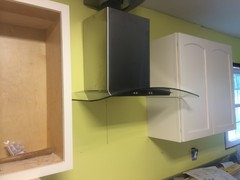
    Here is a range hood we are installing (we are REQUIRED by local code to have one). We have a gas range so it is mounted 30" above the range. This model can use a vent or be ventless. A vent would have discharged onto our future deck, and since we don't do heavy cooking we went ventless which added about. $50 to cost. We used double 2 x 8s stacked two high between studs to support the range hood (overkill, but better than too flimsy ). Range hood has its own separate electrical circuit. Counting tax about $425. Not fancy but right for us. Considered under cabinet model but liked this look better.
  • 12 years ago
    @fluckycharm: your inspector is right. Well, half-right. Let us explain...

    Range hoods which are not ducted to the outside - a.k.a. "recirculating" or "ductless" ones - use carbon filters to remove some of the odors, after the metal filters capture the grease; then the air is recirculated back into the room.

    Unfortunately, the additional charcoal filter reduces airflow, increases noise, and must be replaced on a regular basis (typically 3-9 months, depending on manufacturer's recommendations and cooking style).

    @halbraswell: this is where you might get an unpleasant surprise a year down the road - it's not just the initial $ 50 cost of the charcoal filter, it's an ongoing expense for the lifetime of the hood. If the charcoal filter is not replaced, eventually it gets clogged up with grease that gets past the metal filters, and completely blocks the airflow.

    Long-term, it's better to run the duct - especially in your type of installation, which appears to be on an outside wall (according to the window in the background) - just use a 90-degree elbow, and you're outside - than have to pay $ 50 every 3-9 months to keep the hood operating properly. Your range hood supplier should have discussed this option, but it's not too late to install a duct, ask your contractor for a cost estimate.

    Where fluckycharm's inspector is right, is that yes, ductless range hoods are much less effective than ducted ones. The reduced airflow and extra noise, and the fact that all the excess heat, moisture, and solid smoke particles will be recirculated back into the room, makes them much less attractive than ducted hoods.

    In addition, you don't get the benefit of the range hood extracting the air from the kitchen, and thus forcing fresh air to be pulled in from the outside - which improves the air quality throughout the house.

    Where the home inspector is mostly wrong, is that in situations like condominiums (hello, Miami and Vancouver!) or co-op buildings (half of Manhattan...), it's impossible to run an outside duct, and a full-size range hood, even ductless, will still remove the grease and odors, which is better than nothing. (Note that this doesn't apply to microwave or undercabinet hoods, those are useless in any configuration.)

    For more information about range hoods, please feel free to read our guide "Top 10 Reasons To Have A Range Hood", available at http://www.futurofuturo.com/rangehood-FAQ-10-reasons-to-have-a-range-hood.php
  • 12 years ago
    So, to summarize:

    Ducted range hood (to the outside) > ductless range hood (recirculating) > undercabinet/microwave hood > no range hood.
  • PRO
    9 years ago

    totally unused tool! so much fuss and extra new regulations with extra expense bills!

  • 9 years ago

    I had the dreaded Jenn air downdraft in an island for 9 years. I echo everyone's complaints-control panel burned up twice-associated with use of self cleaning feature-thermostat quit on me-but the worst was the venting. It did pull the flame away from all of the burners-worthless for heat when you are trying to cook. I just quit using the vent fan. My kitchen did not get noticeably greasy or filmy. I wonder what some of the users are cooking? Boiling water, scrambling eggs, making sauces, soups or gravies do not produce too much grime. I do bacon and meats in the oven. My house does not smell for days but it is a 1932 house-plenty of drafty windows and doors. I've ordered an LG gas oven and at this point intend not to vent it at all. There is a door with a screen door not 6 feet away in a straight line if I need to air out the room.

  • 8 years ago

    Old thread, but we have lived without one for 20+ yrs. Looking at a remodel, and putting in an induction cooktop on the island. So if we put in a hood, we block the open space we are trying to create. Put it in the celieng its over 5' away and with induction we wont have much heat rise, so pretty ineffective, thinking about a retractable, but then would need to vent into basement, and furnace is in the way. So could do recirculating but lots of posts here are talking me out of that. Plus no one here has yet to mention a make up air vent. With these units sucking out so much air, you need a make up air vent to bring in cold fresh air.

  • 7 years ago

    I know this is an old thread, but I also have an induction cooktop and I can have an entire all of windows behind it. I dont want wall cabinets, or a hood vent. The window is almost 14 feet, do I really need a hood vent?

  • PRO
    7 years ago

    Yes, you need a vent hood. And do you really want to clean grease off of glass? Do you cook? Or is the kitchen more for visual appeal, with no cooking happening in it?

  • 7 years ago

    Hahaha. I cook a lot. I just really want to have a beautiful wall of windows, uninterrupted. thanks for the advice.

  • 7 years ago

    It not just whether you cook a lot or not, but what kind of cooking you do.

    We stopped using our properly vented hood once we switched from gas to induction. After a while we took it out, got rid of the soffit which hid the vent, and installed a simple recirculation hood instead. We even remember to use it... a few times per year :)

    Considering that most of our cooking is done in the oven and the cooktop is mostly used for soups, steamed veggies, etc., we could easily go without. But if frying is your thing, a hood is a must.