Software
Houzz Logo Print
cherylrowley

Kitchen range top without an exhaust fan?

12 years ago
I have seen this often recently and wonder how this can possibly work. Considering this application in an island but I am concerned about venting cooking odors out of the house. I would appreciate any real-life experience with this application.

Comments (29)

  • 12 years ago
    We just finished building, and I understand your dilemma. Logic told me that installing a fan was a common sense decision. The contractor, though, told me fans are a personal preference these days. Everyone I spoke to in the appliance and cooking fields told me the fat and spatter are what float into the air and coat your cabinets, ceilings and walls; they said they wouldn't cook without a fan. That made sense to me since I love to cook, so I installed a fan over my island cooktop.
    If you're on a budget, a fan that "moves your hair" (in other words, the hair on your head moves when you put your head under the hood) is what you should look for. My fan over my island has 600cfm --the low end of recommended power. When I put a grocery store plastic baggy on my island's cooktop and turned on the fan to high speed, the baggie didn't move a millimeter! I was crushed. Now I don't know how 600cfm will work with cooking smoke and spatter. I'm not optimistic. So, my recommendation is to plan to spend more than you want to (like double), and you'll have a fan that works well. Downdrafts, without question, are useless (spoken from personal experience).
    cherylrowley thanked 26me6
  • PRO
    12 years ago
    Building codes require ventiation for cooktops.
  • PRO
    12 years ago
    Get a good exhaust fan that will suck small children through the roof, that should be adequate. Don't go without one.
  • 12 years ago
    Thanks to everyone for providing your comments. You all confirmed my instinct. I guess all of those kitchens without vent hoods are kitchens where cooking never actually occurs. I especially loved the small child comment. Thanks again.
  • 12 years ago
    last modified: 12 years ago
    G2425.8 (501.8) Appliances not required to be vented.
    The following appliances shall not be required to be vented:
    1. Ranges.
    2. Built-in domestic cooking units listed and marked for optional venting.
    3. Hot plates and laundry stoves.

    G2407.9.3 (304.9.3) Combined combustion air and ventilation air system. Where combustion air is provided by the building’s mechanical ventilation system, the system shall provide the specified combustion air rate in addition to the required ventilation air.


    http://publicecodes.cyberregs.com/icod/irc/2012/icod_irc_2012_24_par397.htm?bu2=undefined


    M1503.4 Makeup air required.
    Exhaust hood systems capable of exhausting in excess of 400 cubic feet per minute (0.19 m3/s) shall be provided with makeup air at a rate approximately equal to the exhaust air rate. Such makeup air systems shall be equipped with a means of closure and shall be automatically controlled to start and operate simultaneously with the exhaust system.

    http://www.engr.psu.edu/phrc/training/Make%20up%20air_4-30-12.pdf

    .

    http://www.healthyheating.com/Kitchen-Range-Hoods.htm#.U018IRNZ6Tk

    .

    http://www.greenbuildingadvisor.com/blogs/dept/musings/makeup-air-range-hoods

    .

    http://oikos.com/esb/53/rangehood.html
  • PRO
    12 years ago
    You definitely need the ventilation. There is the downdraft option but, they're not very effective. If you don't like the idea of a vent hood blocking the line of sight over the island, check out the ventilation I wrote about in this blog post: http://www.addisoninteriordesigndenver.com/whats-new-in-kitchen-appliances/
  • 12 years ago
    Thanks, Addison. Your blog was informative and I've learned about a lot of new products. The Frecan system is interesting but probably not applicable in my kitchen with a pitched 25' high ceiling. It also seems a little iffy and very expensive. I think I am stuck with a suspended "old school" ventilation system that I know will work for the money invested. Thanks again
  • 12 years ago
    There's no code "requirement" for cooktops/ranges to be vented.

    It's not a requirement, but it's a very good idea. Having a range hood will improve air circulation, but most importantly, the grease filters will capture the airborne grease before it drifts through the room, settles on the cabinets & creates an annoying sticky film, and disperses throughout the rest of the house, making all the soft furniture smell like past dinners.

    Here's a list of 10 reasons to have a range hood. We're betting there's at least 1 factor in there that you'd never think of!

    http://www.futurofuturo.com/rangehood-FAQ-10-reasons-to-have-a-range-hood.php
  • 12 years ago
    Even if not required (I'm not sure) gas stoves throw out a lot of particulate and cooking generates a lot of mess and steam. An extractor is essential. The person who designs a quiet one will make a fortune. Mine does the bag trick even on low, but it is loud on any setting. Meanwhile, my dishwasher, which I can run when sleeping, is quiet a a church mouse. I'm thinking the reverse would serve me better.
  • 12 years ago
    Very nice blog, Addison Design!

    However, some thoughts about the Frecan Paradigma:

    1.) 600 cubic meters/hour comes out to 353 CFM - which would be barely adequate in a range hood that's next to the cooking surface, and is nearly useless when it's in the ceiling, several feet away. You would need several of these units, at the minimum. Consider the cost of multiple units + the expense of installing them.

    2.) Multiple ventilation units would involve multiple ducts. Ask any contractor how they would like to manage 3, 4, 5, or more ducts in the ceiling.

    3.) Frecan is based in Spain, so their products would be compliant with the European CE / TUV specifications. They would not be compliant with the United States' UL and Canada's CSA requirements - not unless and until they make a specific version for North American distribution ...and we'll leave it to Fred S. to explain the consequences of using a non-compliant appliance in a residential application.

    4.) There are available "in-ceiling" ventilation options that would look just as good, but are much easier to install, and most importantly, are designed for North American use and are UL/CSA compliant.
  • 12 years ago
    @adivra: 100%, "essential" is a perfect word to describe it.
  • 12 years ago
    Futuro Pro,
    Visited your website and while there are many attractive models, I could not locate the CFM rating on any of the models. Am I missing something? This seems to be the most important element in selecting the proper range hood, trumping design aesthetic and all of the other features listed.
  • 12 years ago
    last modified: 12 years ago
    @cherylrowley:

    The CFM rating for each model is in the line that describes the overall blower specifications - "Power: 110-120V / 60 Hz / 4.0A / 940 CFM", in the left-hand column of each product page.

    (We know, it's not too obvious, we'll redesign it in the next version of the website.)

    Almost all of our hoods are equipped with 940-CFM blowers, so we're not too focused on differentiating among different blower powers. If we were a reseller offering a variety of different brands, with different blower power levels, that would be a consideration, but as we have a single "standard" blower size, our web site is mainly focused on grouping the models into island vs wall versions, then subcategorized by size - 48", 36", etc.
  • PRO
    12 years ago
    Fire your contractor! Fans are required in most county's and they also functional.
  • 12 years ago
    Thanks, Futuro Pro for the clarification on the CFM ratings.
  • 12 years ago
    Thanks again to everyone for your comments to my original query. I think that it's interesting that no one who actually lives in a kitchen without a range hood responded. That speaks volumes. I will definitely be installing a range hood with kick-ass CFM power - and hopefully find one that is aesthetically pleasing as well. The Futuro product line has some nice looking models that I wasn't familiar with until this posting. Does anyone have a comment about the best CFM rating to strive for? Any other manufacturer suggestions for beauty and function? Thanks again.
  • 12 years ago
    last modified: 12 years ago
    "I think that it's interesting that no one who actually lives in a kitchen without a range hood responded." - they're either too ashamed, or, realizing the error of their ways, are too busy shopping for a range hood! ;)
  • 12 years ago
    Coming back to the very 1st comment...

    @26me6: regarding the test with placing a plastic bag on the countertop - no, this wouldn't work, even with a much more powerful range hood - the suction simply won't reach that far.

    You could take the world's best vacuum cleaner, and hold it 2 feet off the floor - it won't pick up anything either. Also, a (hypothetical, non-existent) range hood that could lift a plastic bag off the counter, would also extract so much air so fast that you'll have serious problems with negative pressure only a few seconds after you turn it on. There's a reason why Fred keeps bringing up the "M1503.4 Makeup air required" point from the building codes - you don't get to increase the CFM's without having to compensate for the lost air.

    The standard test is turning on the range hood at the *lowest* speed, and placing 1 square of paper towel against the center filter. If the hood has enough "draw" to keep the paper towel pressed against the filter - at the lowest speed - it will have enough draw to grab the aerosolized grease particles.

    If the hood can't even hold up a paper towel, either you have an installation problem, or the duct is too small / too long / flexible, or the blower is truly inadequate.
  • 11 years ago
    last modified: 11 years ago
    I have an electric Jennair stove/cooktop in my peninsula with the downdraft built in and the down draft fan is SO powerful that is sucks the air out of our wood burning fireplace and makes the house all smokey and nasty smelling. My hubby disconnected the downdraft fan and we cook with no fan. I use covers on all my pans when cooking so there is no real grease splatter anywhere. If I should be cooking something that has quite the odor I will open a window and or turn on the ceiling fan in the dining room. Not ashamed to say no fan used here. I clean my 30 year old kitchen cupboards on a regular basis as well.
  • PRO
    11 years ago
    Irrespective of whether your local code requires a vent hood, I recommend installing one--and using it, too. When used in conjunction with a gas cooktop or range, the vent hood's key function is to maintain air quality by eliminating products of combustion, odors, and moisture. Depending on the vent hood's capacity, you may also need to install a fresh-air make-up system or you can end up backdrafting other devices like @cabingirl13's vent hood is doing.

    In our experience, we've found that wall-mounted hoods to work better than downdrafts, particularly if the downdraft is venting a gas-fired cooktop or range (they tend to mess with the burner flames.) That said, we recently installed a Dacor downdraft for a client's electric cooktop and it's working well.

    Good luck.
  • 9 years ago

    I'm remodeling my kitchen and will not install a range hood. We removed the microwave with had an exhaust fan we never used. My home is clean, grease and odor free. Open a window and clean often.

  • 9 years ago

    I found your post when searching. I'm currently going through the same situation and I don't think I'll be installing a vent during my remodel. I own condo, have a small galley kitchen and will be knocking down a wall where the stove is currently so it kind of limits my options.


  • 7 years ago

    I have a range hood over a gas range that I virtually never use. I have maybe used it 20 times in 10 years! I do a good bit of cooking and do not have grease problems. But I do clean regularly. I am now getting ready to remodel my kitchen to where I will I have a gas cooktop on a peninsula and have decided to forego the expense of a ceiling mount hood with my remodel. It will look better too. I can see though after searching that there aren't many people who don't have one.

  • 5 years ago

    I do not have a ventilating hood. My stove, a gas stove, is in a peninsula in the middle of the kitchen/breakfast room. There is a room above it and a basement below it. When I moved here there was a dying Jenn Air with a downdraft. I thought that I had to replace it with the same arrangement. It was terrible-blew out 2 of the burners and had to travel so far to go down and out of the basement that I could see no use in it. I cook without a vent hood. I have 2 doors, 5 windows and a CO detector in my kitchen. Everything is fine, my cabinets are not ruined. My house does not smell like food. It's fine if you can easily install an adequate one in a functional spot. But if you cannot all the messing around with crawl spaces and long runs of ducting is not going to be functional. And just say no, no, no to downdrafts. Smoke and steam do not want to travel down and it is a losing battle.

  • 5 years ago

    We also do not have a ventilating hood or exhaust fan in our kitchen and I'm not ashamed to say it. We live in a 980 sq ft cabin and the kitchen and living room are one big ol' room with a vaulted ceiling. We have a propane gas range. It would be a really big expense for us to install a range hood or ceiling exhaust fan. The previous owners installed an outdoor ceiling fan in the kitchen and we are about to change that to an indoor one which has a higher CFM and is more in keeping with our way of decorating. There are 3 very large windows in the kitchen and if things get too overwhelming with cooking, I can turn on the fan and/or open a window ... or 2 or 3. The living room also has large sliding windows so we get amazing cross ventilation. We did update the kitchen, keeping the same layout but upgraded to custom cabinetry, quartz countertops and tile backsplash. We had updated the appliances when we moved in 5 yrs ago. We'd love input on what type of ceiling fan would be best for a cabin kitchen and an avid baker.

  • 5 years ago

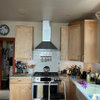
    To the person who commented that those of us without a vent must be too ashamed to admit it I will say this is not so. Reading these comments prompted me to do a bit of reading. A hood that works too well will cause other air quality problems and require other expensive modifications. My old house functions fine without it. I don't cook a lot of meat on top of the stove. Bacon only goes in the broiler for example. Pancakes and scrambled eggs are not going to contaminate your house. I use a rice cooker and a crockpot. Unless you are in the habit of burning bread, cakes, pies and cookies you don't have a smoke problem. My smoke and carbon dioxide alarms are in the same space and never alert. If you look at the picture they are on that back wall where the back door is located. I'm not sure what people do to get grease particles going airborne everywhere. They just go a few feet. Most stove tops are a few feet square. Grease is heavy. It actually doesn't much tend to leave the immediate area and can be easily wiped up. I am attaching a photo. That white linen lampshade-right there by the stove top does not get greasy. I inspect it regularly. My cabinets and pretty white Corian countertops are not ruined. I am not asserting that no one should have one. But they are not required in many states.


  • 5 years ago

    Building a new home. Thought about not having a hood because I never use the one I have now. Wanted an open airy feel with a pot filler and open shelving above stove. Started searching on internet about this and found this thread. I was amazed how strongly people feel about it. Seems people with them don't want anyone to walk to beat of different drummer. I say do what you love, it's your home! Now I'm certain I will NOT be installing one.

  • 3 years ago

    I know this comment is late, but veneration hoods are actually not required in many states and apartments often don’t have them…. Although I cook ALOT (by modern standards), because of a divorce, I actually lived for about 10 years without a kitchen hood/vent and never had a problem, though I did use a lot of cleaning products 😀; occasionally had to open the breakfast room doors if the kitchen became particularly smoky💨; and probably wouldn’t consider “going hoodless” as a permanent option….. I have since moved and was recently researching portable ventilation options for a butler’s pantry and found Maxime Augay’s new technology interesting. Orders a scheduled to be filled in January, 2023— https://www.yankodesign.com/2017/12/07/kitchen-fumes-begone/