
Search results for "Fainting" in Home Design Ideas
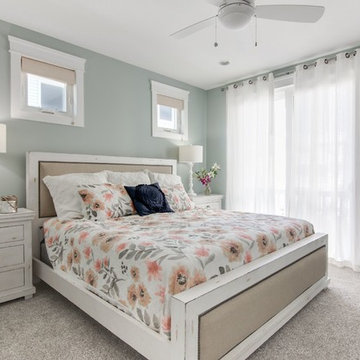
 Jennifer Busler Interiors, LLC
Bedroom - mid-sized transitional guest carpeted and gray floor bedroom idea with gray walls and no fireplace
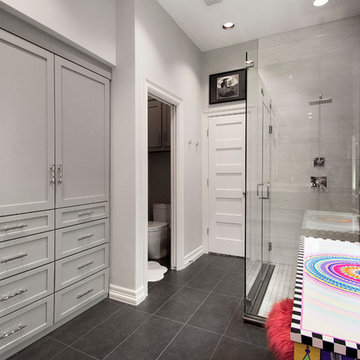
 Alair Homes Plano
The master bathroom remodel was a must! The homeowners hated the existing tile and workmanship. The old bathroom had small split vanities, poor lighting and not enough space. We removed the unused bathtub to free up space for their fun eclectic painted furniture. We installed a frameless shower and added a teak folding shower seat. The new shaker cabinets were painted in Stamped Concrete (SW7655), contrasting with the Web Gray walls. Modela Integrated light custom vanity mirrors were hung above each sink, helped to brighten this master bath in addition to the added recessed lighting. The original built in shelves were redesigned with glass shelves to open them up but keep the added need for storage and to showcase the homeowners travel keepsakes. A heated towel rack was hung on the wall for an additional cozy element. The bathroom is now 100% usable space and the clients love the look! Design by Hatfield Builders & Remodelers | Photography by Versatile Imaging

Find the right local pro for your project
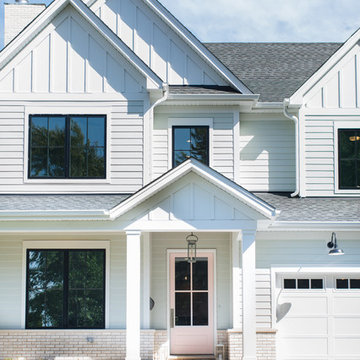

 Ragsdale, Inc.
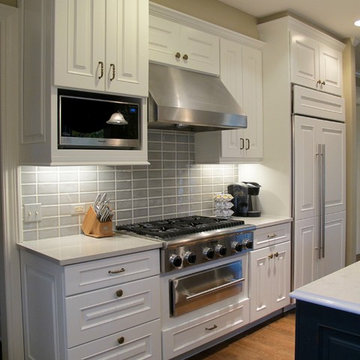
Kitchen island refinished in BM 2129-20 Soot with a faint rub through. Island countertop replaced with Cambria Torquay, basin profile. Perimeter cabinets refinished in White Dove. Perimeter countertops replaced with Cambria Templeton, Ridgeline profile. Backsplash replaced with MSI Dove Gray glazed ceramic subway tile with White Dove grout.
 Pinnacle Design & Remodeling
Once their basement remodel was finished they decided that wasn't stressful enough... they needed to tackle every square inch on the main floor. I joke, but this is not for the faint of heart. Being without a kitchen is a major inconvenience, especially with children.
The transformation is a completely different house. The new floors lighten and the kitchen layout is so much more function and spacious. The addition in built-ins with a coffee bar in the kitchen makes the space seem very high end.
The removal of the closet in the back entry and conversion into a built-in locker unit is one of our favorite and most widely done spaces, and for good reason.
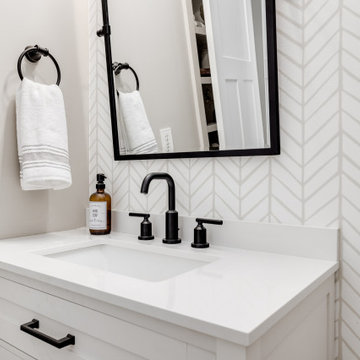
The cute little powder is completely updated and is perfect for guests and the daily use of homeowners.
The homeowners did some work themselves, some with their subcontractors, and the rest with our general contractor, Tschida Construction.
 Red House Remodeling
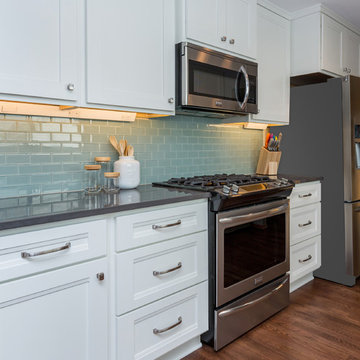
A kitchen that was previously boxed in by bulkheads and a peninsula felt even smaller with stained oak cabinets and poor lighting. Light cabinets now fill the available wall space. Not only is there considerably more storage, but the kitchen looks far more open than before. Can lighting and under cabinet lighting provide plenty of general and task lighting.
 Betty Wasserman Art & Interiors: The Hamptons
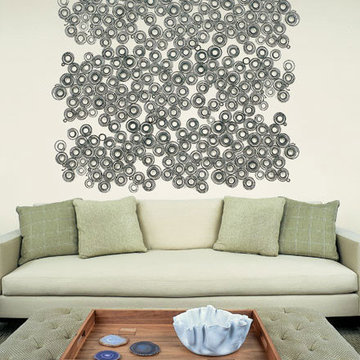
A stunning geometric shaped metal wall decoration brings this modern living room to life! The metallic color brings out the faint green color of the contemporary sofa.
 Signature Innovations LLC
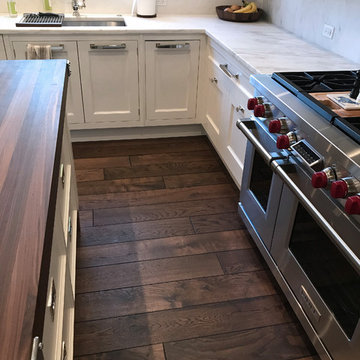
Using white throughout this home makes the dining room’s faint taupe walls pop with understated elegance. The beauty continues in the white and stainless kitchen, grounded on hand scraped flooring. Floor: 7” wide-plank Vintage French Oak | Rustic Character | Victorian Collection hand scraped | light distress | pillowed edge | color Bronze | Satin Hardwax Oil. For more information please email us at: sales@signaturehardwoods.com

 Jennifer Busler Interiors, LLC
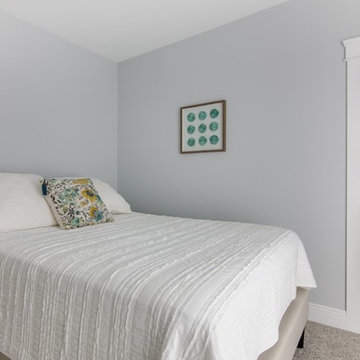
Bedroom - mid-sized transitional guest carpeted bedroom idea with gray walls and no fireplace
 All Canadian Renovations
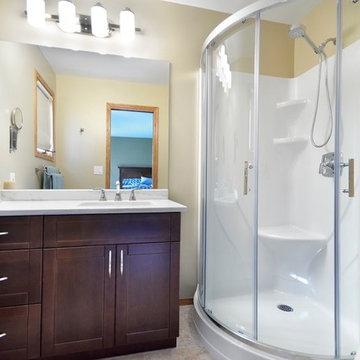
Mid-sized elegant 3/4 ceramic tile corner shower photo in Orange County with flat-panel cabinets, dark wood cabinets, a two-piece toilet, beige walls, a drop-in sink and granite countertops
 Dan Boyle Construction
Jessamyn Harris Photography
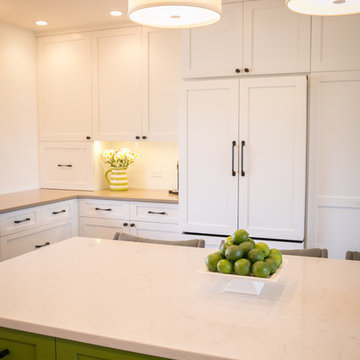
Example of a mid-sized cottage l-shaped dark wood floor eat-in kitchen design in San Francisco with an undermount sink, shaker cabinets, green cabinets, quartzite countertops, white backsplash, ceramic backsplash, stainless steel appliances and an island
Example of a mid-sized cottage l-shaped dark wood floor eat-in kitchen design in San Francisco with an undermount sink, shaker cabinets, green cabinets, quartzite countertops, white backsplash, ceramic backsplash, stainless steel appliances and an island
 Ecstatic Stone, LLC
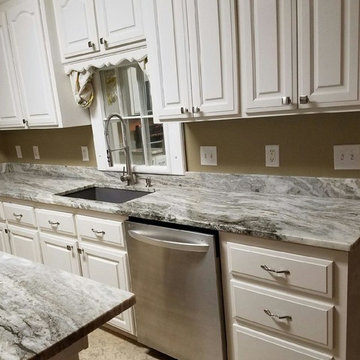
Remodel crafted by E & A Marble and Granite fabricators in West Columbia, SC......Love the white cabinets, beautiful nickel and crystal pulls on the drawers, large deep gray undermount sink, stainless steel dishwasher, all accentuated by the Ocean Beige kitchen countertops. A clean, crisp feel; light grey and white, along with faint colors reminiscent of water....the flow as a slow peaceful brook; a project perfectly crafted! Ocean Beige Hard Marble feels elegant, soft and calming. Light white kitchen. Notice the backsplash becomes one with the Ocean Beige Marble countertops with perfectly matched lines. Stunning kitchen island for additional workspace or to pull up a stool!
 Glenn Gissler Design
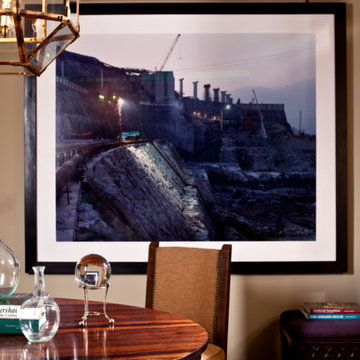
A place for reflection: a contemporary photograph of a Chinese dam joins a patinated brass ceiling fixture and a crystal orb.
The dining room became a study which can be used for occasional entertaining, centered upon the Empire round table the clients brought from Colorado. Chairs are from a 1930s ocean liner. Meant to be flexible, the table may be set up as a dining table, buffet, or bar. At right, a portiere in Kravet’s double-sided “Interweave” fabric marks the separation from the bedroom.
Boudin armchairs upholstered by Jonas in Bellinger’s vibrant Paprika “Pasha” velvet flank an exquisite late 17th century English crewel embroidery with exotic floral motif, from Fuller’s Fine Art Auction. The antique Korean blanket chest, of elmwood with original iron hardware, is from Jacques Carcanagues.
A Victorian Eastlake side table is juxtaposed with a pair of Dorothy Draper walnut tables from Assemblage, Ltd. The long English roll arm sofa in charcoal linen is from Restoration Hardware. The Patrick Naggar candle sconces for Pucci are modern, yet Edison-like, of handblown glass, with bare quartz bulbs. Photograph above the sofa is by Sugimoto.
Outsider art, insider ceramics: a charming primitive painted in a hand-made "tramp art" frames joins arts & crafts movement pots.
Nothing less than sumptuous, the king sized bed features William-Sonoma’s faintly curving “Sutton” headboard, upholstered in sensuous “Mohair Dove.” The crimson, persimmon, black and cream stylized floral pattern bed covering is an antique Suzani
 Kitchens of Diablo
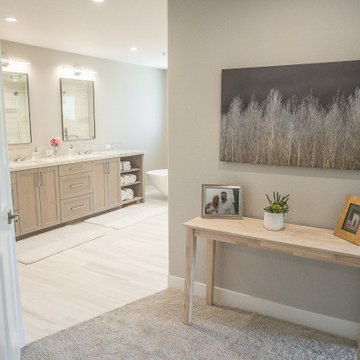
Amazing transformation for the outdated bathroom that needed a huge face-lift. The old bathroom had many walls, a large outdated tub, and glass cube shower walls. It was removing walls and expanding slightly into the bedroom allowed for the expansive steam shower and show stopper free-standing tub by Victoria & Albert. The continued use of white natural stone tile and countertop (bianco dolomiti - all natural stone, la blanc quartzite countertop). The polished nickel plumbing fixtures brings the glam to this luxury master bathroom. The large curbless steam shower is another show stopper in this bathroom, floor to ceiling glass and a beautiful mosaic tile flooring and the faint horizontal lines of the wall tile bring much-needed relaxation to this shower. The final touch is the expansive double vanity from Signature Custom Cabinetry in beautiful alder wood in a light brown stain - driftwood. These items create the luxurious open bathroom that this client had always dreamed of.
 Hague Bldg & Remodeling
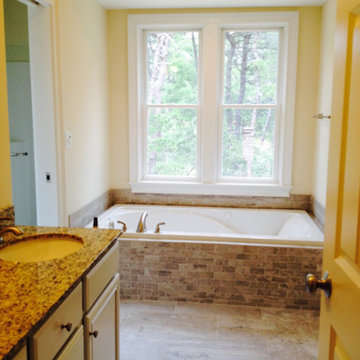
Master bathroom tub/jacuzzi area in two room bathroom
Inspiration for a large timeless master beige tile and ceramic tile ceramic tile drop-in bathtub remodel in Boston with a two-piece toilet, raised-panel cabinets, medium tone wood cabinets, yellow walls, a drop-in sink and granite countertops
Inspiration for a large timeless master beige tile and ceramic tile ceramic tile drop-in bathtub remodel in Boston with a two-piece toilet, raised-panel cabinets, medium tone wood cabinets, yellow walls, a drop-in sink and granite countertops
 Pinnacle Design & Remodeling
Once their basement remodel was finished they decided that wasn't stressful enough... they needed to tackle every square inch on the main floor. I joke, but this is not for the faint of heart. Being without a kitchen is a major inconvenience, especially with children.
The transformation is a completely different house. The new floors lighten and the kitchen layout is so much more function and spacious. The addition in built-ins with a coffee bar in the kitchen makes the space seem very high end.
The removal of the closet in the back entry and conversion into a built-in locker unit is one of our favorite and most widely done spaces, and for good reason.
The cute little powder is completely updated and is perfect for guests and the daily use of homeowners.
The homeowners did some work themselves, some with their subcontractors, and the rest with our general contractor, Tschida Construction.

 safe ZOnea
If you’re active on GardenWeb sharing plant photos, asking for advice, tracking seasonal progress you already understand how much detail goes into gardening. Soil pH, rainfall, emerging leaves, bloom counts, fertilizer schedules it adds up fast. But all that rich information often remains buried in posts, lists or memory. What if you could visualize that data and turn it into clear quick insights? That’s where a graph maker becomes a game-changer for your gardening workflow.
1. Why garden data belongs on a graph
On GardenWeb, you’ll find forums for everything from perennial care, vegetable gardening, patios, herbs, even cooking and craft projects. While plant lovers share observations and ask questions, many track progress manually in spreadsheets or memory. A graph maker flips that around:
Instead of a list of numbers (e.g., “Soil test: pH 6.4 in May, 6.1 in October”), you get a line graph showing the decline over time.
Instead of guessing which plant bloomed most, you see a bar chart comparing counts across plants.
Instead of manually calculating average rainfall effect, you plot scatter points of bloom count vs. rainfall.
By turning your data into visuals, you’re not just recording—you’re analysing, learning and improving. For GardenWeb users this means smarter decisions: Which fertilizer actually improves bloom count? Which shady spot recovers slower? A graph maker gives clarity.
2. What is a graph maker and how to use one
A graph maker is a web tool or software that lets you input raw data (numbers, dates, categories) and output visual charts like line graphs, bar charts, scatter plots, etc. It might allow you to import a spreadsheet, select chart type, customize colours, label axes, and export the image for your blog, forum post or personal log.
Here’s how you could apply it for gardening:
Log blooms per week for each rose plant.
Using the graph maker, choose line graph to track changes over weeks.
Label your y-axis “Number of Blooms”, x-axis “Week of Year”.
Add colour lines for each plant for easy comparison.
Export as PNG and embed it in a GardenWeb forum post: “See bloom trend for my ‘Peace’ vs ‘Knock Out’ roses”.
This isn’t just pretty-to-look-at: it makes the trend obvious, invites discussion (“Hey, your ‘Knock Out’ line dips after week 28—what changed?”) and helps you refine your routine.
3. Use these specific scenarios on GardenWeb
A. Soil pH and plant health tracking
After multiple tests you have pH values over time and bloom results. Upload both datasets into the graph maker, produce a dual-axis line graph: soil pH on one axis, bloom count on the other. Post your findings in the “Soil, Fertility & Nutrients” forum and get feedback.
B. Seasonal pest or disease appearance
Record number of aphids spotted each month and whether you used treatment. A bar chart via the graph maker can show pre- and post-treatment figures. Then ask the “Insect & Disease Control” forum for advice based on your visual data.
C. Yield comparison between varieties
You grow two zucchini varieties. You keep weekly yield in pounds. Use the graph maker for a side-by-side bar chart. Share in the “Vegetable Gardening” forum: “Which was better this year? See the chart”.
D. Rainfall vs growth rate
You log weekly rainfall and growth (in cm) of your tomato plants. Use scatter plot in graph maker. If a pattern emerges, you’re ready to post: “Is my growth plateau due to drought? Chart shows a clear correlation.”
4. Why this elevates your GardenWeb contributions
When you post with a chart made by a graph maker, you’re doing more than asking or showing off. You’re investigating. You’re analysing. You invite the community to give feedback on data, not just anecdotes. That elevates the discussion. Instead of “My plant died, any ideas?” you post “See this graph of pH drop and bloom count—what might be the limiting factor?” High-quality visuals raise your post’s value and garner more thoughtful responses.
Plus, your posts become useful references for others: someone else can say, “Cool graphic, can you share your data sheet?” You build credibility and help the forum become a learning hub—not just a Q&A board.
5. Tips for using a graph maker effectively in the GardenWeb context
Keep it simple: One chart, one insight. Don’t overcrowd.
Label clearly: Titles, axis labels, units (e.g., cm/week, mg/L, °F).
Use readable colours: Avoid faint tones that vanish on mobile.
Annotate when needed: Add notes like “Fertiliser switched week 12” or “Shade cloth added”.
Provide context in your post: Don’t leave the chart alone—write a few sentences explaining what it shows and what you’re seeking.
Embed carefully: Make sure your image displays properly in GardenWeb; check mobile view.
Share raw data: If possible link to your spreadsheet so others can replicate or comment.
Be open to feedback: The chart invites questions; embrace them.
6. Possible pitfalls and how to avoid them
Bad data = bad chart: If your measurements aren’t consistent, your graph will mislead. Use standardized data collection.
Too much complexity: Multi-axis charts, too many variables—confusing. Stick to one or two variables.
Overlooking mobile viewers: Many GardenWeb users browse via phones. Use large fonts and simple visuals.
Ignoring the narrative: Chart alone won’t answer. Explain what it means and what you need.
Outdated charts: If you update your data annually, keep your visuals current or label them clearly as “2024 data”.
7. Final thoughts
On GardenWeb you’ll find a vibrant community of gardeners, DIYers, cooks and design lovers.Using a graph maker for your posts and progress turns your experience from casual hobby-logging into smart data-driven gardening. You’ll not only learn more—your peers will learn more, too.
So next time you log your plant growth, record your yield, test your soil or track pests—don’t just note it. Plot it. Use a graph maker. Share it in the forum. Let your garden tell the story, and let the community help you write the next chapter.
 Neolithic Materials
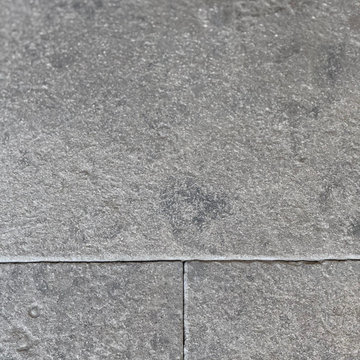
Cielo Limestone is a light, refined stone with soft gray and blue-gray tones. Faint white threads, cloudy patches, small crystals, and shell traces add subtle character, while softened edges keep the look clean and contemporary. Ideal for living spaces, bathroom walls, fireplaces, and counters. For inquiries, contact us at (310) 289-0414 or info@neolithicmaterials.com
25