
Search results for "Migration" in Home Design Ideas
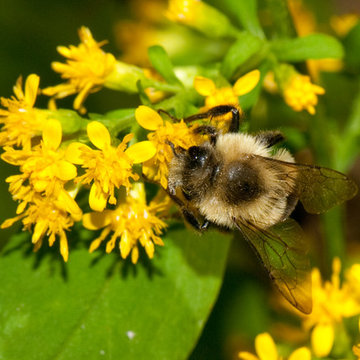
 Pollination Press LLC
Solidago Flexicaulis / Zigzag Goldenrod
This is an example of a landscaping in Minneapolis.
This is an example of a landscaping in Minneapolis.
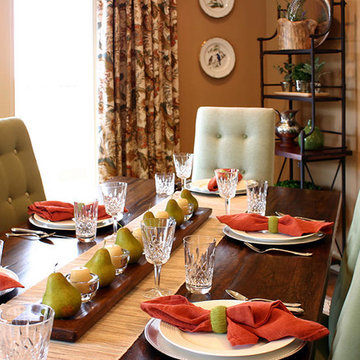
 Avondale Design Studio
Soft, warm greens, oranges, tans, and browns combine to create a richly textured palette inspired by the gorgeous fabric we used for the draperies. In the back, an antique baker's rack is used as a plant stand for fresh herbs and as extra serving surfaces. Hand-painted china plates feature songbirds that migrate throughout North America.
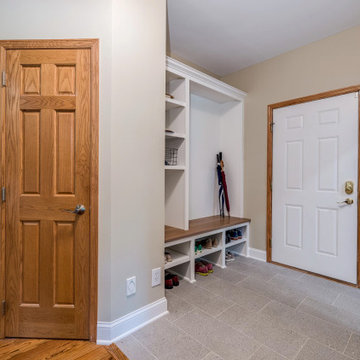
 Pinnacle Design & Remodeling
Referred by our client across the street, this project was one for the books!
It started out just as a laundry room, that then included the back garage entry, that migrated to the owner's suite, that then logically had to include the remaining powder that was located between the spaces.
For the laundry we removed the second powder bath on the main level, as well as a closet and rearranged the layout so that the once tiny room was double in size with storage and a refrigerator.
For the mudroom we removed the classic bifold closet and made it a built-in locker unit.
We tied the two spaces together with a tiled floor and pocket door.
For the powder we just did cosmetic updates, including a bold navy vanity and fun wallpaper.
Find the right local pro for your project
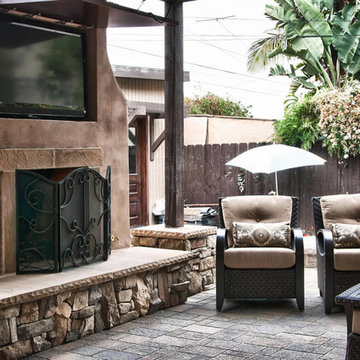
 Western Outdoor Designs
Western Outdoor Design & Build has teams of outdoor living experts, specializing in helping Southern California homeowners expand their living place. Many Southern California homeowners want to add a little wow factor to their backyard paradise and they aren’t sure how to do it. An outdoor fireplace can be the perfect backyard addition that guests will naturally migrate to at night.
http://westernoutdoordesigns.com/gallery-outdoor-fireplaces-san-diego-orange-county.html
 Quax
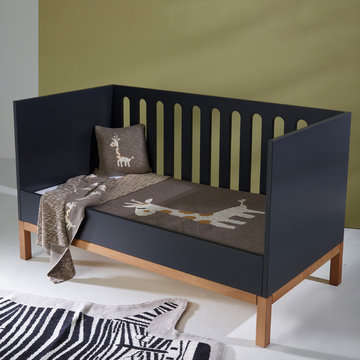
QuaxWith the Indigo bedroom Quax offers a wide range of furniture with a long-lasting use in mind.
Without any worries because where necessary these pieces of furniture were tested by internationally recognized authorities for EN-716 for cots and EN-12221 for changing tables.
In order to achieve this Quax uses durable materials, for example no chipboard but high-density Mdf, well-known for its intrinsic stability and strength. These boards meet the strict E1-standard regarding formaldehyde emission. Do not forget that natural wood too contains formaldehyde. We support durable forestry and ask our suppliers to submit the PEFC and FSC certificates. Special care also goes to the furniture fittings. Only reputable suppliers provide us with, among others, quality slides for the drawers and reliable connecting techniques, including particular attention for eccentrics, necessary for connecting parts which have a great supporting power. Quax does not use self-rotating screws because they obstruct the dismantling and re-assembly of furniture. The lacquer finish also gets our full attention : we only work with international quality suppliers such as Akzo Nobel and not with local producers. These suppliers are responsible for the certificates for their products, for example EN 71-3 with attention for the migration of harmful components.
Design also plays an important role in the business philosophy of Quax. For the Indigo bedroom for example the bars are milled out in the Mdf board, which does not only contribute to the fancy nature of this range but also to the sturdiness of the side-frames, not comparable to tradional bars. The undercarriage has been given special attention and is made of solid beech, which makes colour differences possible, depending on the tree’s habitat. They reflect the richness of the natural product and must therefore be regarded as normal. The frame’s finish with a quality oil may emphasize these shade differences. The charm of the natural patina is the guarantee of the natural product.
The cots can be converted into bench, something which your toddlers will certainly appreciate.
The series includes cots 120x60 cm, 140x70 cm with optional bedrail and beds 200x90 cm, a 3-drawer chest with optional changing extension, one-, two- or three-door wardrobe, a night table, a desk and a bookcase.
As part of the Quax Inclusive Design, we offer a wide range of matching accessories to enchant the children’s room with a wow factor - Be Inspired.
 Teakwoodcentral
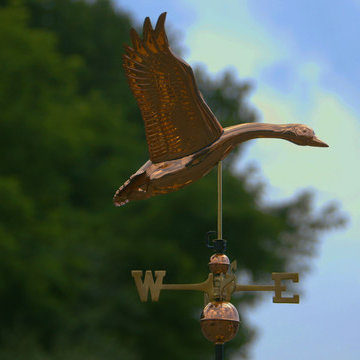
Gently gliding through the sky, this duck is looking for a place to migrate; preferably your garden or yard.
Our Good Directions' artisans use Old World techniques to handcraft this fully functional, garden weathervane that's unsurpassed in style, quality and durability.
A great gift for wildlife enthusiasts.
Polished copper for long-lasting beauty
Includes easy-to-assemble, all-weather garden pole, solid brass directionals and copper spacer balls
Measures 12 L x 21 H x 14" wingspan ideal for any deck, garden, or yard
Weight: 6lbs
L: 12", W: 14", H: 21"
Material: Copper Polished
 Hogue Landscape Services
The concept of the garden was based on, “Brazilian Hummingbirds II”, a painting the MFAH has in its collection by the artist, Martin Johnson Heade. Heade travelled to the rainforest in Brazil between 1863 and 1864 and painted a
series of small paintings depicting hummingbirds in the lush foliage of the Brazilian rainforests. His painting, Brazilian
Hummingbirds, II, evokes the sultry atmosphere of the Brazilian rainforest with its misty quality and subtle lighting. His interest in ornithology can be seen in his detailed depictions of the hummingbirds. The garden location is adjacent to one of Buffalo Bayou’s steep, wooded ravines. The ravine, with its native plant communities and topography, is a perfect back-
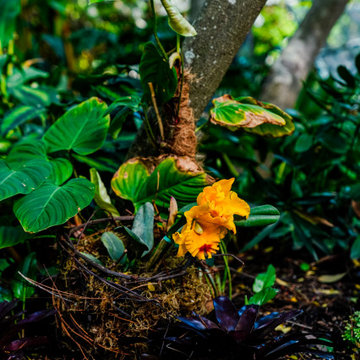
drop for a garden with a rainforest theme. Because the date for the garden opening coincides with the spring migration of hummingbirds into our region, the hummingbird theme seemed appropriate for this garden competition. The garden will include a variety of tropical plants native to the rainforests such as bromeliads, orchids, heliconia, and passion fruit flowers. In addition, native plants to our region such as the Sabal Minor and Southern Wood Fern will be included to integrate
plants that are found nearby in the ravine. The Heliconia flowers produce considerable amounts of nectar, a high energy food essential for hummingbirds who are known to consume three times their bodyweight in a single day. In addition to nectar producing plants, there will be hummingbird nest materials dispersed throughout the garden. A misty quality to the garden will be provided by a misting system, and tropical colored lights will be lit at night for special events. Visitors to the garden will have a unique sensory experience reminiscent to that of Heade’s travels to Brazil’s rainforests.
 Western Outdoor Designs
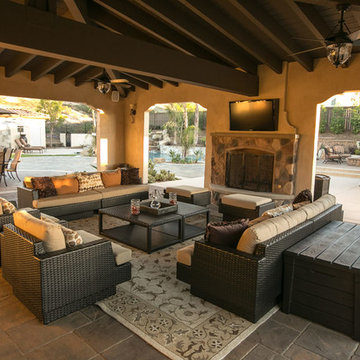
Western Outdoor Design & Build has teams of outdoor living experts, specializing in helping Southern California homeowners expand their living place. Many Southern California homeowners want to add a little wow factor to their backyard paradise and they aren’t sure how to do it. An outdoor fireplace can be the perfect backyard addition that guests will naturally migrate to at night.
http://westernoutdoordesigns.com/gallery-outdoor-fireplaces-san-diego-orange-county.html
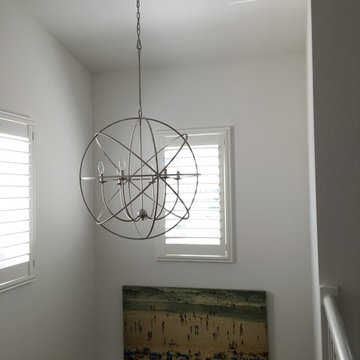
 Mary Harrison for Ethan Allen, Inc.
mary harrison
Example of a mid-sized beach style hallway design in Orange County with white walls
Example of a mid-sized beach style hallway design in Orange County with white walls
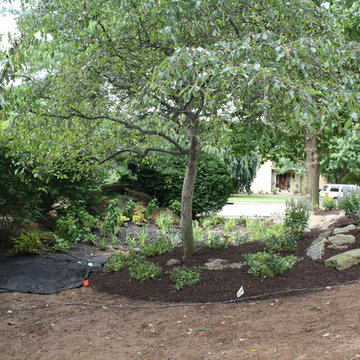
 Pennsylvania Landscape & Nursery Association
Terren Landscapes http://www.terrenlandscapes.com
2014 PLNA Awards for Landscape Excellence Winner
Category: Residential $30,000-$60,000
Award Level: Silver
Project Description:
Our company was contracted to do a master plan for the family who was in desperate need of a rear yard renovation. The existing lawn area remained saturated throughout most of the year and the runoff from the neighboring property ran across their back yard, down the side of their property and all the way to the sidewalk in front of their house. The water was so intense that it had begun to cut through the back yard and erode the soil across the sidewalk and into the nearby storm drain.
By identifying these drainage problems and discussing solutions with the homeowner, we were able to design and create the aesthetically pleasing and sustainable solution of a rain garden. The goal was to slow down storm water runoff, and catch pollution and sediment by creating a rain garden that acts as a filter prior to entering the storm drain, while enhancing the aesthetics of the property.
The rain garden created was a shallow depression, 12 - 16" deep that collects rainfall runoff from all downspouts of the home and water collected into perforated pipes underneath the lawn area. The perforated pipe begins at the highest elevation in the yard and ends in the rain garden, the new lowest elevation that has been excavated down to an 8" depth. The perforated pipe captures the runoff water and allows the water to seep slowly back into the
ground as it runs across the property and into the garden. The garden was lined with a geotextile filter fabric to aide in removing contaminants from the water, prevent migration of the stone in to the soil, and minimalize maintenance.
A large variety of plant material was chosen, focusing mainly on native wetland species for their tolerance of our local soil types, moisture conditions and
the habitat they provide for wildlife. The garden was abundant with native wildlife and was a sustainable ecosystem for birds and butterflies upon completion of the project.
After planting, we arranged decorative stone throughout the garden to slow the flow of water and help prevent erosion. The combination of vegetative and stone surfaces provides temporary storage for runoff before the water either evaporates or infiltrates the soil.
The surrounding beds throughout the property were also all amended with compost and replanted with plants that work in harmony with the rain garden. The front, side, and rear yards are a beautiful display of colors that bloom throughout the seasons and the plants throughout the entire property provide food and shelter for native wildlife.
The rear yard that was once a muddy play space for the kids is now a dry lawn space that can be utilized by the family and their neighbors. This multi functional garden has become the focal point of the residence.
Photo Credit:
Terren Landscapes
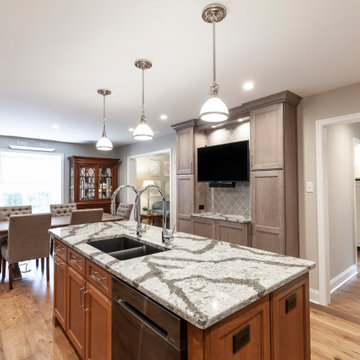
 Touchstone Kitchen and Bath
This kitchen previously was closed in and only included an L-shape layout. We opened up the space to a more open concept design, added an island, and migrated the plumbing (sink and dishwasher) to this new island to free up space on the main counter.

 Hogue Landscape Services
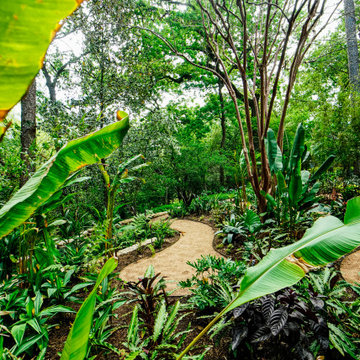
The concept of the garden was based on, “Brazilian Hummingbirds II”, a painting the MFAH has in its collection by the artist, Martin Johnson Heade. Heade travelled to the rainforest in Brazil between 1863 and 1864 and painted a
series of small paintings depicting hummingbirds in the lush foliage of the Brazilian rainforests. His painting, Brazilian
Hummingbirds, II, evokes the sultry atmosphere of the Brazilian rainforest with its misty quality and subtle lighting. His interest in ornithology can be seen in his detailed depictions of the hummingbirds. The garden location is adjacent to one of Buffalo Bayou’s steep, wooded ravines. The ravine, with its native plant communities and topography, is a perfect back-
drop for a garden with a rainforest theme. Because the date for the garden opening coincides with the spring migration of hummingbirds into our region, the hummingbird theme seemed appropriate for this garden competition. The garden will include a variety of tropical plants native to the rainforests such as bromeliads, orchids, heliconia, and passion fruit flowers. In addition, native plants to our region such as the Sabal Minor and Southern Wood Fern will be included to integrate
plants that are found nearby in the ravine. The Heliconia flowers produce considerable amounts of nectar, a high energy food essential for hummingbirds who are known to consume three times their bodyweight in a single day. In addition to nectar producing plants, there will be hummingbird nest materials dispersed throughout the garden. A misty quality to the garden will be provided by a misting system, and tropical colored lights will be lit at night for special events. Visitors to the garden will have a unique sensory experience reminiscent to that of Heade’s travels to Brazil’s rainforests.
 Diane Stein Design for Sheffield Furniture
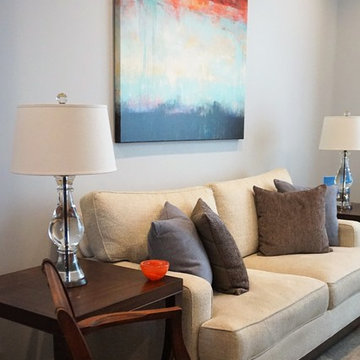
The migration to the city is happening everywhere. This home is all about that process. Downsizing, mixing favorites with new and adding unique character. The design is a mix of Vintage and modern with a nod to the areas industrial past. Vintage chairs this Thibaut fabric for a fresh look. 1920s magazine AD, favorite artwork, antique ceramic vase from days gone by, and new pieces bring this family back their Philadelphia roots.
 Design Matters
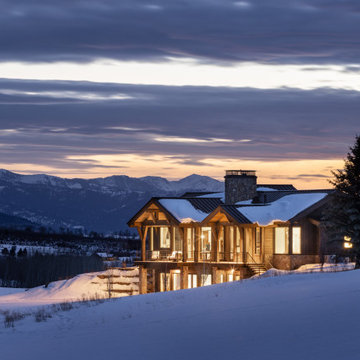
Perched in the rolling landscape of Alta, Wyoming, this legacy home was thoughtfully designed to belong to the land, not dominate it. Nestled into the hillside with sweeping views of the elk migration path and the Teton Range, every decision was made with future generations in mind. Led by Julie Cavanaugh, this project reflects her passion for designing legacy homes...places that honor family history, respect the land, and are built to be passed down for generations. With roots on this property dating back to the late 1800s, the homeowners envisioned a home that would tell their family’s story well into the future.
As featured in the latest edition of Mountain Living Magazine, this home is more than a retreat, it’s a promise to the past and a gift to generations to come.
With 70 acres of land, this timber framed home totals 5,752 sf. - 4 bed, 4.5 bath
 Fiorito Interior Design
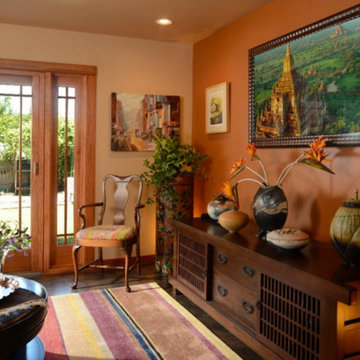
After a decade of being bi-coastal, my clients decided to retire from the east coast to the west. But the task of packing up a whole lifetime in a home was quite daunting so they hired me to comb through their furniture and accessories to see what could fit, what should be left behind, and what should make the move. The job proved difficult since my clients have a wealth of absolutely gorgeous objects and furnishings collected from trips to exotic, far-flung locales like Nepal, or inherited from relatives in England. It was tough to pare down, but after hours of diligent measuring, I mapped out what would migrate west and where it would be placed once here, and I filled in some blank spaces with new pieces.
They bought their recent Craftsman-style home from the contractor who had designed and built it for his family. The only architectural work we did was to transform the den at the rear of the house into a television/garden room. My clients did not want the television to be on display, and sticking a TV in an armoire just doesn’t cut it anymore. I recommended installing a hidden, mirror TV with accompanying invisible in-wall speakers. To do this, we removed an unnecessary small door in the corner of the room to free up the entire wall. Now, at the touch of a remote, what looks like a beautiful wall mirror mounted over a Japanese tansu console comes to life, and sound magically floats out from the wall around it! We also replaced a bank of windows with French doors to allow easy access to the garden.
While the house is extremely well made, the interiors were bland. The warm woodwork was lost in a sea of beige, so I chose a deep aqua color palette for the front rooms of the house which makes the woodwork sing. And we discovered a wonderful art niche over the fireplace that the previous owners had covered with a framed print. Conversely, a warm color palette in the TV room contrasts nicely with the greenery from the garden seen through the new French doors.
Photo by Bernardo Grijalva
 One Eleven Joule
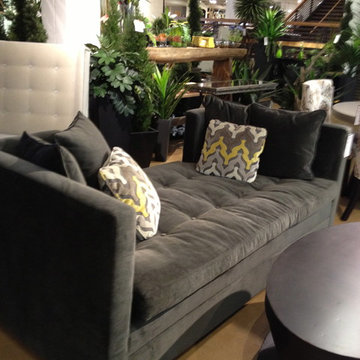
Found this settee at High Fashion Home on a 50% off sale. It works well at end of long kitchen living area. Open back keeps the window from being totally ignored and large size doubles as another bed in the space for overnight guests.
Update: Cushion is down so it is comfy but feathers constantly migrate to surface and create a messy look.
 Hogue Landscape Services
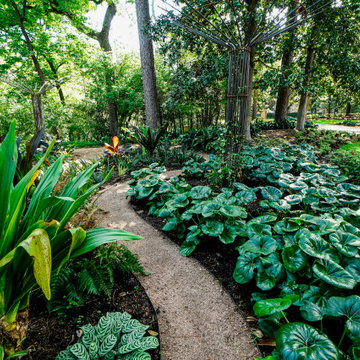
The concept of the garden was based on, “Brazilian Hummingbirds II”, a painting the MFAH has in its collection by the artist, Martin Johnson Heade. Heade travelled to the rainforest in Brazil between 1863 and 1864 and painted a
series of small paintings depicting hummingbirds in the lush foliage of the Brazilian rainforests. His painting, Brazilian
Hummingbirds, II, evokes the sultry atmosphere of the Brazilian rainforest with its misty quality and subtle lighting. His interest in ornithology can be seen in his detailed depictions of the hummingbirds. The garden location is adjacent to one of Buffalo Bayou’s steep, wooded ravines. The ravine, with its native plant communities and topography, is a perfect back-
drop for a garden with a rainforest theme. Because the date for the garden opening coincides with the spring migration of hummingbirds into our region, the hummingbird theme seemed appropriate for this garden competition. The garden will include a variety of tropical plants native to the rainforests such as bromeliads, orchids, heliconia, and passion fruit flowers. In addition, native plants to our region such as the Sabal Minor and Southern Wood Fern will be included to integrate
plants that are found nearby in the ravine. The Heliconia flowers produce considerable amounts of nectar, a high energy food essential for hummingbirds who are known to consume three times their bodyweight in a single day. In addition to nectar producing plants, there will be hummingbird nest materials dispersed throughout the garden. A misty quality to the garden will be provided by a misting system, and tropical colored lights will be lit at night for special events. Visitors to the garden will have a unique sensory experience reminiscent to that of Heade’s travels to Brazil’s rainforests.
 Hogue Landscape Services
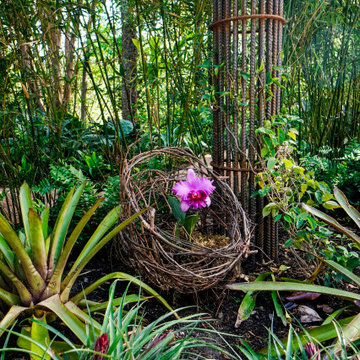
The concept of the garden was based on, “Brazilian Hummingbirds II”, a painting the MFAH has in its collection by the artist, Martin Johnson Heade. Heade travelled to the rainforest in Brazil between 1863 and 1864 and painted a
series of small paintings depicting hummingbirds in the lush foliage of the Brazilian rainforests. His painting, Brazilian
Hummingbirds, II, evokes the sultry atmosphere of the Brazilian rainforest with its misty quality and subtle lighting. His interest in ornithology can be seen in his detailed depictions of the hummingbirds. The garden location is adjacent to one of Buffalo Bayou’s steep, wooded ravines. The ravine, with its native plant communities and topography, is a perfect back-
drop for a garden with a rainforest theme. Because the date for the garden opening coincides with the spring migration of hummingbirds into our region, the hummingbird theme seemed appropriate for this garden competition. The garden will include a variety of tropical plants native to the rainforests such as bromeliads, orchids, heliconia, and passion fruit flowers. In addition, native plants to our region such as the Sabal Minor and Southern Wood Fern will be included to integrate
plants that are found nearby in the ravine. The Heliconia flowers produce considerable amounts of nectar, a high energy food essential for hummingbirds who are known to consume three times their bodyweight in a single day. In addition to nectar producing plants, there will be hummingbird nest materials dispersed throughout the garden. A misty quality to the garden will be provided by a misting system, and tropical colored lights will be lit at night for special events. Visitors to the garden will have a unique sensory experience reminiscent to that of Heade’s travels to Brazil’s rainforests.
 Hogue Landscape Services
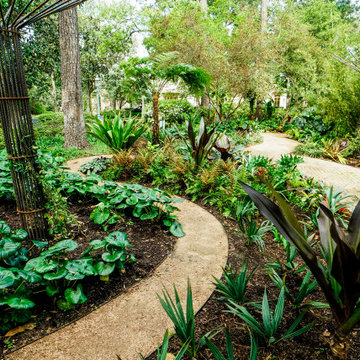
The concept of the garden was based on, “Brazilian Hummingbirds II”, a painting the MFAH has in its collection by the artist, Martin Johnson Heade. Heade travelled to the rainforest in Brazil between 1863 and 1864 and painted a
series of small paintings depicting hummingbirds in the lush foliage of the Brazilian rainforests. His painting, Brazilian
Hummingbirds, II, evokes the sultry atmosphere of the Brazilian rainforest with its misty quality and subtle lighting. His interest in ornithology can be seen in his detailed depictions of the hummingbirds. The garden location is adjacent to one of Buffalo Bayou’s steep, wooded ravines. The ravine, with its native plant communities and topography, is a perfect back-
drop for a garden with a rainforest theme. Because the date for the garden opening coincides with the spring migration of hummingbirds into our region, the hummingbird theme seemed appropriate for this garden competition. The garden will include a variety of tropical plants native to the rainforests such as bromeliads, orchids, heliconia, and passion fruit flowers. In addition, native plants to our region such as the Sabal Minor and Southern Wood Fern will be included to integrate
plants that are found nearby in the ravine. The Heliconia flowers produce considerable amounts of nectar, a high energy food essential for hummingbirds who are known to consume three times their bodyweight in a single day. In addition to nectar producing plants, there will be hummingbird nest materials dispersed throughout the garden. A misty quality to the garden will be provided by a misting system, and tropical colored lights will be lit at night for special events. Visitors to the garden will have a unique sensory experience reminiscent to that of Heade’s travels to Brazil’s rainforests.
13