
Search results for "Nations" in Home Design Ideas
 Morning Star Builders LTD
Mike Kaskel
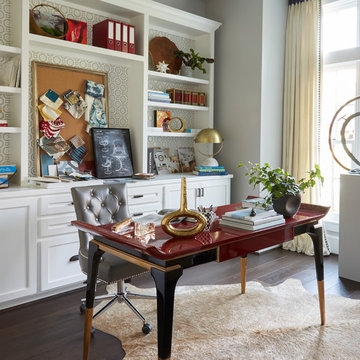
Large elegant freestanding desk dark wood floor and brown floor study room photo in Houston with multicolored walls
Large elegant freestanding desk dark wood floor and brown floor study room photo in Houston with multicolored walls


Find the right local pro for your project
 Chairma Design Group
Mike Kaskel
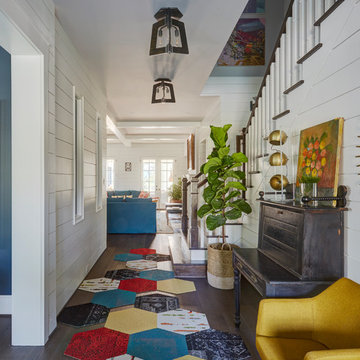
Country dark wood floor and brown floor entry hall photo in Houston with white walls
Country dark wood floor and brown floor entry hall photo in Houston with white walls
 Chairma Design Group
Mike Kaskel
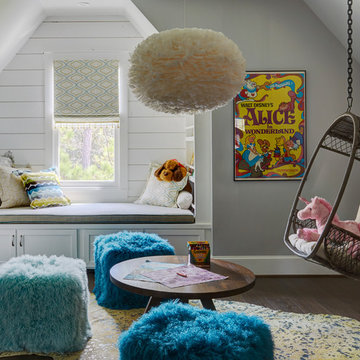
Farmhouse girl dark wood floor kids' room photo in Houston with gray walls
Farmhouse girl dark wood floor kids' room photo in Houston with gray walls
 Morning Star Builders LTD
Mike Kaskel
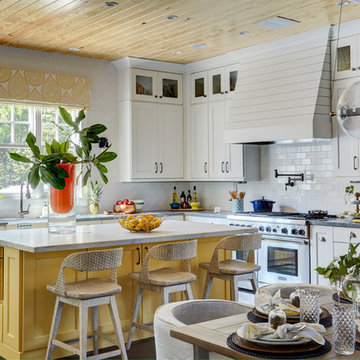
Inspiration for a large timeless l-shaped dark wood floor and brown floor open concept kitchen remodel in Houston with a farmhouse sink, shaker cabinets, white cabinets, white backsplash, stainless steel appliances, an island, marble countertops and subway tile backsplash
Inspiration for a large timeless l-shaped dark wood floor and brown floor open concept kitchen remodel in Houston with a farmhouse sink, shaker cabinets, white cabinets, white backsplash, stainless steel appliances, an island, marble countertops and subway tile backsplash

 Maxim Lighting International
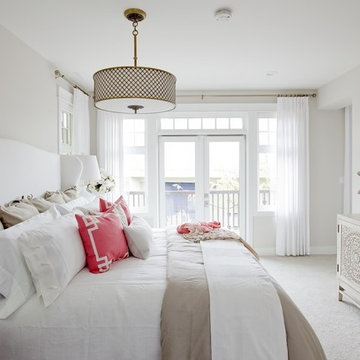
Example of a transitional l-shaped light wood floor open concept kitchen design in Los Angeles with flat-panel cabinets, dark wood cabinets and an island

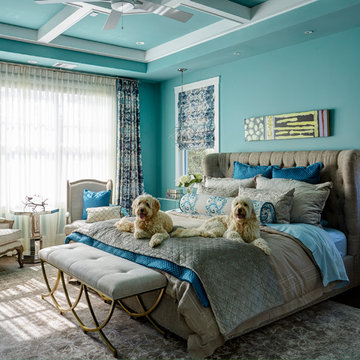 Chairma Design Group
Mike Kaskel
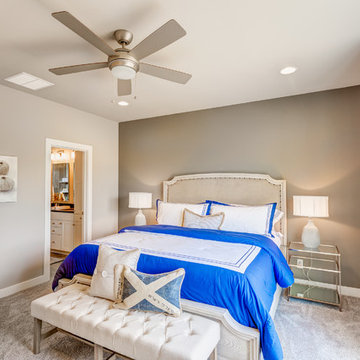
Bedroom - traditional dark wood floor bedroom idea in Houston with blue walls
Bedroom - traditional dark wood floor bedroom idea in Houston with blue walls
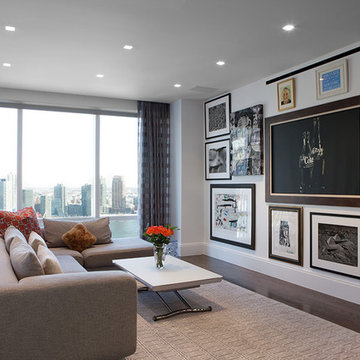
 Linda Jaquez Architectural Photography
© Linda Jaquez
Example of a trendy enclosed dark wood floor family room design in New York with white walls, no fireplace and no tv
Example of a trendy enclosed dark wood floor family room design in New York with white walls, no fireplace and no tv
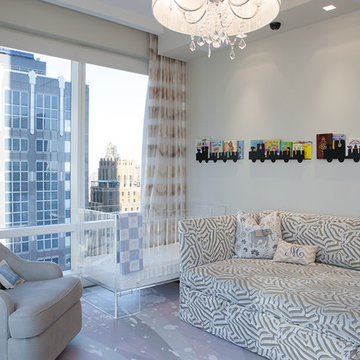 Linda Jaquez Architectural Photography
© Linda Jaquez
Nursery - contemporary gender-neutral nursery idea in New York with white walls
Nursery - contemporary gender-neutral nursery idea in New York with white walls
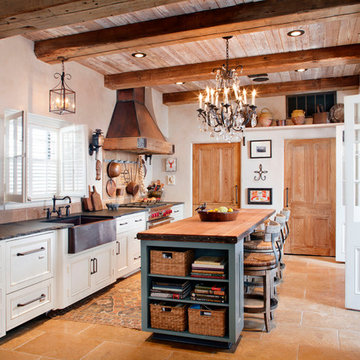
 National Kitchen & Bath Association
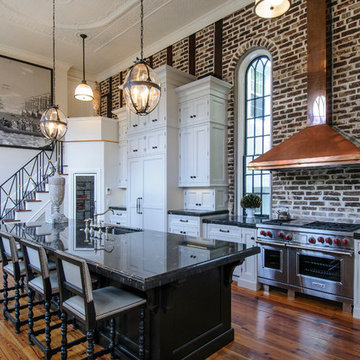
Visit NKBA.org/ProSearch to find an NKBA professional near you- turn your dreams into reality! 2013 NKBA Design Competition Finalist 'Rustic Old World Charm' by Richard Ourso, CKD, CAPS Material and Salvage finishes recreate the Old World French décor the clients truly desired. A custom hood was created, using copper, copper rivets, forged-iron strapping and an old beam, and the finish was left with a naturally dark patina. Photo: Chipper Hatter
 National Kitchen & Bath Association
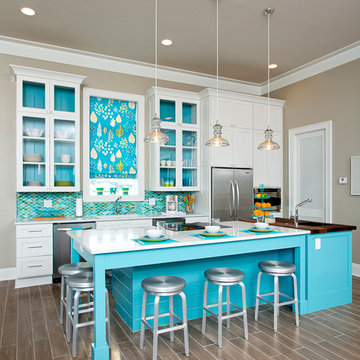
Visit NKBA.org/ProSearch to find an NKBA professional near you- turn your dreams into reality! Budget Friendly Kitchen & 2nd Place- Medium Kitchen 'Beach Ball' by Cheryl Kees Clendenon Here’s a perfect rendition of a contemporary twist on a classic beach cottage. This kitchen in a rental was designed for the easy navigation of a large number of guests. The island offers generous seating areas and plenty of counter space aptly crafted to serve multiple cooks. Photo: Greg Riegler Photography
 National Kitchen & Bath Association
Visit NKBA.org/ProSearch to find an NKBA professional near you- turn your dreams into reality! 2nd Place- Large Kitchen & People's Pick Kitchen Winner 'Step Back in Time' by Bryan Reiss, CMKBD This renovated kitchen in an historical home features antiqued, hand-painted finishes and a large antique Chinese print on the soaring wall over the stairs – a step into historic modernity! Oversize cabinets and hefty details on the island are embellished in different shades of gray. Photo: John D Smoak III
 National Kitchen & Bath Association
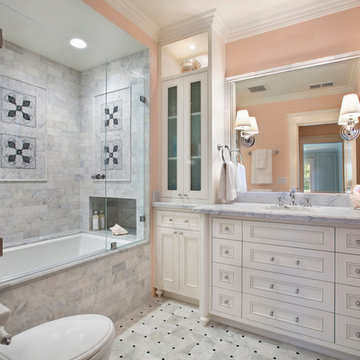
Visit NKBA.org/ProSearch to find an NKBA professional near you- turn your dreams into reality! 1st Place- Small Bath & People's Pick Bath 'Room to Grow' by Leslie Lamarre, CKD, CID, CGBP An eight-year-old client can enjoy this grown-up refuge now and for many years to come. Photo: Bernard André Photography
 Building Designers Association of Australia
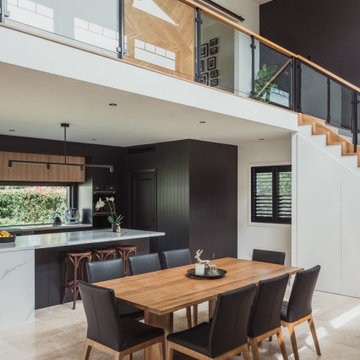
The kitchen is truly the heart of the home in the design for Lisarow House. The bold black cabinets have been paired with warm timber tones to help anchor this kitchen with-in the space. The dark tones are offset by the abundance of natural light that floods in from a double height void over and large stacking doors to the deck areas, providing a sense a light and volume whilst maintaining a cozy ambiance. The kitchen location was carefully considered so it benefits from sightlines to all backyard, entertaining and living spaces.
 Building Designers Association of Australia
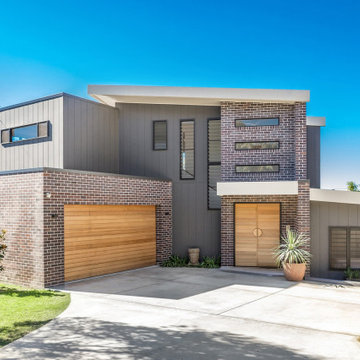
The knock down & rebuild revolution is here to stay. This new modern family home replaces a tired old house that was not designed to capitalise on its location, whereas this new contemporary modern building has been designed to capitalise on the natural environment – natural sunlight, sea breezes & sea views, to create a very liveable coastal family home. This new residence with its contemporary coastal styling utilises the natural finishes of modern materials to ground this family home’s context into this locations evolving executive seaside neighbourhood. This buildings design is a balance of form & function with a deliberate consideration of passive solar liveable design techniques, designed to capture the natural sunlight, sea breezes & sea views that this property offers. This new residence has been designed with a variety of indoor & outdoor living areas to capitalise on the natural environment & climate of this property’s location. This house incorporates design elements to allow the house to be comfortable all year round, providing a variety of areas for occupants to utilise, whether it be capturing natural sunlight & warmth in winter, creating cooling cross ventilation from sea breezes in summer & then there is the direct access to a beautifully natural landscaped garden, this new house will provide the occupants with a low maintenance, healthy living environment for years to come.
 Building Designers Association of Australia
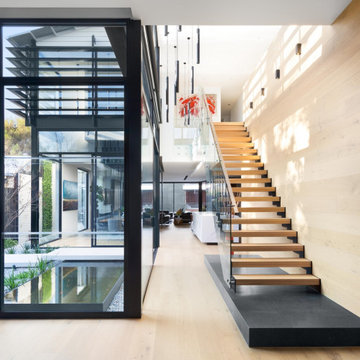
Located on a heritage-lined street in Melbourne’s Williamstown, a young family were seeking a contemporary home with ample room to grow. Benni Trajcevski of Achieve Design Group answered their call, creating the epitome of modern living concealed behind a modest façade. To achieve the long wish list including large indoor and outdoor gathering spaces to entertain family and friends, separate adult and children living and sleeping zones, and a pool suitable for year-round use, Benni has maximised every inch of the block. Seamless transitional spaces link inside with out. This flow between the indoors and outdoors is a key feature of the home, achieved through generous open floor planning and glazing. For example, large hidden sliding doors allow the pool to be closed-off for use in winter; acrylic glass panels link the pool with the sunken lounge, which includes a fire pit for year-round comfort. The inclusion of a courtyard and voids throughout create separate useable zones while maintaining the feeling of spaciousness. Orientated to the north and surrounded with floor to ceiling windows to optimise natural light, the courtyard divides the formal lounge area with the informal living area, while the first floor is divided into four separate wings for privacy and functionality. The interiors are detailed with quality materials and finishes to achieve a sleek and sophisticated aesthetic. Contrasting materials in muted tones, including tiles, steel and lightweight timbers are featured throughout. Corian and a moss green wall are unexpected features.
 Boyenga Team / Compass
Eichler X-100: A Nationally Recognized Architectural Landmark
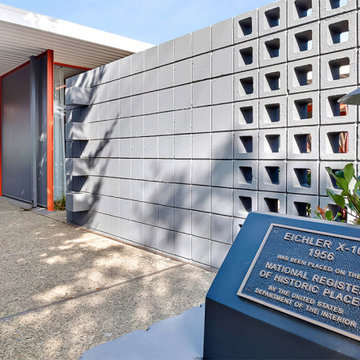
The Eichler X-100 holds a rare distinction in residential real estate—it is listed on the National Register of Historic Places, recognizing it as a property of exceptional architectural and cultural significance in the United States.
This designation places the X-100 among a select group of homes that have not only endured over time, but have helped define the evolution of modern living.
What the National Register Means
The National Register of Historic Places is the official list of the nation’s most important historic resources—properties that embody significant contributions to architecture, history, and culture.
For the Eichler X-100, this recognition affirms:
Its role as a groundbreaking experimental prototype
Its importance within the broader movement of California Modernism
Its association with visionary figures like Joseph Eichler, A. Quincy Jones, and Frederick Emmons
It is not simply a well-designed home—it is a documented piece of architectural history.
A Rare Level of Integrity
One of the key factors in the X-100’s designation is its remarkable level of preservation. Over the decades, the home has been carefully maintained and thoughtfully updated to respect its original vision.
Important defining features remain intact, including:
The steel-frame structural system
The open, garden-centered floor plan
Skylights and natural light strategies
Signature material palette of steel, glass, and laminate
This continuity allows the home to be experienced today much as it was in 1956.
Preservation Without Limitation
A common misconception is that National Register status restricts ownership—but for private residences, this is not the case.
The designation:
Does not limit private ownership or resale
Does not impose federal restrictions on modifications (unless federal funding is involved)
May offer potential incentives or recognition for preservation efforts
Instead, it serves primarily as a recognition of significance, elevating the property’s status in both cultural and real estate contexts.
A Collector-Level Opportunity
For buyers, National Register status adds a layer of meaning that goes beyond square footage or location. It signals that the property is:
Architecturally important
Historically documented
Extremely rare within the marketplace
Homes like the Eichler X-100 are often viewed as “trophy properties”—assets that combine lifestyle, design, and long-term cultural value.
Stewardship of a Legacy
Owning a National Register home like the Eichler X-100 is not just about possession—it’s about participation in a larger story.
It means becoming part of a lineage of stewards who understand the importance of:
Preserving architectural intent
Respecting design integrity
Carrying forward a vision that helped shape modern living
The Significance Today
Nearly 70 years after its debut, the Eichler X-100 continues to stand as a symbol of innovation, optimism, and design excellence.
Its listing on the National Register of Historic Places ensures that its story is recognized—but its future will always depend on those who choose to own and care for it.
The Eichler X-100 is not just a home on a list.
It is a recognized landmark of modern architecture—now ready for its next chapter. Image Sabrina Huang
9