Software
Houzz Logo Print
kristimama

Square Foot Gardening / Containers?

18 years ago

Hey Al and others,

I'm hoping some of you can share your experiences and opinions on the whole Square Foot Gardening concept. Good, bad, ugly. I just want to understand it all better so I can make an informed decision for my "raised beds". And I REALLY value and trust the knowledge base of folks posting here.

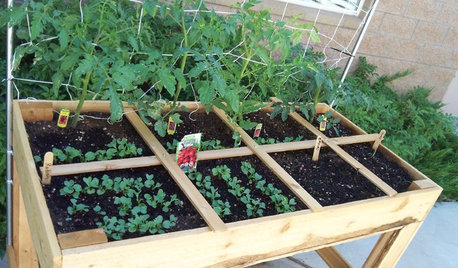
I'm also asking here because the boxes SEEM like a hybrid of a container and "in ground"... since the boxes are often placed right on top of the native soil. And some are literally containers with wood bottoms.

The "Square Foot" approach of bringing in a "perfect" soil appeals to me because I have some challenges with my soil: it's heavily compacted clay, plus I am a little worried about possible contamination issues from a long-time previous owner who was a jeweler and who knows what he tossed in the yard.

Have any of you tried the SFG boxes with Mel's Mix, or Al's Mix, or some variation on the two?

Obviously, the Mel's Mix has much more organic material and is probably heavier than Al's container mix. Which I think is probably OK for in ground applications of veg's that you're turning every 6 months.

I'm not a big fan of peat, and I'm wondering if the bark fines could make a good substitute (in terms of their functionality) for peat?

Thanks for the thoughts, folks!

-kristi

Comments (7)

  • 18 years ago

    Square foot gardening is rather different from container culture. It's pretty much the same as growing in the earth. Container culture, on the other hand, is much more like hydroponics and quite different from growing in the ground.

    Al

  • 18 years ago

    I have 4 sq ft beds, open to the earth. As far as what you would fill them with you have to consider your climate.

    I used Mel's mix to start with. Overall I am happy with it, but it does tend to dry quickly in the summer. You certainly could sub bark for the peat, but if the bark isn't well composted the mix would dry down even faster. Not necessarily a problem, you have to decide. For me I used soaker hoses with a timer for anytime I wouldn't be around or when I just didn't feel like watering it all.

    Can't really comment on going closed bottom as I haven't done it. I suspect it would work out OK primarily because these are intensively planted with veggies whose roots will rapidly colonize to the bottom removing the issues of a PWT and effectively creating their own aeration.

  • 18 years ago

    Hey JaG,
    Thanks for sharing your experience. That's kinda my gut feel for the short growth veggies is that his mix is probably good for that. Not gonna plant my citrus in it. Good to know about the bark fines... you're probably right that they'd dry out even more than the peat... so that doesn't seem like it'll work here in Northern Cal. Our summers are HOT. Sheesh it was 88 here yesterday. LOL.

    Hey Al,
    Do you say SFG is "the same thing as growing in the earth" because
    a)the dynamics of the water wicking down to the earth?
    Or
    b) because of the biological component of the planting benefiting from mixing with the native earth?

    The reason I'm belaboring this distinction is that he recommends a weed barrier between the native soil, AND because his latest edition of his book brings in a 100% non-native planting material.

    I thought it seemed more like container culture because the above ground boxes are essentially bottomless containers... exposed to the elements using a home brewed potting mix.

    Thanks!

  • 18 years ago

    Oh, yeah, Al...

    The other thing he recommends is building a 4x4 box, put a plywood box on it, and put it anywhere and at any height. To me, those are REALLY just containers and have more to do with container culture than anything sitting in or on the ground. But like JaG says... for quick turn veggies, his compost/peat/vermiculite mix is prolly OK. Just wondered what people like to use for container veggies.

    Anyway, thanks for reading and indulging my questions.

  • 18 years ago

    Do you say SFG is "the same thing as growing in the earth" because
    a)the dynamics of the water wicking down to the earth?
    Or
    b) because of the biological component of the planting benefiting from mixing with the native earth?

    I said "pretty much" which means "nearly the same thing". The answer to your question is "Both".

    If asked to draw distinction, I would say that a bottomless box on native soil is a raised bed, and a 4x4 perimeter with a plywood box (5 sides) on top is a container, unless there is a bridge between the native soil and the medium in the box, in which case it becomes a raised bed as well.

    The weed barrier is just that - a WEED barrier. It won't impede water migration.

    Al

  • 18 years ago

    Thanks, Al. That's kinda what I suspected but I wanted to run it by the expert. ;-)

    The fact that it contacts the earth and water migrates solves for the wicking issue, so that makes me more comfortable using Mel's heavier compost/vermiculite material for the potting mix (vs. your mix recommendations which I use for my containers).

    And as always, your willingness to help beginners like me is so very much appreciated. I know you hear it a lot, but THANK YOU. I'm sure it feels like I keep asking question after question, but you've helped me climb up a VERY steep learning curve in such a short time and I am really thankful for your information. The way I'm wired, my brain can really get around the way you carefully distinguish each part of an answer. I am a similarly detailed person, but it sometimes comes across as me worrying too much in my posts. Anyway, I really do appreciate the time you take to answer questions.

  • 18 years ago

    I have both of the square foot gardening books (old and new improved version). The new book says the garden is more like a raised bed. I'm ok with that, but it also states the box could be placed on concrete or even on a table to get it off the ground. It doesn't mention that the growing medium should be any different. I know it uses mostly compost to grow in, so I too would wonder if I were not placing it on ground (dirt) after everything I've learned in this forum.

Sponsored
Peabody Landscape Group
Average rating: 3.5 out of 5 stars8 Reviews
Franklin County's Reliable Landscape Design & Contracting