Software
Houzz Logo Print
christy_bell

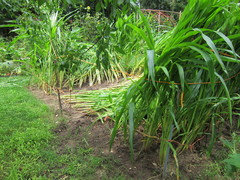
Corn stalks falling over.

16 years ago

How do I support corn stalks? We have a lot of wind and hard rainfalls in the afternoon, which is bending over my stalks. Any ideas?

Comments (31)

  • 16 years ago

    Christy: You are certainly not alone in having your corn lodge. Over the last 10 years I've tried many different varieties and hilling as Fruitnut suggested in combinations and still get lodging when the bad summer thunderstorms come howling through but only then. Hilling makes no difference for me but sure seemed a logical thing to try to encourage the prop roots to form. Last year was the first and only year we had a big blow that didn't cause any lodging and the variety was Delicious (I think) which was a lousy variety with poor flavor and little sweetness. This year's crop was blown FLAT 3 times but stood straight up later with straight stalks before harvest. In some years I've had varieties lodge at about a 45 degree angle from the ground upward and stay that way except that the stalk then bends upward to the vertical position. It is a real pain in the *ss to spray, weed and harvest as the rows are leaning against each other and then shooting skyward, a real tangled mess.

    In conclusion, I'd say let it lodge if you can still care for it (irrigate, weed, etc.) and keep trying different varieties, row spacings, in-row spacings and any other cultural practices you can think of. I know your situation all too well, hang in there. Oh BTW, in my part of the country, I can't imagine a method to keep corn from lodging as the winds can come any time from 1' tall corn to fully mature aside from high fencing or planting a 360 all surrounding wind row of trees and shrubs.

  • 16 years ago

    I have fewer problems since I started planting my corn in a trench about six inches deep.

    I have had at least one wind-storm with 70 mph wind every year since I started gardening here in 2004. The first year, my corn got flattened.

    The next year, I started planting it in a 6" deep trench. When it gets to 10" tall, I fertilize it with nitrogen and fill in the trench with soil.

    A week after tassels appear, I fertilize it with nitrogen again, and rake more dirt into the row. The roots of my cornstalks are now about 10" below the top of the soil mounded up and surrounding the base of the stalks. I have not had any corn flattened by the wind for 5 years.

  • 16 years ago

    tdscpa:

    I too plant in a furrow but only ~3 inches deep. It is much easier on my soil to get germination that way. Then I fill the furrow in until there is a mound along the row of corn and a furrow in between rows. I irrigate in this furrow. All my mounding of soil is done by the time the plant is 2 ft tall.

    Had a bad thunderstorm yesterday. It leaned a few plants over a little. But without the mounded soil they would have been flat on the ground or nearly so.

    Much of these problems are caused by planting into loose soil. Say after rototilling. When the soil gets wet later in the year it's not firm and strong enough to support the plant. Corn planted notill usually doesn't lodge because the soil is firm. However herbicides are need for weed control in notill and I don't want to go that direction.

  • 16 years ago

    Back when I was younger, and had the energy to deal with corn (lots of weeds, always falling over, raccoons eating it, etc.)
    I would put several metal stakes up around the corn patch and through it and attach a strong twine up next to the corn rows. It definitely helped them from falling the ground. They weren't straight up ever again, but its amazing the draw that the sun has on them. Plus....even when they're down, they continue to produce. I did always plant them in a furrow and slowly hilled them up......but they would still fall over in a windy storm.
    Good luck with your dilemma.

  • 16 years ago

    Often people say their corn was laying flat and then stands back up straight on it's own. Corn will do this if the stem is bent over but the roots/crown are still upright.

    If the corn root lodges, meaning the base of the plant twists over, the stalk will bend back up but the base of the plant will still be laying over. So the real problem only occurs when the crown, that is the base of the plant, is pushed over in weak soil.

  • 16 years ago

    Aha, not firm enough soil, that may be my problem, should have thought of that long ago! I do rototill prior to planting but only about 2" deep. However, I use drip irrigation via a drip tape within about 4" of the seed line. Likely, the soil never settles much with the drip as opposed to overhead irrigation and/or rain through the season. But then again, this year I planted on the other side of last year's corn drip line, tilled only 2" deep and still had what appeared to be blown flat lodging fairly late. I mean the crop was literally flat.

    As to Fruitnut's point about it being the base or the stalk, I must admit I never looked to see if the bases were bent 90 deg., too disgusted at the time. The pleasant surprise was that the plants returned to the upright position with straight stalks, not my usual experience, bent/curving stalks is the norm. The crop was nearing the completion of pollination at the time of the blow down.

  • 16 years ago

    michael:

    Some soils are just weaker than others. I farmed many years on a dense clay loam near Amarillo. Corn and milo never lodged on that soil. My current soil is much weaker. It's a better soil in many ways but corn will lodge unless well supported.

  • 16 years ago

    I used to plant in a furrow about 8" deep, at least. And then once filled in to ground level, and I would hill it up about 6-8" and it would still fall over. :(
    We had the best tasting corn.....but it was just too much trouble and we could get it so cheap and the store.

  • PRO
    11 years ago

    I have lodged corn from a storm. Can the corn be staked like a tomato plant?

  • 11 years ago
    last modified: 11 years ago

    OK, I just read through all these comments and I feel somewhat encouraged. I still have a question though, but first let me tell you how I planted my corn because its a bit different...

    I read that native Americans planted corn -- not in neat little rows spaced a foot between stalks and a couple feet between rows, but several seeds at once in DEEP (as in 8 to 12 inches deep) holes. Usually a squash and some beans were tossed in or in other holes around the corn at the same time. The idea was that the corn stalk would support the growing beans and the squash would shade and keep roots moist.

    I tried this scheme a few times, but because humidity is such a problem here, the squash on the ground kept rotting and I had to eliminate it from the equation. Then the beans would wind round the cornstalks so tightly that they would smother them, and that was out as well. I'm thinking this would be a better way to grow in the dessert areas than areas like ours with abundant rainfall and hot, HUMID summers.

    Then I thought maybe giving up on this method entirely was kind of like throwing the baby out with the bath water -- plus I remembered all those years of conventional corn patches being flattened (and me out there with string and stakes for hours tying it back up!!!) -- and felt inclined to avoid that again. I wondered if retaining the practice of deep cluster-planting, but without the beans and squash in the equation, might keep my corn upright. So...

    As an experiment, I pulled weeds off a section of my garden (no-till) where, for several years, I had been making a large compost pile to raise the soil level in that spot. It was a truly tiny experiment because the bed was only about 6' x 8', but it seemed like a good enough test. Anyway, I poked 10" deep holes in the ground at 6" intervals both ways over the entire area using a long digging bar, and dropped 6 seeds into each hole. Then waited. And waited. And waited...

    Finally after about 10 days, young corn plants emerged. They had a long way to go reaching the soil surface, but when they got there, they looked strong and sturdy. After a few weeks of steady growth, the entire patch resembled a giant lawn -- with no space between the corn except those bare intervals left over from the original spacing -- maybe 4 inches between groups of stalks by this time. All the stalks were thick and strong, and being so close together, they held each other up. It did fantastically all summer -- though it was hot and very dry that year -- and I got a huge number of ears from it. (Actually more in that tiny test plot than I'd gotten in a 20' x 30' "field" of corn grown conventionally for several years.) And not a single earworm or gap in the ears over the entire plot! I was sold!

    So, then this year, at the end of May, I decided to increase the size of the plot and put it in the center of the garden where we have more sun. So, I hoed off the grass over a rectangle approximately 12' x 15', poked holes in the ground and planted several seeds per/hole like before, and voila' 7' stalks by July 1st and so densely clustered at the bottom that you could barely see light through when squatting down to look. AND, there were no weeds to remove after the plants reached a height of about 2 feet tall because the shade was too intense for weed growth. It was a BEAUTIFUL thing!!!

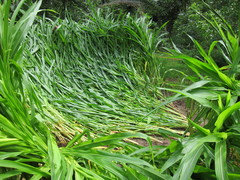
    Then... we began getting Midwestern Monsoons! At first, the corn just grew and grew with all the wonderful rainfall. Then the ground got saturated. Then the ground became a pudding-like slurry. Yesterday, I looked out at my beautiful corn patch and found the entire thing neatly flattened from NW to SE -- looking like a perfectly thatched roof -- except on the ground. Aaaarrrrgghh!!! So, now to my question...

    Given that the roots are so deeply buried (though the ground is pudding, as I mentioned) and the stalks so close together... is it likely that it will stand back up by itself? These aren't long rows but a huge, dense mass. I'm thinking that the corn on the top would have to rise out of the way of all that below it or the weight of the whole thing would keep the bottom stalks down. I am willing to go out there with my stakes and string for the sake of all those beautiful stalks, but I sure don't want to. (I am an ardent gardener, but I quail in my rubber boots at the thought of all those hours of pulling up one stalk at a time and tying it all upright again. So much easier to let Nature do it if she can.) We do at least have sun in the forecast for the next week or so, if that makes a difference. Any thoughts or helpful advice?

  • 11 years ago
    last modified: 11 years ago

    Planted end of May and had 7' stalks by July 7th ? I would think that is impossible, As far as the stalks coming up on their own, I would say no.

  • 11 years ago

    When I planted it, my husband said "Isn't it too late for corn." I told him that I always heard the saying "Knee high by the 4th of July." So... every week, I went out and stood next to it and told him how close it was to my knee. By mid-June it was waist high! On July 4th, it was way over my head -- about half an arm length -- (and I'm 5'9" tall). I told him I thought I had managed it well enough. He had to agree. ;-) Anyway, I'm an organic gardener so the only thing it gets is a lot of compost and chicken manure. However, we have had record rainfall this year and I'm thinking that is half the reason for the rapid growth. Anyway, if you don't believe me...

    I took some pictures today of the flattened corn. (The orange string is my half-hearted attempt to pull it back up.) I don't have anything in there for scale, but you can sort of see it IS tall. What do you think?


  • 11 years ago

    Great looking corn, Really didn't say I didn't believe you, hope no hard feelings there, Chicken manure is high in nitrogen so I'm sure that really helped, Knee high by the fourth of July is what I was always told also, Tell your husband to get out and help put that corn up, LOL!

  • 11 years ago

    I know exactly what you mean by corn exceeding your expectations. This is my first year planting corn, growing Indian glass corn, and I also heard knee high by the 4th of July. Well at the fourth, my stalks were over 7 foot tall. I guess all that compost and May rains really helped!

    I've also tried the three sisters method with pole beans and squash and I'll never do it again. It's just too much of a jumbled mess. I guess I prefer a tidier garden.


  • 11 years ago

    Jimmy56 -- Definitely NO hard feelings! I didn't take it that way at all. Gardeners and fishermen have reputations for exaggeration so I thought a photo or two would help. As for my husband helping in the garden... he likes to call it OUR garden, but I do all the prep work in spring, all the planting, all the weeding, all the harvesting, all the preserving. (I feel like the Little Red Hen.) Once in awhile, he walks through and says something along the lines of "We're going to need to do something about [fill in the blank.]" then strolls out again. Really, it's better that he doesn't help much because we never agree on how anything should be done anyway, and this way, I can just do what I like. ;-)


  • 10 years ago

    man, I know how it feels to see all that work laying in a tangled mess on the ground....so.....I have a small garden about 60x80..amongst other things I like

    to plant and grow corn...the type that I like since I start early is Silver Queen..

    I have never tried anything else.....But, every year except last year, I wind up with

    corn stalks on the ground....lodging big time....I have tried ... stringing them up

    etc., but it is just too much trouble....however, this year I considered the direction

    that the winds have come from and decided that it would be best to plant in the

    other direction to offer less resistance....did so....last evening my corn at about

    5* started falling over.....I went to the net and was told perhaps too much nitrogen

    or corn borers....Neither.....had some winds but nothing extraordinary...just started

    falling over...and it was beautiful...just starting to tassel and you can see the swells

    along the stalks for ears....Pissed? oh yeah but!!!!! This time, I am gonna go to

    each planting and cut the weakest stalks leaving the strongest and then using a 6*

    stake I am gonna tie up the stalk using torn sheet strips at the highest point I can...

    and even tho the fertilization charts show that the highest uptake of nitrogen is

    between tassel and silk I am putting no more nitrogen on my corn....if the tying up

    and whats in the ground don't do the trick then forget it...I have tried for 7 years to

    get a good crop of corn but no luck...couple of things that I might offer...the stalks on my corn never get bigger the a mans thumb around....the soil here is very sandy...

    great for irrigation but I don't think very strong for developing roots.....I live in the

    Panhandle of Fla. and start my corn around end of Feb......good luck everybody...

  • 10 years ago

    haha speaking of which, have you guys seen that video on youtube of GIANT corn? Seriously like 50 ft tall.

  • 10 years ago

    Mac holiday.... if you have sandy soil and want corn, have you tried a 'bed' just for the corn? You could build up a great soil base in a small area and plant deep and dense. I live in SW Georgia and have clay. I've gone over to the BTE method 1.5 yrs ago and I'm loving the results of my soil now. Just a thought. ~cin

  • 10 years ago

    well, today i did a couple of things re my corn: one was with my wife, we went out and placed stakes along the corn rows about every 5 feet and tied sisal twine along

    the rows to the stakes. then we tied the drooping stalks to the twine with strips of

    old bedsheets..hope that it works 2nd, i did some research on "lodging" of corn...

    found out that the farmers in the corn belt suffer with as much as 25% loss in their

    total crop of corn to lodging...i should not complain..3rd found out that there are

    several contributing factors that affect lodging, everything from too much rain before you plant to lack of brace roots that develop right about tassel time....4th, i called my

    farmers coop manager and he said that he has blow down in his crop also,

    he has no answers 5th..i have come to the conclusion that hybrids unless they are

    specifically early maturity types which develop a good root base, especially the brace roots will always experience lodging....and if i am to grow corn, i will probably

    experience lodging into the future...so....thats the way it goes....good luck...

  • 10 years ago

    What is the BTE method?

  • 10 years ago

    BTE...you mean "back to earth" method? I do not know what you mean...?

  • 10 years ago

    BTE method is what gawhitemoose mention in a post, So I was asking what that meant, I guess it could mean "back to earth" I just never heard of it but I'm old school.

  • 10 years ago
    last modified: 10 years ago

    BTE=Back To Eden. It is a gardening method some swear by. Essentially it is just deep mulching with wood chips.

    Rodney

  • 10 years ago

    You can watch the Back to Eden movie here

    https://vimeo.com/28055108

  • 10 years ago

    great video,,,i cut, split and sell firewood..the stumps of trees that I cut on my property are ground into chips plus I create a lot of saw dust from cutting the logs into firewood lengths...guess what I plan to do with the s/d and chips from now

    on?....yup...you got it.....give the man a ceeeegaaaaar...thanks for the tip...happy

    growing.....

  • 10 years ago

    Just make sure you don't till the wood chips in, or they will deplete the nitrogen in the soil to use to decompose.

  • 8 years ago

    Well - this post is a bit late since the last one was 2 years ago but this is my experience. We live on a ridge in the foothills and wind is always an issue. We get blowdown about every year. We've tried hilling, trenching and praying. No joy. Two years we tried to tie up the poor stalks. It seemed as if we were doing more damage than good and it was an awful lot of work. The last two years we have delegated it to Mother Nature. Most of the stalks stood back up really well. A few stayed on the ground but set ears fairly well.

    That will be my method from now on - More time for wine....

  • 8 years ago

    I garden in raised beds with very soft soil. I dig a trench and plant the seed down in the trench. Then as the corn stalk grows I hill up soil around the base of the stalk. Then when the corn gets a little higher, I do the Florida Weave around the stalks down the row. Works pretty good but would be prohibitive if you are growing a lot of corn. I use three 3' x 8' beds planted in succession and that works fairly well for me. Silver Queen corn.

  • 5 years ago

    What if my 🌽 stocks get bent in to at bottom

  • 5 years ago

    Probably will still raise themselves. Might not be totally straight but should still be productive.