Software
Houzz Logo Print
antraci

Insulation - polyurethane foam vs. others

21 years ago

I am building a new house and is considering insulation material. I heard that Polyurethane foam (Corbond) is the best there is out there (but costs more). Anyone has any feedbacks on foam, fiberglass, cellulose, and others???

Comments (19)

  • 21 years ago

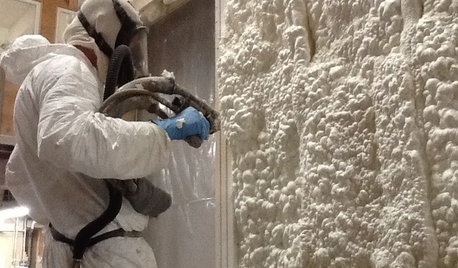
    with the way fuel to heat your home is going up and if i was stick building a home, I would bite the bullet and have foam insulation put in. I would also look at Icynene Spray Foam Insulation.

    If i was building a home, I probably would go with SIP panel system

    My $.02 worth.

    Here is a link that might be useful: icynene

  • 21 years ago

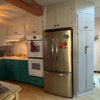
    Here's a pic of my LR after I had Icynene installed. Wonderful stuff.

  • 21 years ago

    This was recently discussed at length:

    http://ths.gardenweb.com/forums/load/build/msg10004745618.html

    Foam insulation is very costly and can take decades to pay for its initially high installation costs before seeing any actual energy "savings" by it's use.

    Foam insulation requires special thermal barrier enclosing techniques by code to prevent fire acceleration adding to the cost.

    Foam does not provide for complete insulation needs and does not address heat loss/gain via convention through framing members.

    In short, foam will be your most costly way to insulate and will provide you with the leat return economically and energywise than using combinations of conventional insulations.

    Foams should be your last choice as insulation in most instances.

  • 21 years ago

    I do not agree with the above statement. Foam seals all the air leaks in the walls that would bypass fiberglass insulation. The foam gives you a tighter house. Might cost more but with the price of heating fuels going up, 70% for natural gas, It will pay for itself faster then ever.

  • 21 years ago

    "The foam gives you a tighter house. Might cost more but with the price of heating fuels going up, 70% for natural gas, It will pay for itself faster then ever."

    Foam may seal air gaps, but so does housewrap at much lower the cost.

    Foam does nothing to prevent conductive heat loss through the studs because the only way to do that is to install rigid foam on the outside of the structure to creat a thermal barrier.

    It also does not matter if energy costs go UP 70% or DOWN 70%, the reality and only difference is that your money gets sent to the insulation manufacturer, not the energy company, for as long as 20 years to pay for the exorbitant costs of the insulation before any money is ever applied to actual energy "savings"?

    And what "savings" anyhow?

    If a house is insulated to proper R-values using conventional insulation techniques and materaisl or insulated to proper R-values using foam, the only difference is COST, usually 2X more for foam.

    But you do not get 2X more in energy efficiency.

    You get the SAME efficiency and TWICE THE PRICE.

    I see a total of NO savings under this plan.

    You can get as good if not a better insulated house by using a variety of insulation materials and techniques than using foam as your 'single' insulation material for many times less the cost.

    The real "savings" are by not using foam at all...and applying your money directly to energy cost reduction NOW not 20 years down the road...

  • 21 years ago

    manhattan 42,

    What is your preferred insulation for residential home construction in a heating (northern) climate?

  • 20 years ago

    manhatten42...why are u on such an "anti foam war path"? I am willing to bet you have never lived in a home, or had it installed in a home, or ever known anyone who has. Your convection argument is straight up retarded. Convection will occur with ANY insulation. However, convection currents (moves warm air to the top of stud cavities) is virtually eliminated with sprayfoam. And yes, foam does cost 2x fiberglass, but who says you have to save 200% on utilities per year for the insulation to pay for itself? Lets say you pay an average of $2,000 per year on utilities. Savings when using foam average 40%. 40% of $2,000 is $800. Lets say your foam job costs $10,000 and your insulating with fiberglass cost $5,000, that is a difference of $5,000 leaving a payback period of 6.25 years. In addition, energy prices are not going down in case you have'nt noticed. Payback period will only shrink with rising energy cost. Face it Manhatten, your logic is flawed and without one once of truth.

  • 20 years ago

    Snuffy you are right on. Spray foam will eliminate convection due to its ability to get in any crevices. Also if you live where it gets very cold, fiberglass has been shown to basically be ineffective below the typical dead of winter temperatures(at 20 degrees looses 40% of its R value) As for cost, I cut my gas usage by more than half and it is warmer and quieter in my house than it has ever been since using the foam. With the gas rates going nowhere but up as Snuffy said the payback period gets shorter..I originally figured 10 years but that was BEFORE gas rates went up 30%..so it's probably down to around 6 years.

    Here is a link that might be useful: insulation

  • 20 years ago

    Not wanting to bring the whole flammability/combustion debate back up, but it's my understanding that any insulation installed in a residence has to be class 1 fire rated. Our foam product is class 1 fire rated, im assuming all foam outfits that install their products in homes are as well as mandated by code. I realize that fire rating does not mean fire proof, but what insulation is completely fire proof. If a fire breaks out hot enough to ignite our foam, we are going to be out of there long before it gets to that point anyhow.If your going to lay awake at night worrying about it, you might as well build an all concrete house with all concrete furnishings, all concrete everything. Fiberglass insulation is like three tab shingles. They are still around because they are produced by major corporations,(johns manville, owens corning) who dont want to take the hit of pulling inferior products from the market and introduce more efficient ones. It's called corporate greed!

  • 20 years ago

    To a certain extent the flammability issue as a moot point...the foam will be covered by gypsum board in the living spaces, taking flame ratings out of the equation.

    The only place where foam would require additional detailing would be in a place like an unfinished attic. In an attic, FG could be left exposed. Foam would still have to be covered by gypsum board or some other material to achieve a 1-hour rating.

  • 20 years ago

    thanks wangshan. Good point about the loss or R-value in cold climates (like here in Michigan). I could have really taken it to manhatten but it was 1:30 am and I was tired. Incidently Fiberglass loses around 50% of its R-value when it gets wet, which it will. So in a nut shell, put fiberglass in your home and you mind as well toss that money right in the garbage can. The flammability issue is a moot point as mongoct pointed out. All insulation, including foam, must be covered with a thermal barrier, aka known as fire barrier, such as sheet rock among other things.

  • 20 years ago

    In our area where foam is applied in unconditioned spaces, as mongo mentioned,doesn't need dry wall, but in the two small attic spaces along side a finished attic space,im going to rock with 5/8"f.r. just for peace of mind. The foam in that area will be sprayed in the rafter cavaties.Im working on having our underfloor pony walls on the stem wall crawl space foamed as well and will cover with greenboard 1/2"m.r. board,moisture resistant drywall,leaving the underfloor uninsulated.2-3" of pea gravel with heavy mil. plastic will cover the ground in the crawl space.I've narrowed it down to foam or cellulose as being the most efficient forms of insulation from reading other posts, as well as my own research.The problem i have with cellulose in wall cavities is that if not installed properly, can settle leaving a gap from the top plate down to the settled cellulose. This settling is very common with fiberglass insulation as i have done many remodels removing interior drywall, as well as exterior stucco and sidings, and there has never been less than a 4" gap between the top plate and the fiberglass.When pulling the fiberglass out of the wall cavity, it literally disintegrted,proving the breakdown theory.Fiberglass is an inferior product and im thankful that there are more efficient alternatives, although more costly. Like most new technology, should drop in price with popularity.

  • 20 years ago

    Nobody mentioned dense-pack cellulose. :)

    Each type of insulation has its merits and drawbacks. This is based on research we've done for a future addition:

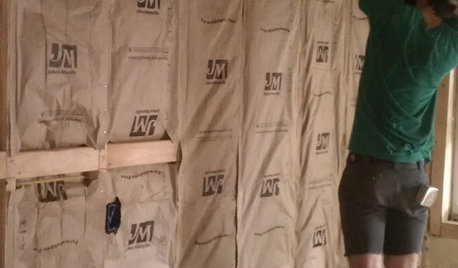
    Fiberglass is less expensive to purchase, easy to install. To properly address the building envelope, you still need to seal all air gaps, a vapor barrier on the warm side, and a thermal break to eliminate bridging at the studs. Fiberglass also allows convection between the fibers; it's a very slow process, but one that is augmented by increased temperature variables between inside & outside. That's one reason why FG's effectiveness decreases as the outside temperature drops. Plus if it gets wet, it's practically useless.

    Dense-pack cellulose is supposed to give a slightly higher R-value per inch, and retains more of its insulating value at greater temperature differentials than FG. (People I know who have used it say it has better sound-absorbing features, but there may be other contributing factors to that as well.) The same issues apply regarding sealing air gaps, using vapor barriers and thermal breaks. And don't let it get wet.

    Sprayed expanding foam addresses and virtually eliminates issues regarding air infiltration, convection, and vapor barriers, and has a high R-value per inch; however, you still need to address thermal bridging. You might save the cost of an inside vapor barrier, but the product appears to be 2- to 3-times the cost of FG, so payback will be longer. I have read some claims regarding added structural benefit, but I know nothing about that. Supposedly it results in a quieter home as well.

    Perhaps the most important information I gathered from all my research is that, in the typical home, there is more to be gained by choosing -- and properly installing -- GOOD windows & doors, tightening up the building envelope, and properly sizing and designing your HVAC system, than by simply choosing any particular type of insulation. So in a way I agree with Manhattan, especially for the budget-conscious, you're not likely to recoup the cost of sprayed foam as quickly as a more conventional product, as long as the entire envelope is properly addressed.

    But then, of course, there are SIPs. :)

  • 20 years ago

    Uncledave,what are your thoughts on settling issues of fiberglass and cellulose, and does densed packed cellulose not have settling problems. Also heard something about cellulose being blown in wet.Haven't completely made a decision on foam.Money is always an issue, but im not concerned with the payback factor. We are only doing this once, and want an efficient, comfortable home.By cutting down on energy bills right from the start,we are doing our part, in a sense, to lessen the dependence on fossil fuels and the grid.We are incorporating radiant barrier in conjunction with the insulation, and of course going with insulated doors and windows and the house will be wrapped with stucco wrap,(even though it's claimed that wrap isn't needed with foam), because in our area, an exterior barrier is required.

  • 20 years ago

    Sierraeast, I really couldn't say because I'm not an authority on such matters, I only know what I've read & seen; but I'd wager that any non-rigid material will settle and compress somewhat. If that's all I could really afford, and/or my tenure is limited to a few years, I'd put more effort into making the place tight and save a few grand on the insulation material itself. That's why, IMHO, foam probably wouldn't make much sense for the statistical average American who moves within 5 years. Besides that, if I was building my Forever House today, hands down I'd use SIPs.

  • 20 years ago

    sierraeast,

    Dense-packed cellulose will not settle. That's why whenever ceelulose is blown into a sealed framing bay (stud/rafter/joist, etc), it should be dense-packed.

    When cellulose is loose blown, as in when blowing to cover an attic floor, it will settle over time. It eventually settles to its natural density.

    Dense-packing blows packs the cellulose in at a density GREATER than it's natural settling density, therefore the cellulose will not settle anymore after installation.

    Cellulose is a great insulating material, for when it is DP'd the fibers knit together. It acts as an air infiltration barrier, it most certainly deadens sound, and it not only gives a higher R-value than FG, much a much higher EFFECTIVE r-value than FG.

    Cellulose will also absorb radiant energy. FG is transparent to radiant. That means that if you pack your rafter bays with it, you won't get a hot attic in the summer, as the cells block the radiant gain into the attic.

    Cellulose an also hold moisture better and longer than FG (that's a good thing) and then release it during a drying cycle, minimizing potential harm to the framing.

  • 20 years ago

    Thanks, Mongoct!

  • 20 years ago

    Great info, Mongoct! Our friends who had DP installed are very pleased with it, but their installer disappeared. I had a hard time finding a reputable installer of DP, so there was much I didn't know. We'll have to consider this for our addition. Do you know of an installer in N.E. CT?

  • 20 years ago

    we are in a dither (actually my husband does not dither--I should have said "quandry" ) over trying to choose between remodeling our 20 yr old home in Dallas-Ft Worth TX area and buying new build--we will probably add/change insulation to this home in any case because of rising energy costs--
    we have original loose fiberglass in attic and probably batts in walls--brick and plywood siding exterior (some of which is really starting to deteriorate and should be replaced probably) and composition roof which is about 7 years old--we should have changed insulation when we replaced the roof as contractor suggested but did not want to spend money when energy was still inexpensive---stupid us....
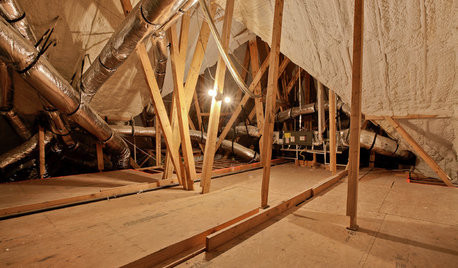
    Is it possible to foam in the attic rafters since we did not use radiant barrier at reroofing and should we take out the loose fiberglass altogether and add batts or cellulose loose fill>
    I have seen the difference that the radiant barriar sheathing makes in attics of new homes---some builders in this area are using that as exterior wall insulation before bricking---can we add that to exterior walls if we replace the siding???
    any comments regarding best way to handle these changes appreciated---heat is more of concern that cold insulation but there are cold spells and high humidity as well in summer months...

Sponsored
Mary Shipley Interiors
Average rating: 4.8 out of 5 stars34 Reviews
Columbus OH Premier Interior Designer 10x Best of Houzz