Software
Houzz Logo Print
knitbug

Another dimmer question

18 years ago

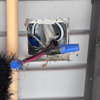
I want to add a dimmer to my lights while my DH is out of town, his solution is to pay $50/hr. because he is not incline to being a DIY, I am. My ? is how to add a dimmer to an existing switch that I have been told has been "back-wired". The wire looks like it has been pushed into a little slot on the back instead of some I have done that have the wire wrapped around a screw. Can I change that and how. Now if you can help me please make it simple since I am not an electrician, just a cheap DIY. I want to get this done so badly while he is away!! Thanks for any help.

Comments (16)

  • 18 years ago

    The back stabs either have a slot you can stick a small screw driver in to release the grip or you can just grab the wire with a pair of pliers as close as you can get and pull. The other option is to just cut the wires off flush.

  • 18 years ago

    !! Safety First !!

    Turn the light on. Flip proper circuit breaker off. If light goes out you should be OK to work but bear in mind that an improperly wired circuit might still be dangerous to you.

    Wearing a glove (rubber or thick leather) on one hand will greatly reduce the likelihood of a lethal current flow through your body but the unprotected hand may get bit. Do not allow any part of your body to contact any exposed metal surface except the switch you are working on.

    Follow ronnatalieÂs advice and I also suggest you examine the exposed wire to make sure it has no deep gouges which may cause breakage. Make sure the wire is Cu, not Al. If Aluminum you will need special connectors and anti-oxidant grease.

    The dimmer switch may have wires (stranded) instead of screw terminals. Carefully wrap the strands around the solid wire and than insert into wire nut and tighten. Pull hard (within reason) on each wire separately, it should not pull out.

    Good luck

  • 18 years ago

    Now Geniere! You have made me afraid I will get electracuted.I do know to turn the power off...I also have one of those little tricks to ck. to see if no power. Actually I have put dimmers on before but not with the switch "back-wired". Home Depot tells me "a piece of cake".I will know tomorrow!! Thanks to you both.

  • 18 years ago

    All of us, especially electricians, should be afraid of being electrocuted.

  • 18 years ago

    I disagree with that statement. I'm an electrician and I am not afraid of being electrocuted because I use common sense. That's all it really ever boils down to.

    Anyway.... the easiest/fastest way in my opinion is just cut the wires that are stabbed into the back of the switch close to the switch, strip about 1/4 inch and wire nut them onto the wries coming from your dimmer. If it doesn't have wires and just terminal screws, land them on the screws and you're done.
    Paying someone $50/hr to come put a dimmer in is just insane. But oh well, I guess I have charged people a service fee to come reset a GFI, but that's mainly on principal because they wouldn't listen to me on the phone while I tried to explain all they had to do was push the little button....

  • 18 years ago

    Thank you, thank you Hexus! I knew it could be made simple,just needed a backup. I'll just do it, I know I can. I need to do this since DH is away because he also paid $50 to reset a GFI after a storm cut power to a freezer.I guess electricians are lucky these people are out there, gives you somthing to laugh about. Thanks again.

  • 18 years ago

    That's right, girl. Don't let them bend you over a barrel. Just use caution and have someone there with you and you'll do alright.

  • 18 years ago

    I've never sparked a dimmer.

    I've never worked on a hot line or fixture.

    I guess only a qaulified electrician works without turning the power off first, is that why they spark everything?

  • 18 years ago

    Hi Knitbug,

    I think changing a dimmer is quite easy and you can do it. However I would recomend the following safety tips.

    1) Do not work alone. May sure there is another adult there with you who can call for help and turn of power at the mains in case of a mishap.

    2) One tool that I recomend is a vol-tick. I have a link here. Fluke makes a good one, but there are also other brands. Home Depot sells them too. What they do is they sense power without having to make electical contact. They sense Electric Fields. So if the power is on they will beep and flash. This is a good way to double check that power is really off, along with the other methods of switch on and off the lamp. The Volt ticks cost between $US 15 to 20.

    3) Read up on how to do it, and take your time. It takes me usually about 30 mins to do one. I am a occasional DIY person.

    All the best, Mike.

    Here is a link that might be useful: Volt - Tick Tester

  • 18 years ago

    Some wires pushed into that little hole in the back are released by losening the screw on the side.

    I usually shove a paperclip in the quickwire type if I can to release the wire. Usually it doesnt require much effort.

  • 18 years ago

    Cutting wires shorter is something I rarely do. Often, the original installer cut them to minimum length already. And cutting off backstabs may leave them to short to get proper wrap around a screw. So use some careful experienced judgment about cutting conductors. And for installing any device that contains electronics, power OFF is often crucial to survival of the device. Often I do change regular switches and receptacles hot, but could never in good conscience recommend the practice to anyone else.

  • 18 years ago

    my two cents, I keep reading hexus post and don't see where he even hinted at op working on a hot wire, I've been bit a few times, sometimes its just not pratical to shut off the power, but I wouldn't try disconnecting one of them backstab wires without it off. and by the way, who the hell invented them things anyway.

  • 18 years ago

    Verify that the power is off. There is a rectangular quick release tab next to round hole that the wire is pushed in. A small jewlers screw driver will fit in the hole. A heavy duty paper clip will work but a small screw driver works best. Push it into the rectangular hole. When you have resistance, push a little harder and pull on the wire. Another simple way to remove it is to twist the switch back and forth while holding the wire taught in the other hand, one wire at a time. If your wire is #14, which is typical for areas as your switch is locted, it will come out very easy when twisting the switch (because it does not make a good connection, see below). If you use this method be sure to cut enough of the wire off to remove any scarring before wiring the dimmer. When stripping the wire, remove the insulation without scarring the wire. Scarring promotes heat in the scarred location. Heat is not good in your wiring.

    QUICK-CONNECT (STAB IN) CONNECTIONS, THOUGH UL APPROVED, CAN BE VERY DANGEROUS WHEN USING #14 GUAGE 15 AMP WIRE AND ALSO CAN BE DANGEROUS WHEN USING #12 GUAGE 20 AMP WIRE WITH HEATING LOADS (space heaters). I STRONGLY SUGGEST TO EVERYONE TO REMOVE ALL QUICK-CONNECT (STAB IN) CONNECTIONS FROM THEIR HOME. IF YOUR OUTLETS ARE QUICK-CONNECT, THE FIRST OUTLET CONNECTED IN THE CIRCUIT WILL DRAW THE ENTIRE LOAD OF THE CIRCUIT THROUGH IT'S QUICK-CONNECT CONNECTION. TYPICALLY TWO BEDROOMS ARE ON A CIRCUIT. IF 1 SPACE HEATER IS RUNNING ON A 15 AMP CIRCUIT, 12.5 AMPS PLUS ANY LIGHTS, FANS, TVs, ETC..... IS BEING DRAWING THROUGH THE FIRST QUICK-CONNECT OUTLET. I APOLOGIZE FOR GOING ON AND ON, BUT I CAN NOT STRESS THE IMPORTANCE OF DELETING QUICK-CONNECTS FROM ALL HOMES ENOUGH.
    I have 33 years of electrical experience following 6 years in the US Navy. I am a master excel and word VBA programmer. I am not trying to brag, I'm just stating my qualifications in hopes you will listen. Peace to All :)

  • 18 years ago

    ".....IF 1 SPACE HEATER IS RUNNING ON A 15 AMP CIRCUIT, 12.5 AMPS PLUS ANY LIGHTS, FANS, TVs, ETC....."

    If you have a heater that draws 12.5 amps and you also have lights, fans, TVs, etc... all on a 15 amp circuit you have bigger problems than using stab in connections....
    First I doubt the breaker would even stay on. Assuming it did though, all bedrooms are AFCI protected so any arcing would/should trip the breaker, assuming even that didn't however, 12.5 is more than 50% and even 80% of 15 amps. Legally you would not be able to do what you said and have all those thing on one 15 amp circuit.
    Not using quick connects is your opinion and that's fine. Personally I've seen more failures due to loose terminal screws on devices and the wire arcing because it's loose and "floats" than stab ins.
    May I ask how many service calls you've had to go out on due to failure of a stab in connection, and how it was a dangerous situation?

  • 18 years ago

    You can't do 12 gauge anyway, it don't fit the holes.

  • 18 years ago

    "You can't do 12 gauge anyway, it don't fit the holes."

    Originally the holes would take #12, but this use was quickly prohibited and the holes reduced to #14 diameter.

    You may still find older devices with holes that will take #12, or even some installed that way.

    If you have to loosen the screw to release the wire it is NOT a 'back-stab' but a back clamp.
    There is nothing wrong with these and they are found in many higher quality devices.

    'Back-stabs' use a spring element to grab the wire and hold it.
    They are released using a hole beside the wire entry.
    They have problems with staying tight after repeated thermal cycles, and once they get the lightest bit loose it goes downhill from there.
    The arcing results in even more heating and a loose connection till failure occurs.

Sponsored
J.Holderby - Renovations
Average rating: 5 out of 5 stars4 Reviews
Franklin County's Leading General Contractors - 2X Best of Houzz!