Software
Houzz Logo Print
mikedc_gw

Light fixture used as a junction?

19 years ago

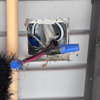
When replacing a bathroom wall light fixture I found that when the house was renovated whoever wired the bathroom basically used the light fixture as a junction. I have 3 major cables coming through the hole in the wall (no junction box). All 3 ground wires are wrapped together and attached to the ground screw of the light bracket. The other wires are connected (black to black, white to white, white to black etc.) there is one red wire from the switch to the black on the light and the white on the light is spliced back into the white to white connection. All of this is tucked into the housing of the light fixture. Is this an acceptable way to wire or should I install a junction box behind the fixture or somewhere else?

Comments (26)

  • 19 years ago

    I'm not sure what's acceptable, but when I wired my garage for flourescent lights, I intalled junction boxes and pigtailed to the lights. That is just good common sense to me.

  • 19 years ago

    Mike,

    What you described is a two way light fixture and its correctly wired.

    What you have is one light controlled by two switches, not a junction box. One of the Black white pairs is bringing the AC from the panel box to the light fixture box. Next you have a 3 wire cable run using Black / White and Red.

    Just guessing, but it sounds like the ceiling feeds the switches which is normal. The Black/White pair that has a White lead going to a Black lead from the light fixture. Effectively this is a load carrying run from the ceiling fixture supply line to SW1 and back to the light. My only suggestion to you would be to wrap some black electrical tape around the insulation covering the white wire coming from SW going to the Black wire from the light. You want to do that so you know that the White wire coming from SW1 is actually a Load carrying line.

    Basically, Black & Red wires are load carrying wires, all of the time. White is normally a return or neutral wire and ground wires are normally colored green or they are bare.

    Basically you purchase wire by asking for a 14/3 wire. This means three leads in it. that you want a length of wire X#of feet long and it should have three leads in it. They are Black, Red and White plus a grounding lead. You normally don't count the ground wire as one of the leads.

    Don

    Live Longer, Never work on LIVE WIRES. Shut off the BREAKER

  • 19 years ago

    I would install a box behind the light. Chances are the light fixture is not of a proper size or listing to be used as a junction box.

  • 19 years ago

    Norm,

    To tell the truth, I've never seen a light with a mounting box together in a box.

    Usually what I've foud is an Octgonal box already holding the source line and switch lines. You make the connections, tuck everything back in place and then mount the fixture to the box.

  • 19 years ago

    I agree normel. And as I said, it just makes more sense to do it this way.

  • 19 years ago

    Thanks for the responses. There is only one switch that controls the light. The other half of the same switch control s the exhaust fan.

  • 19 years ago

    Also, there are no other lights in the bathroom (no ceiling light)

  • 19 years ago

    I've seen fluorescent fixtures rated for through wiring. I've seen some light bars and medicine cabinets designed to accept cable directly. I don't believe I've ever seen a light bar or medicine cabinet rated for through wiring (use as a j-box). However, I haven't (yet) seen everything. ;-)

    In this case I agree that the prudent approach would be to use a j-box. It would also make replacing or servicing the unit easier when the time comes.

  • 19 years ago

    Mike you are changing stuff on us.

    First, I beleive that NEC code requires that all connections be made inside a junction box. I'm not sure of that, but I believe it to be true.

    Second, what do you mean by a split switch? How are you determining that the cables are "Major Cables"?

    If you actually have a two way switch, that makes sense. Guessing here:

    [Black/White] pair = Source
    [Black/White/Red]= Source to Switch to light & Fan supply?
    [Red] (traveler)= fan supply.
    [Black /White] = Lamp.
    [Black/White] = Fan

    >>Pigtail. Lamp [White, Source White -Fan White] >>Pigtail Switch White (w black tape) from switch to
    Lamp Black & Switch White (W black tape). >>Pigtail Sw Red to Fan Black.

    Up on the switch turns light and fan on, down on the switch turns fan only on.

    If I'm way off base, would you be kind enough to tell me exactly what is supposed to happen when the switch is toggled, please?

  • 19 years ago

    He's got a stacked switch--two switches on one strap. There is an incoming cable (B/W) and an outgoing cable to the fan (B/W) There is a B/W/R cable going to the switch, the white serving as hot to the switch. The red returns as the switched leg to the light, the black returns as the switch leg to the fan.

  • 19 years ago

    Sorry for the confusion. I think we got a little off track. Because there is no box behind the light fixture (just a hole in the wall) then what I am hearing is that I need to install one because it is not a good idea to have all of those pig-tails stuffed into the light fixture itself. If I install an old workbox and then mount the light to it I should be covered.

    Thanks everyone.

  • 19 years ago

    Mike,

    Sorry, I believe the code requires that you use a metal box and that each wire pass through a cable clamp that is then secured to one of the access holes. You would then use the light fixture to cover the junction box.

    One of the reasons that you use a metal box is to prevent sparks from the wiring from hitting flammable housing materials like studs, joists and the like.

  • 19 years ago

    There is no reason or code mandate to use a metal box if the wiring is type NM (Romex). A plastic old work box is fine.

  • 19 years ago

    Norm, you are absolutely correct!

    It is my personal preference to use metal, (good ground screw) especially when doing wiring in a room with exposed ceiling joists.

    I use the plastic boxes to replace metal boxes when I do a remodel or an upgrade.

    Don

  • 19 years ago

    It is my personal preference to use metal, (good ground screw)

    You like metal boxes because you have to ground them? That doesn't make sense to me. Could you explain that further?

  • 19 years ago

    Greg H,

    I prefer to use metal boxes because they just seem to be built better. I know that the plastic boxes are just as good as metal, but I just feel that if I'm going to bet the families well being I'd rather do it with metal.

    Also, you would have to understand this house we are in now. It seems to have been built by two competing branches of the US Military as in US Navy CBs (on a bad day) and US Army Engineers (on a worse day). Then, there came the spectre of the "Home Owner". Let me give you some examples:

    250 Amp in to the house, One breaker (20 Amp) by way of a Romex 12/3, feeds a 220 sub panel which services what I use as an office. On the sub panel, there is a 30 amp 220 Breaker that feeds a line for a welder (RED). On the adjacent block there is another 110 breaker also 20 amps that feeds all of the remaining outlets in the office.

    There is a 2nd, breaker off the main panel that is dedicated to a base board heater, This is a 30 amp breaker, 220 VAC line. The run is made with a 12/2 romex tied directly to the heater. Both Black and White carry power and the white lead is taped with black tape.

    As I look around this room there are no less than 5 runs to free standing splices. Not a box near any of them

    What I thought was truly comical is the use of a 30 amp breaker for their welding machine being tied back to a 20 amp breaker on the panel box. I am curious how the previous owner did on math while he was in school. Other than being cheap I can't think of a logical reason why the second run to the baseboard heater was not done with a 12/3 instead of a 12/2.

    When I installed the ceiling fan in the master bedroom I found the following,2 sets of SPST switches next to the door. 1 controlled a pair of lights in the bedroom and fed a second switch over by a closet. The second switch controls the ceiling fan and lights. It too has a second switch over by the closet. This switch allows you to turn the fan and light on. If you happen to put the switch into the down position, all lights and the fan turn off.

    Inside the 2nd junction box there is an extra 12/2 cable. I have absolutely no idea where this goes to, but the black wire is cut off just below the cable sheath. The white wire is connected to one of the switches. Both wires are perm. hot. I checked them with a meter.

    So yes, I prefer metal boxes at this point in time. I silently curse any homeowner who believes that all they have to do is look at what's there and then they too are electricians, at least until the excrement hits the wall.

    I have three cardinal rules:

    1) Get a Permit.
    2) Never work on a live circuit.
    3)Call an electrician if I am not sure about what I'm doing and Why I'm doing it.

    On the plus side, I'm 60 and still on this side of the grass.

  • 19 years ago

    The 12-2 on a 30 amp breaker is a violation and rather hazardous. Same with the flying splices.

    However, there is nothing wrong with feeding a 240v load (not 120/240) with 12-2 with the white wire re-identified. There's no reason at all to use 12-3 for this purpose.

    Sounds like you should be using your spare time to rewire your house, not to write long stories on this board!

  • 19 years ago

    And Don, if you're not a sparky, I would request you not "quote" code and procedures such as:

    "Sorry, I believe the code requires that you use a metal box and that each wire pass through a cable clamp that is then secured to one of the access holes."

    Let's leave that to the experts here unless you are absolutely positive. Someone can take one of your quotes to heart if they read it prior to a sparky correcting you in a follow up post. Your suggestions are always appreciated, but post them as suggestions...not facts.

  • 19 years ago

    Actually, David & Corbraguy, I have both on my to do list.

    And I accept your statements asking me to shut-up.

    However, I do have one more little tidbit. The term, "Sparky" originated from the radio-men on-board ships. When they worked the arm on the radio to send Morse Code it would generate sparks. Radio operators became known as "Sparks or Sparky" on board ships.

    Electricians were called ET's until the true line of Electronics Techs. and fancy gear showed up.

    For the foreseeable future I will refrain from quoting Code, but not from answering simple questions. Is that agreeable?

  • 19 years ago

    When they worked the arm on the radio to send Morse Code it would generate sparks.

    Yeah, not the key, but the transmitter itself! Talk about crude - but this was a century ago, for goodness sake.

  • 19 years ago

    Wow, Dave, I'm impressed. I didn't think anyone around here remember about the Marconi days.

    Someone dropped a cheap shot about IBM Service, I know it was not you, but it was a cheap shot anyway so, I'm going to stay active on the forum. I will not state anything as code. I just may go get a code book and read in my spare time after I get my house in order.

    BTW, re the 30 Amp breaker. The only device on that line is a laser printer. The inrush current is "Momentary 18 Amps. Also a periodic inrush of 18 AMPs every 4 seconds to keep a charge carona warm.

    Don

  • 19 years ago

    I could use some help with a similar problem. I wired a second light from an existing light that runs to a switch. The new light came with a black wire, white wire and a copper ground wire. I'm using 14/3 wire. I'm certain I messed up somewhere because the new light only works when the white wire goes to the white wire on the light and black wire from the light goes to the copper ground on the 14/3. I don't have to hook the black wire from the light to anything for the light to work off of the switch. It works but is it safe?

  • 19 years ago

    "I don't have to hook the black wire from the light to anything for the light to work off of the switch. It works but is it safe?"

    No. It sounds like the polarity is reversed. Your neutral wire is a switched hot, and the bare equipment grounding conductor is acting as the return path for the current allowing the light to work. This is against code, dangerous, and my advise is to call a licensed electrical contractor to come and fix it.

  • 19 years ago

    re the 30 Amp breaker. The only device on that line is a laser printer.

    I thought you said the 30a breaker fed a heater through 12-2 cable. Or maybe that's a different 30a and you didn't mention this one before, or I missed it. In any case, it's still unsafe. What if someone else plugs something into that circuit while you're away? What about after you're NOT "on this side of the grass" any more, and somebody else owns the house?

    I see this as a personal responsibility issue. Who knows, some cell phone chattering dope in a Hummer could run me over tomorrow, so I try not to leave problems around. Generally when I find hazardous wiring in my house (and I found a lot in the current one), if I don't have time to rewire it right then, I disable that segment of wiring until I can. (Which makes me REAL popular with the lady. ;-)

  • 19 years ago

    Davidr, You speak the truth. We are only in here until January. Right now we are renting waiting on a nicer spread. Rather than re-wire, I may just swap the breaker out and drop it to a 20 Amp line.

    There is no way I or anyone in my family is going to be using an arc welder. I'm into math, programming, elect and electronics.

  • 19 years ago

    Ow, that makes it even worse. In most areas (not all), the law says you can't touch the wiring in a home you don't own. Even the landlord isn't allowed to. An owner is allowed to work on the wiring of his own owner-occupied home (with a permit). Otherwise, it has to be a pro.

    That leaves you in a lousy predicament. The choices aren't great. You can break the law and perhaps your lease by fixing a hazardous situation yourself. You can call the landlord and try to get him/her to have it fixed (some landlords are good about this, others resent being asked to spend a penny on their properties, liability be d--ned). You can call a pro yourself and pay the bill, hoping that the landlord will reimburse you (I think that in most cases he/she is NOT obliged to do so). Or you can shrug your shoulders and hope for the best.

Sponsored
Hope Restoration & General Contracting
Average rating: 4.7 out of 5 stars35 Reviews
Columbus Design-Build, Kitchen & Bath Remodeling, Historic Renovations