Software
Houzz Logo Print
terribletom_gw

Help with conduit/derating issue?

19 years ago

The project: add wiring for a kitchenette and a half bathroom being put into a

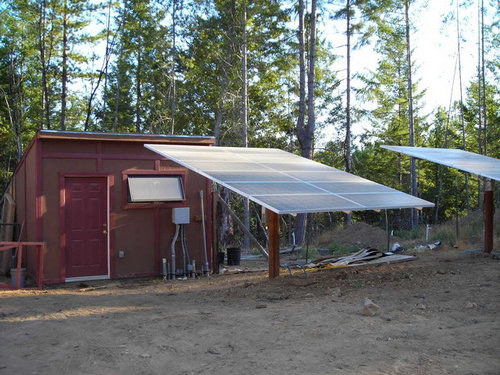
comprised of a small barn/garage and artistÂs studio. (No bedrooms, so I donÂt think it is technically a "dwelling unit".) As a sidenote, the building is 100% off-the-grid and is served by a 3kW
with a battery bank and inverter supporting surges up to 7kW. The AC service is single-pole (120VAC onlyÂ-no 240V) with a 60-amp main breaker.

Following is a list of anticipated circuits:

1 x 15A lighting (both kitchenette & bath)

2 x 20A kitchen counter receptacles

1 x 15A refrigerator (small, 200W energy saver)

1 x 20A bathroom receptacles

(There will be no dishwasher, electric range, garbage disposal, etc.)

My initial plan for getting the power from the building's main AC service panel to the bath/kitchen area is to pull THHN in PVC conduit (all indoors) for a run of about 55Â before it branches out to individual circuits, none of which will be very long and will be wired with NM (Romex). IÂm thinking that conduit is the prefered approach because most of the run will be through workshop and garage areas without finished interior walls. IÂd also assume moderate ambient temperatures throughout.

IÂm especially interested in advice about three issues:

1. WhatÂs the optimal number of wires (by guage), making good use of shared neutrals, wherever possible and prudent, in the conduit run?

2. WhatÂs the effect of derating requirements? That is, will the wire sizes need to be increased from the customary ampacity chart (i.e., #12 for 20A and #14 for 15A)?

3. Does anyone know if two 20A receptacle outlets are required in a small occasional-use "kitchenette" or is there an exception permitting a single circuit? It seems like overkill here, given the intended use, but if it's code, it's code.

IÂm not too worried about "conduit fill", since IÂm a believer in bumping conduit size up a notch to make it easier to pull the wires. IÂm thinking 1". Still, IÂd be interested in recommendations on conduit size as well.


Any advice would be greatly appreciated. You guys rock.

Comments (10)

  • 19 years ago

    You are permitted to run up to 18 #12 wires in 3/4" conduit. 29 are permitted in 1" conduit. If there are bends, I'd go with the 1", though by using a couple common neutral circuits you can consolidate down to 11 wires. (You are permitted up to 4 quarter bends, or the equivalent, in any one run of conduit.)
    I'd also use EMT or rigid conduit for better appearance and durability.
    Have you considered running #6 wires from the main panel to a sub panel in the kitchen/bath area? The same conduit sizes would apply if THHN, or you could use type MC cable.
    I'd ask your building inspector about the kitchen receptacle circuits. There may be tolerance for a judgement call, though the small additional expense and effort for the additional circuit may be worth it to avoid an argument.

  • 19 years ago

    Tom,
    Who pays to replace a PV panel destroyed by a hailstorm?
    This is a serious question as the local utility is pushing their
    use increasingly in this area. Since my house has had to have
    a new roof twice in the last 15 years due to hail and cars have
    been badly damage at least an additional time or two. I think
    I'd Sh!t if it took out a Solar power array I'd just installed.

    Thanks

  • 19 years ago

    Given that other circumstances are normal, the number of current carrying conductors you can put in conduit without derating is 9. Single phase limits this to 8, and not having 240 volts available with a center tap neutral makes multi wire circuits (shared neutral) impossible. So, you can have 4 circuits per conduit as both the hot and neutral count as current carrying conductors. It doesn't matter how big the conduit is, the same derating requirements apply.

    Depending on the layout you can either bump up 1 wire size to get your 5 circuits in one conduit or use 2 conduits. ½ inch is too small if you elect to use 1 conduit.

    Whether this project will fly under any possible local rules is unnknown. It would be up to a local AHJ to determine the status of the strucure and if residential or commercial power requirements for minimum power supply/service apply.

  • 19 years ago

    Just remember for #12 and #14 the derating starts at the full ampacity of the conductors, not the breaker limit of 20 A and 15 A.

  • 19 years ago

    Randy,

    Thank you, that's some good feedback you've offered.

    You are permitted to run up to 18 #12 wires in 3/4" conduit. 29 are permitted in 1" conduit. If there are bends, I'd go with the 1", though by using a couple common neutral circuits you can consolidate down to 11 wires. (You are permitted up to 4 quarter bends, or the equivalent, in any one run of conduit.)

    But the number of conductors allowed by conduit size speaks nothing about the derating issue. Am I correct about this?
    . .
    I'd also use EMT or rigid conduit for better appearance and durability.

    Nods. EMT may well be the better choice if I go with a conduit solution. Thanks for that. Will consider.
    . .
    Have you considered running #6 wires from the main panel to a sub panel in the kitchen/bath area?

    Yes, that was actually the first option I threw out. If I could go the subpanel route, I'd probably use #6-2 NM (plus ground) and not use conduit. The studs in this building are huge (actual dimension 2" x 6" rough-sawn Doug Fir) and Romex could be run through the studs about 10' above the floor level. (But not 5 independent circuits, for aesthetic reasons, by direction of the owner!)

    This is my sister's property (btw, her name is Randy!). She's held a California GC license for years and made her living building houses on hillside lots in the SF bay area, so her real specialty is engineered foundations in earthquake country and she admits that electrical stuff is not her strong suit. (She's pretty much just always subbed it, although she has more than her share of experiences arguing with inspectors at punchlist time.)

    Anyway, this building is in a remote rural area in Mendocino County that has some kind of quicky permit/inspection program for non-dwelling units meeting certain characteristics, one of which is single-panel electric (no subpanels). Apparently, when a building conforms to all the requirements of this program, the process is cheap, quick and usually hassle-free, or so I've been told. It consists of one inspection done at or near the end of construction. (Among other things, I was interested to learn that no rough-in inspection is required, and the inside walls can even be drywalled over wiring at the time of inspection!)

    Sooo...the reason for not using a subpanel may, in this case, be more a tactical or political decision on the part of the owner, if you catch my drift.

    The downside of the deal is that she's found the AHJ (a "generalist", apparently) to be "not helpful" in getting advice before work is performed. I have to take her word on that, groan.

    - Tom

  • 19 years ago

    Given that other circumstances are normal, the number of current carrying conductors you can put in conduit without derating is 9. Single phase limits this to 8, and not having 240 volts available with a center tap neutral makes multi wire circuits (shared neutral) impossible. So, you can have 4 circuits per conduit as both the hot and neutral count as current carrying conductors. It doesn't matter how big the conduit is, the same derating requirements apply.
    ..
    Great reply and much appreciated! Your advice confirms what I thought, especially that shared neutrals won't help in this case because of the single-pole power supply.

    I think we're on the same page as to the number of wires required. By my count, that's 11 (3 x 20A hots, 3 x 20A neutrals, 2 x 15A hots, 2 x 15A neutrals and 1 x 20A ground) and, therefore, a derating analysis kicks in.
    ..
    Whether this project will fly under any possible local rules is unnknown. It would be up to a local AHJ to determine the status of the strucure and if residential or commercial power requirements for minimum power supply/service apply.

    Fortunately, eetsa nah mah problemo, mon. My sister--the GC in this case--seems quite confident with the overall power supply issues and 59 years experience with being her brother has taught me a lot about when and how far to question her judgement. Fact is, there are quite a few buildings in that area with similarly sized off-grid solar power supplies. I'm only beginning to understand the culture in the area, but it seems to be mostly a matter of "how bummed are you if your power browns out every so often?" ((grins))

  • 19 years ago

    Just remember for #12 and #14 the derating starts at the full ampacity of the conductors, not the breaker limit of 20 A and 15 A.

    Understood and thank you for that spot-on comment.

    Yes, I know that a derating analysis starts with the free-air, full ampacity of the conductor. What I don't have before me are the current NEC tables and algoritms. I have to beg and borrow for those and I'm not confident working through the problem using second-hand materials on the 'net.

    If memory serves me right, #12AWG/CU starts out at, like, 30A and #14AWG/CU is something like 21A. Am I close?

    It makes me wonder: Do most jobbers do precise derating analyses per code? Or, based on your experience, do electicians just bump everything a size according to rules of thumb or when it "feels good"? Or, is there a good automated tool (e.g., spreadsheet) for assessing derating in conduit?

    I dunno.

  • 19 years ago

    Take this with a grain of salt, because I'm by no means an expert in solar power equipment. In fact, installing the charge controller, inverter, battery bank and related control equipment on this job (my sister's building) was my first experience with solar power. (The two PV arrays had already been installed by an equipment installation contractor.)

    All that DC wiring involved a steep learning curve for me, so I put quite a bit of time into researching the issues. Still, consider the source.

    What I (think I) know (and don't know) in answer to your question:

    In this case, the tempered covers are rated for hail up to 2 killograms (4.4 pounds), which should resist hail damage from anything short of so-called softball-sized hail, which is apparently unlikely or at least very rare where these panels are installed (northern California).

    The panel warrantee includes coverage against hail damage, but I do not remember now how long that warrantee item extends.

    If hail damage occurs and it's not covered by the warrantee, there seems to be little doubt that it's the owner who must pay. (In this case, it can't be the POCO because there is no POCO. The nearest utility lines are three or four miles away.)

    When I was in the area (it's not where I live), I went to something called the "Sol Fest"--a sort of solar energy trade expo and a good place for overaged hippies to meet. ((grins)) One of the speakers there was telling stories about cases where cars were damaged, roofs were destroyed and solar panels left undamaged. I think the place was crawling with industry propaganda, though, so I don't put too much credence in these accounts one way or the other.

    I'm quite sure, though, that hail damage is a risk that varies greatly in different parts of the country. It's gotta be a lot larger in the mid-west plains states, wouldn't you think?

  • 19 years ago

    OK, upon further review and research, I think I may have gotten this through my thick skull.

    [What I was missing was the derating factors chart and I was under the mistaken recollection that it involved a joint solution involving the number of conductors (rather than a simple trigger point at which all deration starts).]

    So, if I'm understanding this now, #12 has a deration factor of 0.5, regardless of the other wires in play (reducing its effective ampacity to about 15A). And #10, after deration, has an ampacity of a bit over 20A. Right?

    Therefore, it looks like I'd need to pull #12 for the 15A circuits and #10 for the 20A circuits. Or, looking at the whole picture, the run would include:

    3 x #10 hots
    3 x #10 neutrals
    2 x #12 hots
    2 x #12 neutrals
    1 x #12 equipment ground

    Conduit: 1" EMT (could be 3/4", but I'd rather pull through 1").

    Anybody want to venture an opinion about whether or not this is my correct "final answer" before I tell Regis?

  • 19 years ago

    Thanks Tom, that's where I live in Tornado Alley.
    Nice to know they warrant against hail.

    Regards

Sponsored
Wannemacher Interiors
Average rating: 5 out of 5 stars26 Reviews
Customized Award-Winning Interior Design Solutions in Franklin Cnty OH