Software
Houzz Logo Print
12crumbles

Help with 240V 50A location

11 years ago

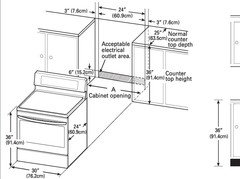
I'm trying to do a challenging kitchen layout. I will have a cooktop requiring a 240V 50A line. I have no permanent structure, such as a wall, to affix the junction box. Can the line be run on top of the floor but underneath the cabinets with the junction box on the floor? It the junction box has to be affixed to a wall, what is the longest run that the wiring can have from the box to the cooktop? The cooktop would be on an "L" in the cabinet run and it would be 54" from a wall to the back of the cooktop where the wiring comes out. I would really appreciate advice. Thank you.

Comments (15)

  • 11 years ago
  • 11 years ago

    Thank you - but which surface?


  • 11 years ago

    OK. Thank you very much.


  • 11 years ago

    Better if junction box affixed to house or cabinet wall than floor. In the kitchen, spilling water is common and you would not want water reaching a junction box on the floor. If the cable is passing through an area where something could hit it and cut it, it would be safer to use armored cable(flexible metal sheath) or conduit over cable to protect it. 50A 240V can provide a very serious jolt! See if you can find the installation instructions for the cooktop online. These often provide detailed descriptions of acceptable practices.


    12crumbles thanked zver11
  • 11 years ago

    Thank you for the advice. The installation manual doesn't give the specific information I was looking for. My concern - which you have answered - had to do with how/where the outlet box could be located. Since the outlet is not going on a wall I didn't know what could be done. I was afraid to do a layout and then have an electrician say that there was no way to get the outlet to it or that cabinets would have to be revised/moved/redone so that an outlet could be secured properly.


  • 11 years ago
    last modified: 11 years ago

    You don't need to worry. Just show the cabinet plan to the electrician during rough-in wiring before the cabinets go in. I have to assume there will be a back cabinet panel. Your electrician will decide if conduit is necessary. Usually, conduit isn't necessary in this situation, and can create problems. There is almost always a better way to run the cable than conduit. In any case, the receptacle will be on the floor or practically on the floor even if you had a wall to put it in.

    You can't put it on the side cabinet because you wouldn't be able to get the stove in where it goes. On most stoves, you won't be able to put a surface receptacle on the back cabinet panel either. Between the depth of the receptacle and the plug, the drawer on the stove won't be able to close all the way. For installations like this, it is often necessary to mount a surface mount receptacle directly to the floor, face up. There is nothing wrong with doing this. That is what they are made for.

    Depending on how the back panel of the cabinets is constructed, you may have other options. Just give the electrician the specific details. They will figure it out.

    If they absolutely must bring the cable through the base of the cabinet, you will most likely need the stove there so they can measure where the leg brackets are and bring the wire through to avoid them.

  • PRO
    11 years ago

    If the installation of the circuit is going to require a permit, depending on your location, consult with your local authority having jurisdiction (Inspection Official) for clarity.


    Per the latest version of the NEC (National Electrical Code),


    if the circuit is NM (Nonmetallic Sheathed) cable, and it passes through the floor, conduit (or other approved means) that extends at least 6" above the floor, IS a requirement for protection of the cable.


    Receptacles in Countertops and Similar Work surfaces in Dwelling Units, unless listed as receptacle assemblies for countertop applications, SHALL NOT (code language) be installed in a face-up position.


    It is always best to consult with your local city electrical inspector. There may local codes, specific to your area, that are above and beyond the NEC.

  • 11 years ago

    NEC 334.15(B) Protection from physical damage

    That is precisely why a surface mount range receptacle is designed to mount directly to the floor.(surface)

    NEC 406.4(E). The space behind the bottom stove drawer, underneath the stove, is neither a countertop or work surface.

    "(E) Receptacles in Countertops and Similar Work Surfaces in Dwelling Units. Receptacles shall not be installed in a face-up position in countertops or similar work surfaces"


  • 11 years ago

    I suppose you think that 406.4(E) prohibits these floor receptacles too :D


  • 11 years ago

    I don't know about how you cook, but the FLOOR is not a work surface in my kitchen.


  • PRO
    11 years ago

    12Crumbles.....

    As you can see, certain people attack and critique responses. It is difficult for anyone to answer your questions specifically. There are still a lot of unknowns for your particular situation.

    Permits are normally required for new circuitry. I only gave a couple of potential areas of consideration to remember. There are others. Someone with specific knowledge of your local area is best to answer this, in my opinion. Your particular situation may vary tremendously depending on local codes also. (These are above and beyond the NEC in certain municipalities.)

    As a former electrical inspector, I must reiterate using your inspection department. The NEC is the minimum safety standard. Your installation has to meet or exceed the NEC, satisfy the intent of the NEC and also local codes, if applicable.

    Everyone on Houzz.com can analyze and interpret the codes anyway they see fit and give you all sorts of advice.

    In the end, if it fails inspection, all you can say is, "XXXXX on Houzz.com told me it was fine or told me to do it that way".

    The bottom line is that it still fails and you either have to redo or pay someone to correct or undo/ redo the whole project.

    Get your responses documented from the electrical inspector, if at all possible. Then you may have recourse if an unfortunate circumstance occurs or there is an inspection problem down the road. (when you sell, etc.)

    I hope that helps.

  • 11 years ago
    last modified: 11 years ago

    And you should know that while the AHJ always has the final authority, absent knowing exactly where that is, the best we can do is with the acutal NEC rather than invented allegeations from some HOUZZ alleged "pro" who inserts his own unsubstantiated opinions.

  • 11 years ago
    last modified: 11 years ago

    PRIMOS Electric, LLC

    "12Crumbles.....

    As you can see, certain people attack and critique responses."

    .

    Yes. The following is "certain people" making a point to directly contradict the post directly above it. Even if "certain person" has to pull "certain codes" out of a "certain dark hole" to do so, even when the "certain code" would NEVER apply, just to do so.

    .

    PRIMOS Electric, LLC

    "If the installation of the circuit is going to require a permit, depending on your location, consult with your local authority having jurisdiction (Inspection Official) for clarity.

    Per the latest version of the NEC (National Electrical Code),

    if the circuit is NM (Nonmetallic Sheathed) cable, and it passes through the floor, conduit (or other approved means) that extends at least 6" above the floor, IS a requirement for protection of the cable.

    Receptacles in Countertops and Similar Work surfaces in Dwelling Units, unless listed as receptacle assemblies for countertop applications, SHALL NOT (code language) be installed in a face-up position."

  • 11 years ago

    What part of the "countertop" is not the floor do you not understand. Nobody said anything about leaving exposed where it is subject to physical damage. I don't know what silly assed vendetta you're running here, but you seem to want to come here just to denigrate those who gave the correct answer withut contributing anything anything other than a spam mention of your company.