Software
Houzz Logo Print
kawaiineko_gardener

need help with seed starting mix!

I want to make my own seed starting mix. The thing I'm confused about is how much of each ingredient to use for the size of the batch I want to make. I plan to make a 15 gallon batch.....the mix says to use.....

  • 2 parts sphagnum peat moss OR coconut coir – for moisture retention
  • 2 parts finely sifted finished compost, vermicompost or a blend – for nutrients
  • 1 part perlite – for drainage and to reduce weight
  • 1 part vermiculite – for drainage, moisture retention and to reduce weight

I really suck with ratios, so if I'm making a 15 gallon batch what would each of these ingredients translate to with gallons?


Also, it says to add 1/4 cup of slow release fertilizer for each cubic foot of mix.


How many cubic feet would be in 15 gallons of the mix? When converting from the 15 gallons to cubic feet, should I just convert to dry cubic feet?


Also one question about the fertilizer; it says to use a balanced slow release fertilizer (one with equal parts each of nitrogen, phosphorus and potassium). I found a bag of slow release fertilizer that is 5-5-5. It doesn't specify whether it can be stirred directly into the soil mix. However since it's slow release, I'm going to assume it would be suitable for container gardening? Yes or no? I honestly don't know.

Comments (11)

  • 11 years ago

    Not sure where you are getting your recipe from but seed starting mix is typically a very finely textured, sterilized medium with no added fertilizers. Seeds need no fertilizer to germinate and grow into seedling stage - everything they need is contained in that seed embryo. Seeds can't photosynthesize, so they have no use for fertilizers nor the ability to assimilate them.

    I would simplify your recipe to equal parts peat, perlite and vermiculite. This mix will be light, sterile and moisture retentive while still offering decent drainage For 15 gallons, you would need 5 gallons of each. Adding compost eliminates the sterile component, which opens up the possibility of common seed starting diseases like damping off or fusarium, as well as impeding drainage.

    Once the seeds have germinated and are a couple inches tall with their second set of true leaves, repot them into a regular potting soil to grow on until they are ready to plant out. You can fertilize with a dilute liquid fertilizer at that time and with every watering.


  • 11 years ago

    The mixture sounds fine to me. Once the first true leaves appear plants can uptake fertilizer, and many commercial mixes for seeds contain fertilizer.

    Also numerous studies show compost suppresses damping off, not cause it. That is 100% incorrect information given.

    http://cwmi.css.cornell.edu/organicfarmingfinalreport.pdf

    Just google compost and damping off and you will find hundreds of reports that indicate the benefits of compost.

    Here is a great study of compost and root rot

    http://www.hindawi.com/journals/jmy/2013/324570/

  • 11 years ago

    15 gallons divided by 6 equals 2.5 so each part is 2.5 gallons. Two parts is 5 gallons.

    So if you choose to use that recipe, 5 gallons peat, 5 gallons compost, 2.5 gallons perlite and 2.5 gallons vermiculite.

    15 gallons is two cubic feet. Don't worry about dry vs wet.

  • 11 years ago

    15 gallons of seed starting mix? WOW! you're a lot more ambitious than me!

    I use my "lazy method".

    I put regular 5-1-1 (ish) and use a dibble to make a cone shaped depression (making sure the soil is sufficiently moistened to hold its shape) and fill the cone shaped depression with sterile bagged seed starting mix. The seed sprouts in the seed mix, then grows into the 5-1-1 when it gets bigger.

    Bob's your uncle, Fanny is your aunt and there is no mucking about transplanting seedlings!

  • 11 years ago
    last modified: 11 years ago

    I stand by what i say, try it both ways then tell me I'm wrong. I see a day when sterile mixes are a thing of the past, old school bigtime. If you go to the research sites you will find thousands of studies. not just hundreds. I would take your own advice and read the studies.

  • 11 years ago

    I'm not going to argue with you- that is obviously pointless. What you predict is in your own imagination, nothing that is yet verifiable.

    btw, plant science is my business - I am a professional horticulturist - and I do keep abreast of all the technology. And the research cites (not sites) number in the dozens, not hundreds, let alone thousands.


  • 11 years ago
    last modified: 11 years ago

    Site refers to website. It must be tough to always be wrong!

    http://dictionary.reference.com/browse/site?s=t

    Humans are so funny, in nature are seeds germinated in a sterile environment?
    No, so let's forgo millions of years of evolution and do it our way. Ha! I'm a
    research scientist, or was I worked for MSU and Sparrow hospital. I'm retired
    now. Horticulture is more a trade than a profession for many. I suppose if you had a masters or higher, then yes a profession.

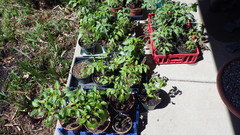
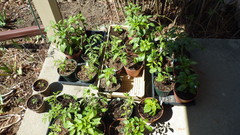
    Here are my seedlings started in a compost mix. Peppers and tomatoes, now in a homemade potting mix described below. Let see yours?

    Fig cuttings in a compost mix with pine, peat, DE, and perlite.

    Some more seedlings

  • 11 years ago

    If research cites (quoted authorities, typically stated at the bottom of research papers) only number in the dozens, then it stands to reason all those "hundreds" of websites are just repeating the same thing from the same sources. Still trying locate all those hundreds, btw..........not coming up with anything approaching those numbers with even advanced searches.

    And since you are so intent on definitions, take a gander at 'profession': a paid occupation, especially one that involves prolonged training and a formal qualification.

    Let me see.......I have a degree, have spent more than 20 years practicing my "trade", taking additional classes and specialized training, have qualified for and received state certification and I am paid for it. Seems I qualify as a professional on all fronts!

    And it would seem to me that a trained scientist would understand the implicit difference in plants growing untended in nature and those manually cultivated by humans. Totally separate conditions that cannot be compared equally. Apples and oranges.

    It would also help your arguments carry a bit more weight if you weren't quite so demeaning and rude in your responses.


  • 11 years ago

    I've been starting seeds for over 40 years. Lots of flats for large seeding areas. I have started flats indoors and outdoors. I could not afford to buy or mix a sterile mix which frankly, is not possible. I don't understand what Gardengal is talking about. Unless starting seeds inside a bubble, nothing is sterile. The flats, the water, the air.

    So, I tend to agree with Drew. Use any fine soil indoors. Outdoors use whatever you can get. Sow your seeds and give them good light.

    Jane


  • 11 years ago

    Sorry to be rude, I was, as Jane says one can still get the fungi even in sterile mixes, it's all over. Compost gives at least gives some degree of protection, and studies have shown it works. All I should have said. Another way to keep it down is to cover surface of soil with sand or vermiculite. The fungal spores splash unto the plant. Bottom watering helps too. I have found those bottom watering wicking mats work well. Btw I too have been doing this for over 40 years. Nothing trumps experience.